How does a four-stroke engine work?
A four-stroke engine burns a mix of air and fuel in a closed cylinder. The piston moves four times per cycle: it lets the mixture flow in (intake), squeezes it (compression), is pushed down by the burning gas (power) and pushes the burnt gas out (exhaust). That takes two turns of the crankshaft, and only one stroke does the work.
In this tour you follow one cylinder of a cut-open petrol engine in 3D through all four strokes, and find out why it needs all four.
9 steps · Beginner · free, no account
 Start the 3D tour here
What's inside a four-stroke engine
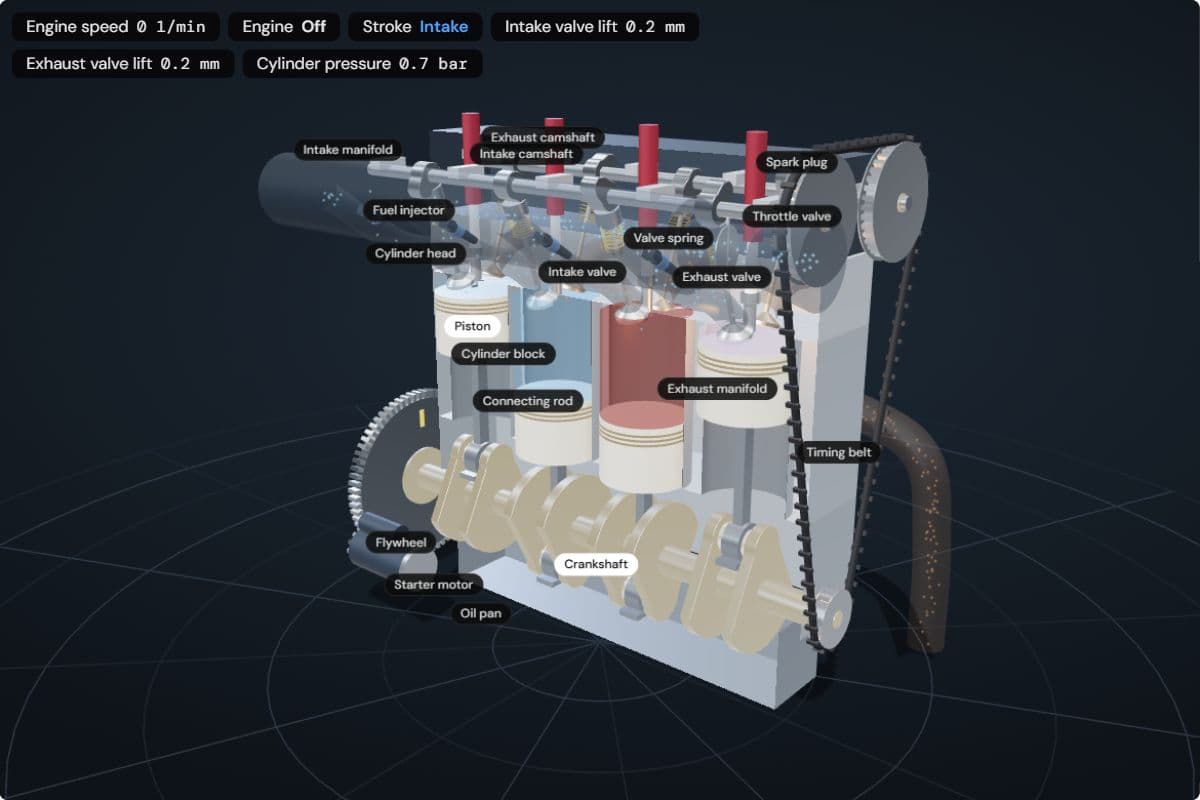
A car engine looks complicated from the outside, but the part that makes it run is simple: a tube closed at the top, the cylinder, with a piston that slides up and down inside it. A connecting rod links the piston to the crankshaft, which turns the up-and-down movement into rotation, the same way your legs turn the pedals of a bicycle.
The top of the cylinder, the cylinder head, holds the rest. The intake valve lets fresh air and fuel in, the exhaust valve lets burnt gas out, and the spark plug sits between them. A camshaft above the valves opens each one at the right moment; a belt or chain from the crankshaft drives it. Below the crankshaft, the oil pan holds the oil, and at one end a heavy flywheel keeps everything turning smoothly.
Most car engines have four cylinders side by side, but every cylinder works the same way. Once you understand one, you understand the whole engine.
Step by step
Four jobs, one stroke each
To turn fuel into movement, a cylinder has to do four things in a row: fill up with a mix of air and fuel, squeeze it, burn it, and get rid of the burnt gas. It can only do one of them at a time, because there is just one space above the piston.
Each job takes one stroke: the piston travelling once from the top of the cylinder to the bottom, or back. The top turning point is called top dead centre (TDC), the bottom one bottom dead centre (BDC). Four jobs, four strokes: that is where the name comes from. The four strokes are called intake, compression, power and exhaust.
Intake: air pressure pushes the mixture in
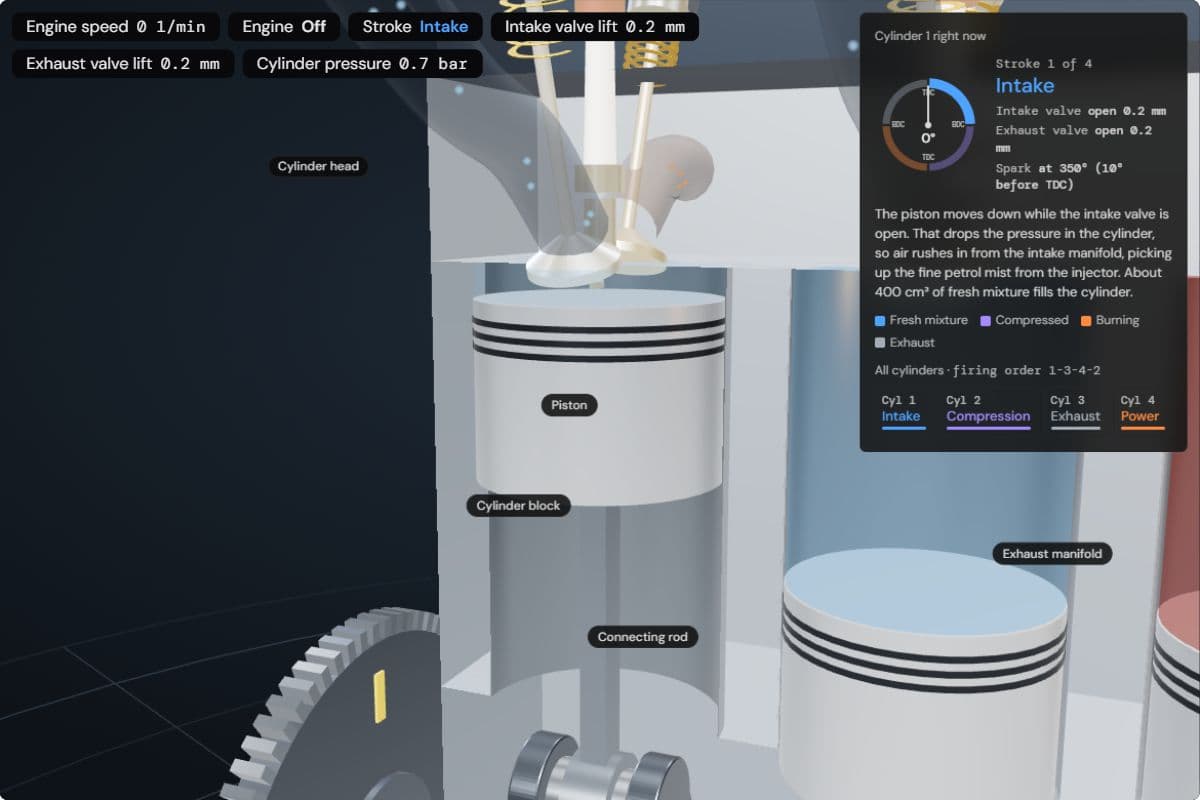
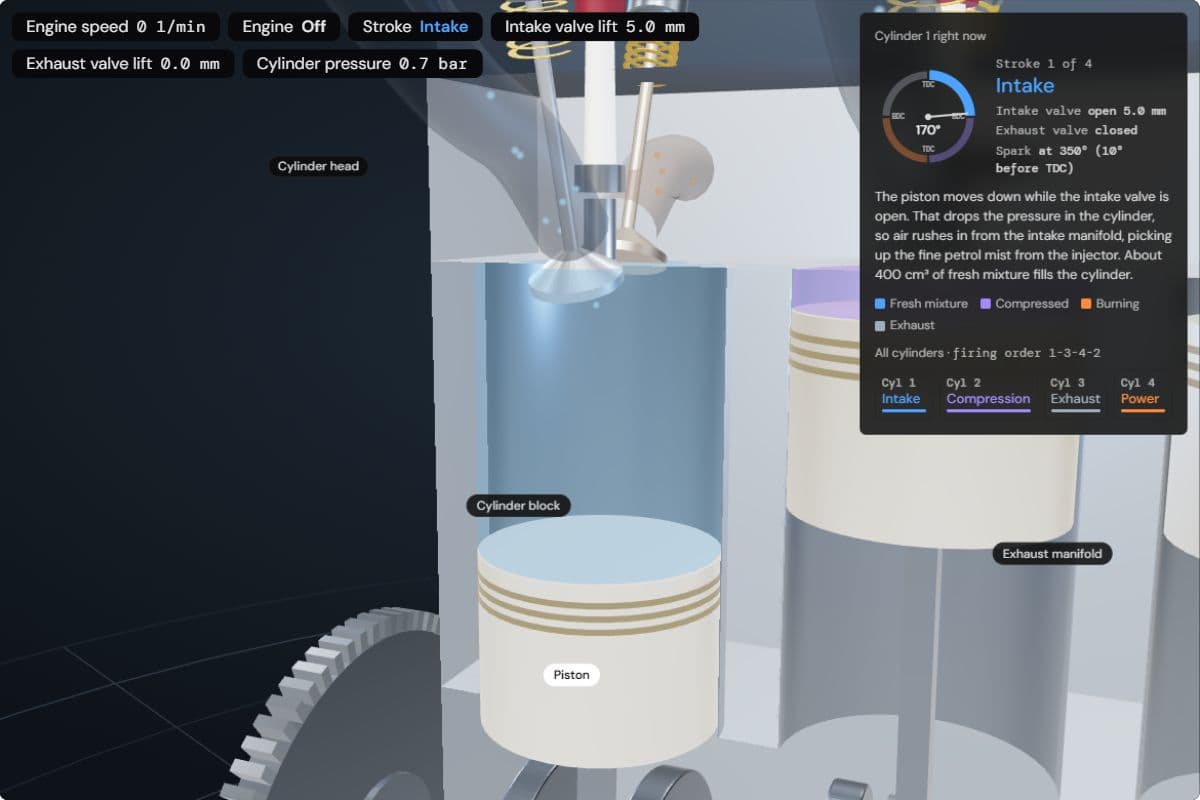
The piston starts at the top and moves down while the intake valve is open. People often say the piston sucks the mixture in. What really happens is that the piston makes room: the pressure in the cylinder drops below the pressure of the air outside, and the outside air pushes into the gap. On its way it picks up a fine mist of petrol from the injector.
In the engine of the tour, each cylinder takes in about 400 cm³ of fresh mixture per cycle, so all four together make a 1.6-litre engine. The intake valve already opens slightly before the top and closes about 50° of crank rotation after the bottom. The air keeps flowing in for that moment, carried by its own momentum.
Compression: why the mixture is squeezed first
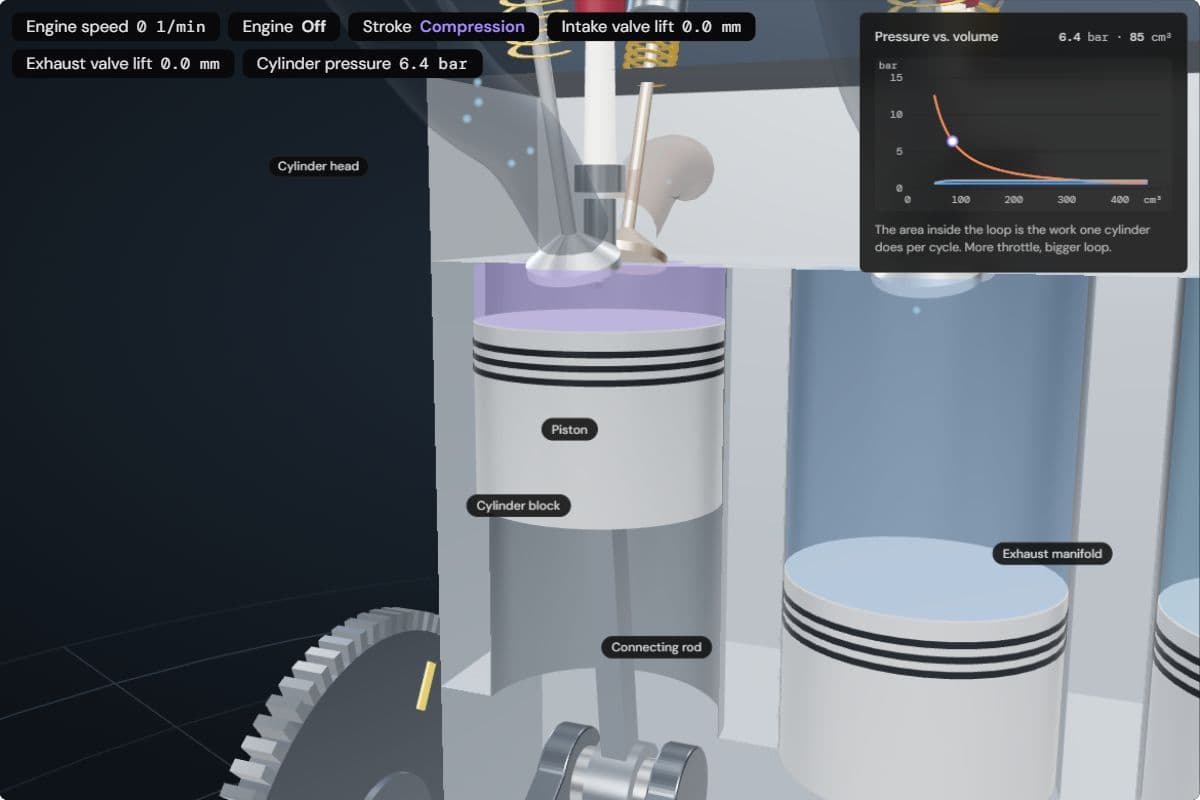
Now both valves are shut and the piston moves back up. It squeezes the mixture into the small space left above it at the top, one ninth of the volume it had at the bottom. This ratio of 9:1 is the compression ratio; petrol car engines typically run between 8:1 and 12:1. At full throttle the pressure climbs to around 15 bar and the gas heats up to roughly 400 °C.
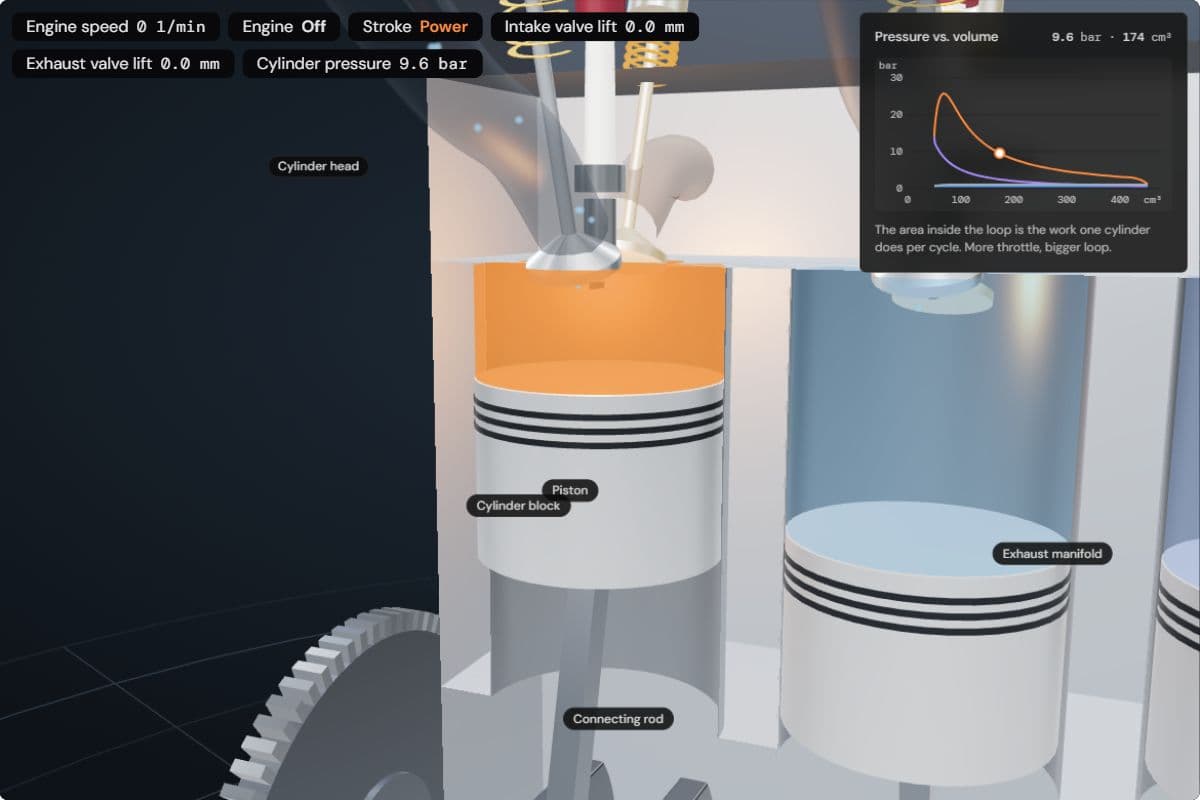
Squeezing costs work, so why do it? Because squeezed mixture burns faster and pushes much harder afterwards, and it pushes over the whole length of the next stroke. The p-V diagram shows it: it plots the pressure in the cylinder against its volume. The area inside the loop is the work one cycle delivers, and the higher the compression, the larger the loop. Engines without compression were built in the 1860s and turned only about 4 % of their fuel into work.
Power: the spark lights, the gas pushes
Shortly before the piston reaches the top, at 10° of crank rotation before TDC in this engine, the spark plug fires. A common idea is that the spark itself pushes the piston down. It doesn't: the spark only lights the mixture, like a match. The spark comes a little early because the flame needs time to spread, about 2 milliseconds, and the pressure should peak just after TDC.
The burning gas gets very hot, and its pressure jumps to 40 to 60 bar at full throttle. That pressure pushes the piston down hard, and through the connecting rod it turns the crankshaft. This power stroke is the only one of the four that delivers work. The other three cost a little.
Exhaust: clearing the cylinder
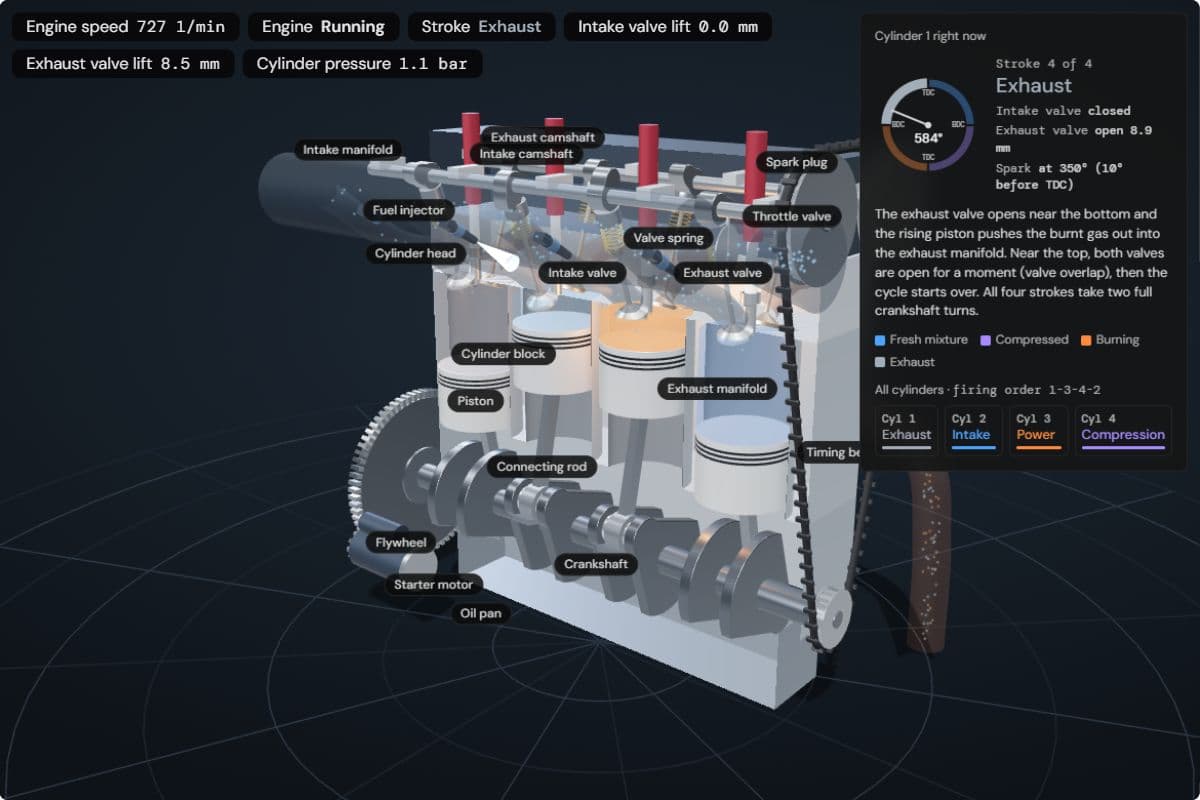
After the power stroke the cylinder is full of burnt gas, and fresh mixture can only come in once it is gone. The exhaust valve opens about 50° before the bottom, while the gas still has some pressure, so much of it rushes out on its own. Then the rising piston pushes out the rest.
Near the top, the exhaust valve is still closing while the intake valve is already opening. For about 20° of crank rotation both are open at once. This is called valve overlap: the gas rushing out helps the fresh charge follow it in. Then the cycle starts again with the next intake stroke.
Two turns, one power stroke
Each stroke is half a turn of the crankshaft, so a full cycle of four strokes takes two turns. Only one of those four half-turns pushes. The heavy flywheel stores energy from the power stroke and carries the crankshaft through the other three, the way a spinning top keeps going after you let go.
A four-cylinder engine makes this much smoother. Its cylinders take turns in the firing order 1-3-4-2, each half a turn after the last, so at any moment one of them is in its power stroke. To start the engine, the electric starter motor turns the crankshaft until the first cylinders fire and the engine runs on its own.
Valves and camshaft: why the camshaft turns at half speed
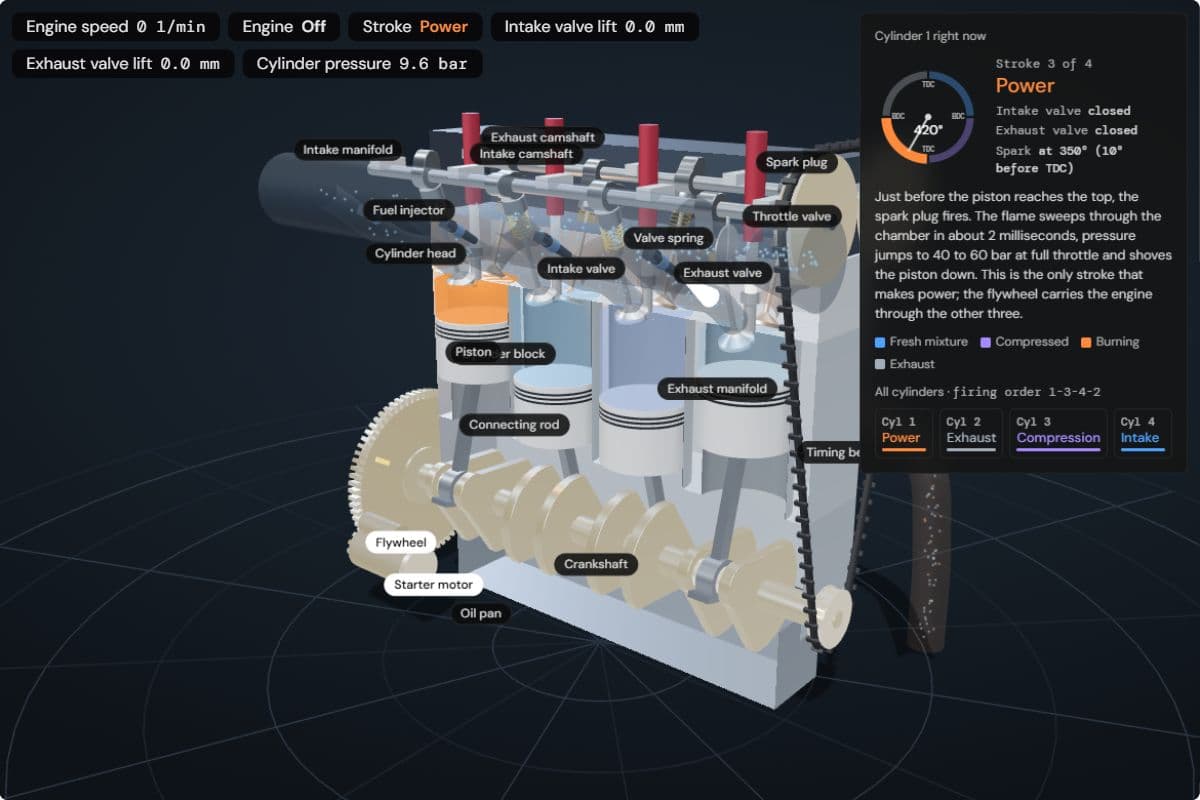
Each valve has to open exactly once per cycle, and a cycle is two turns of the crankshaft. So the camshaft is geared to turn once while the crankshaft turns twice: the pulley on the camshaft is twice the size of the one on the crankshaft. On the camshaft sits one egg-shaped lobe per valve. As it rotates, the lobe presses the valve open; a spring closes it again.
The shape and position of each lobe set the valve timing. In the engine of the tour, the intake valve is open from 10° before TDC to 50° after BDC, the exhaust valve from 50° before BDC to 10° after TDC. Opening early and closing late gives the gas more time to flow, which matters at high engine speed, when a whole stroke lasts only a few thousandths of a second.
Four-stroke vs two-stroke
A two-stroke engine does the same four jobs in just two strokes, one turn of the crankshaft. It has no valves and no camshaft. Instead, the piston itself uncovers openings in the cylinder wall as it moves, and the fresh mixture flows in while the burnt gas is still leaving. So it gets a power stroke on every turn, not every second one.
That makes two-strokes light, simple and powerful for their size, which is why they are used in chainsaws, small scooters and model engines. The price is that some fresh mixture escapes with the exhaust, and the oil that lubricates the engine is mixed into the fuel and burns with it. A four-stroke engine separates the gas changes cleanly and keeps its oil in a closed circuit, so it uses less fuel and runs cleaner. That is why almost every car, most motorcycles and modern lawnmowers use four-strokes.
Petrol and diesel engines both work in four strokes
The engine in the tour is a petrol engine, also called an Otto engine. A diesel engine goes through the same four strokes, intake, compression, power and exhaust, but it lights its fuel differently. It takes in only air and squeezes it much harder, with compression ratios typically between 15:1 and 23:1. That makes the air so hot that diesel fuel sprayed into it at the end of the compression stroke catches fire on its own. A diesel needs no spark plug.
The higher compression is also why diesels use less fuel: diesel car engines turn up to about 43 % of their fuel's energy into work, more than petrol engines manage.
Frequently asked questions
Who invented the four-stroke engine?
The French engineer Alphonse Beau de Rochas described the four-stroke principle in a patent in 1862, but he never built an engine. Nicolaus Otto in Germany built the first working four-stroke engine with compression in 1876, which is why the petrol engine's cycle is called the Otto cycle.
How many times does the crankshaft turn in one cycle?
Twice. Each stroke is half a turn, so the four strokes take two full turns of the crankshaft, or 720°. In that time each cylinder makes power once, and the camshaft turns once.
Why does an engine need four strokes and not just one?
Because a cylinder has only one space above the piston, it can only do one job at a time: fill, squeeze, burn or empty. Each job needs the piston to move once, so one cycle takes four strokes, and only one of them delivers power.
Is a four-stroke better than a two-stroke?
It depends on the job. A four-stroke uses less fuel, runs cleaner and lasts longer, so it suits cars and most motorcycles. A two-stroke is lighter, simpler and gives more power for its size, so it suits chainsaws and small tools.
Does a four-stroke engine need oil in the fuel?
No. A four-stroke engine keeps its oil in the oil pan, and a pump sends it to the bearings and the camshaft, while oil splashed up from below coats the cylinder walls. Only two-stroke engines need oil mixed into the fuel.
How efficient is a four-stroke petrol engine?
A modern petrol engine turns about 30 to 35 % of its fuel's energy into work at its best operating point, and less in town traffic. Most of the rest leaves as heat in the exhaust gas and the cooling water.