Four-stroke engine · Question 5 of 5
How does a starter work?
A starter is an electric motor that spins the engine until it can run by itself. When you turn the key, its small pinion slides into the toothed ring on the flywheel and turns the crankshaft at about 250 rpm, so the cylinders draw in and squeeze fuel and air. The spark plugs light it, then the starter lets go.
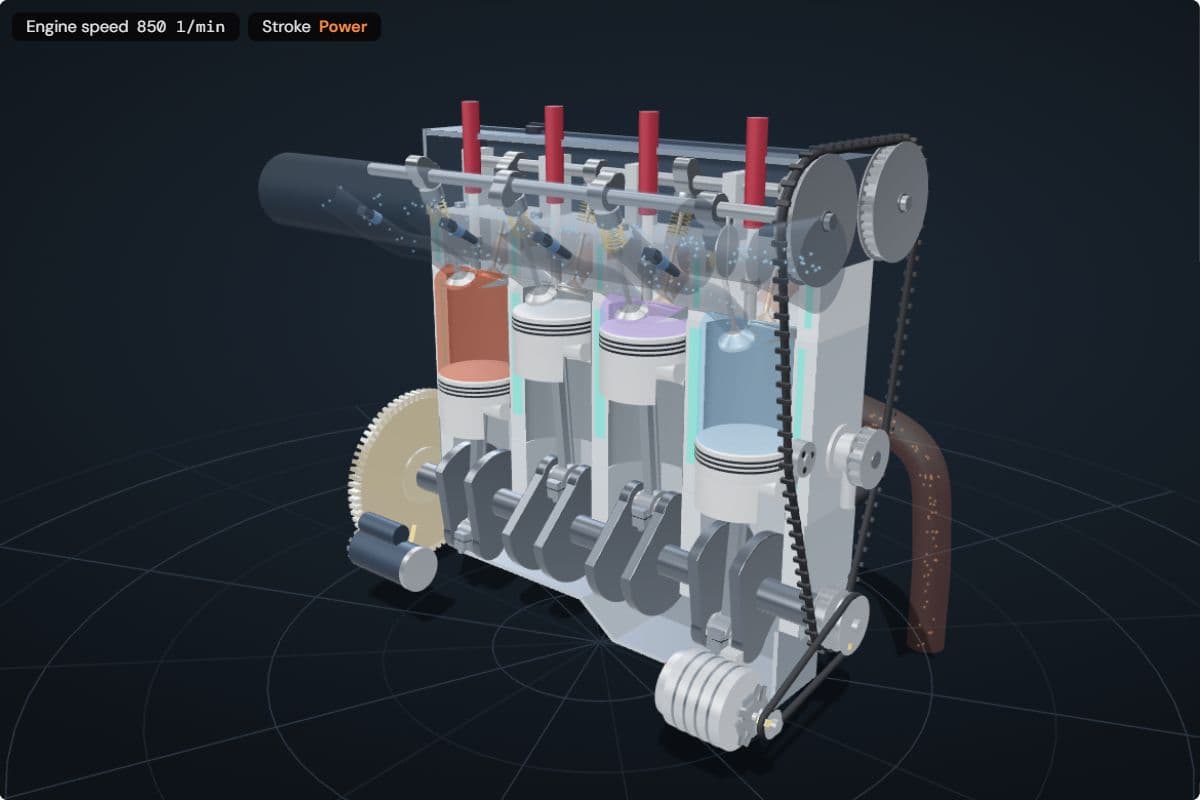
In this tour you turn a 3D engine by hand like a starter would, then start it and watch the pinion mesh, crank and pull back.
7 steps · Beginner · free, no account
Why an engine needs a starter
A petrol engine makes power in only one of its four strokes. Before that power stroke can push, the cylinder has to draw in fuel and air on the way down and squeeze them on the way up. At a standstill nothing moves the pistons, so nothing gets drawn in, squeezed or lit. The first cycle has to be driven from outside and fast enough for the cylinders to fill and build up pressure.
For the first cars that outside help was a hand crank at the front of the engine. Cranking took strength, and if the engine fired too early it could kick back and break the driver's arm. Charles Kettering's electric starter, first fitted to the 1912 Cadillac, replaced it with a small motor and a button, and today every car with a combustion engine has one.
The tour, retold
Step by step
Step 1 of 7 · Explain
The starter sits at the flywheel
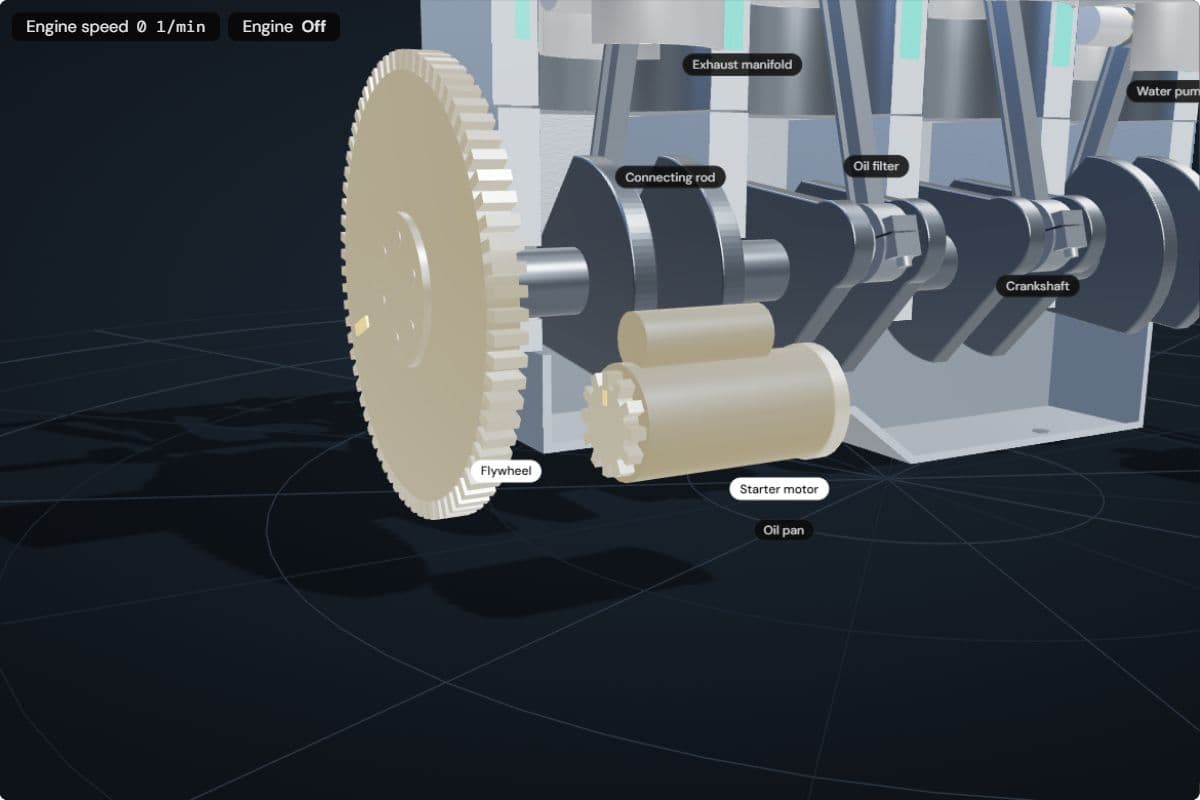
The starter is a compact electric motor, bolted low on the engine where it meets the gearbox. On the front of its shaft sits a small gear, the pinion. Right next to it turns the flywheel, a heavy disc on the end of the crankshaft with a toothed ring around its edge, the ring gear.
While the engine is off or running, the pinion stays back and doesn't touch the ring gear. Only for the few moments of starting does it slide forward and mesh.
Step 2 of 7 · Try it
Turning the crank builds the pressure the spark needs
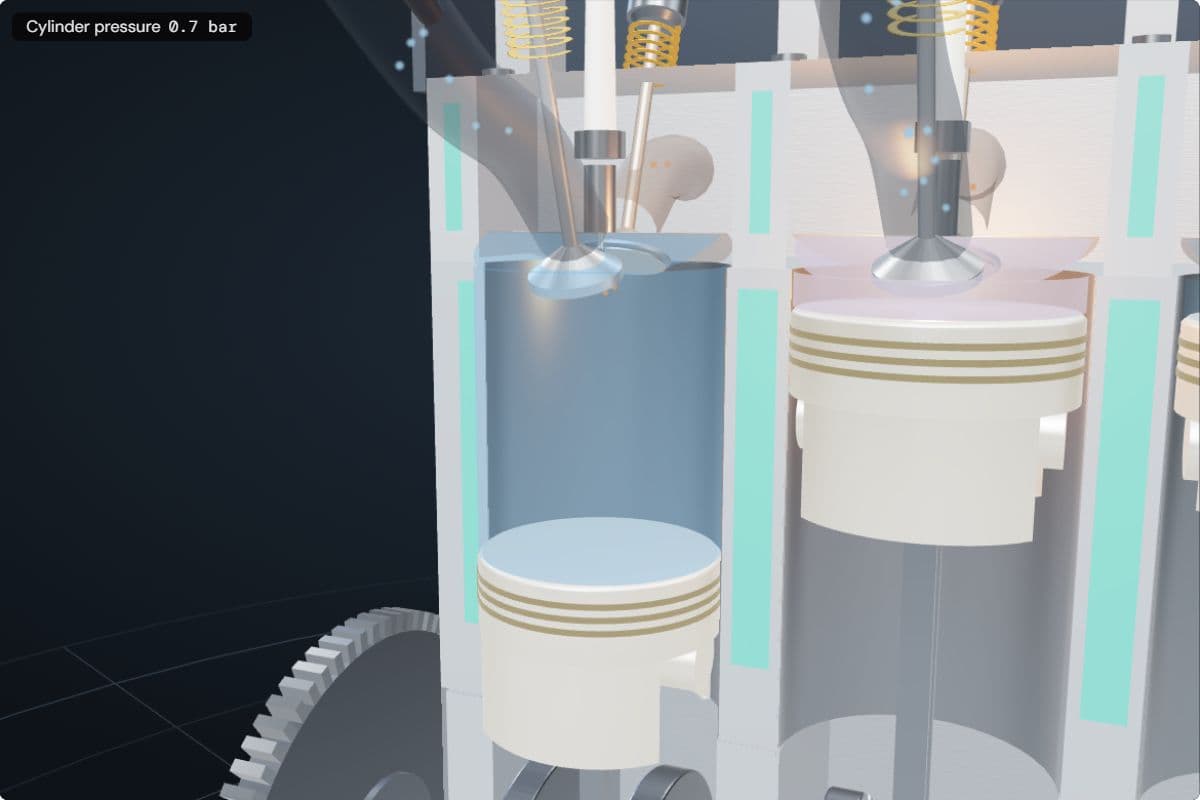
Turn the engine of the tour by hand and you do the starter's job. With cylinder 1's piston at the bottom, the cylinder is full of mixture at about 0.7 bar, about 30 % below the air outside. As the piston rises, the pressure climbs slowly at first and then steeply: 2.5 bar at 60° before the top, past 10 bar about 15° before it.
Just before the top, at 10° before top dead centre in this model, the spark plug fires into the tightly packed mixture and the pressure shoots up to its peak after the top. Only now does the engine make power of its own. That is the point of starting: the starter has to carry the pistons through intake and compression until the first cylinders fire.
Step 3 of 7 · Explain
A small gear turns a big one
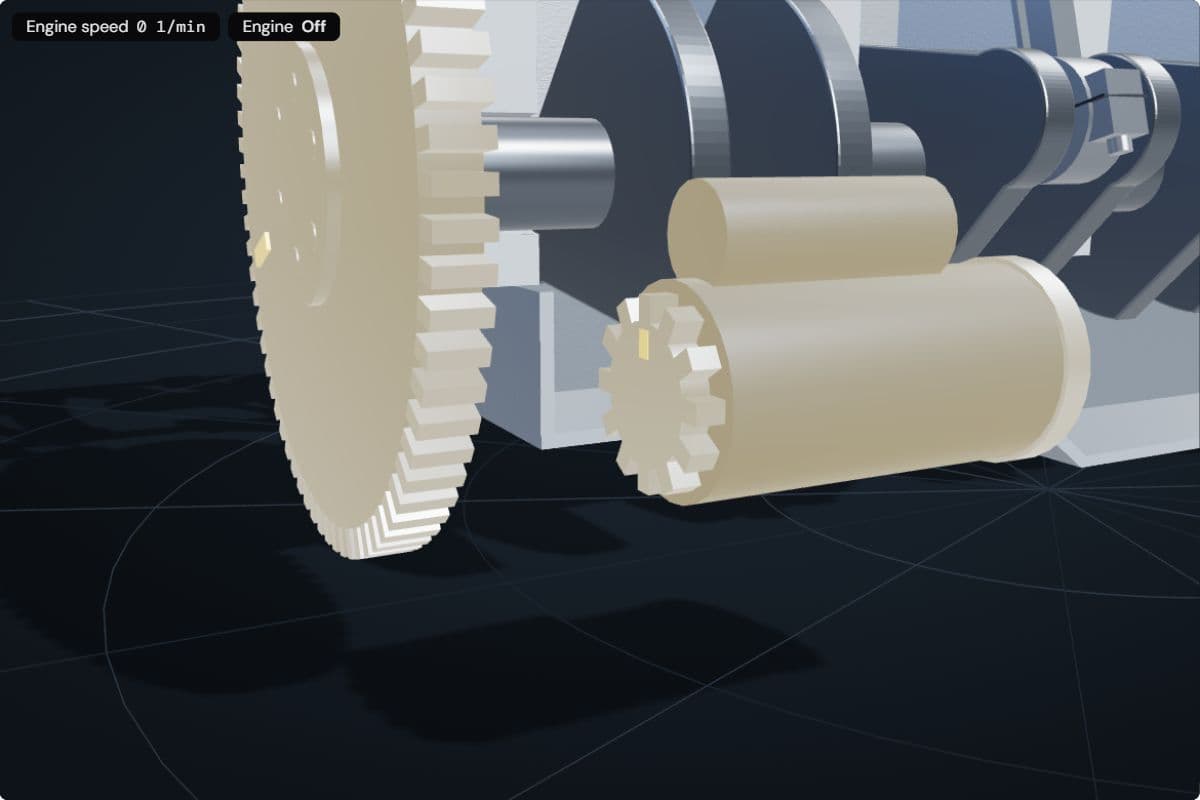
The starter motor is small, but it has to turn the whole engine against the compression in its cylinders. The trick is gearing. In the tour's model the pinion has 12 teeth and the ring gear 72, so the pinion turns six times for one turn of the crankshaft, and the motor's torque is multiplied six times at the crankshaft.
Real cars gear down more: between about 10 : 1 and 20 : 1 from pinion to ring gear, and most modern starters add a small planetary reduction gear inside the housing, so the motor itself can spin fast and stay light. The engine turns over at a cranking speed of about 250 to 300 rpm, a third of a typical idle.
Halfway
See it for yourself in 3D
Reading is one thing. In the tour you change it yourself and watch what happens, step by step.
Start the 3D tourStep 4 of 7 · Predict
The starter doesn't light the fuel, and it doesn't keep the engine running
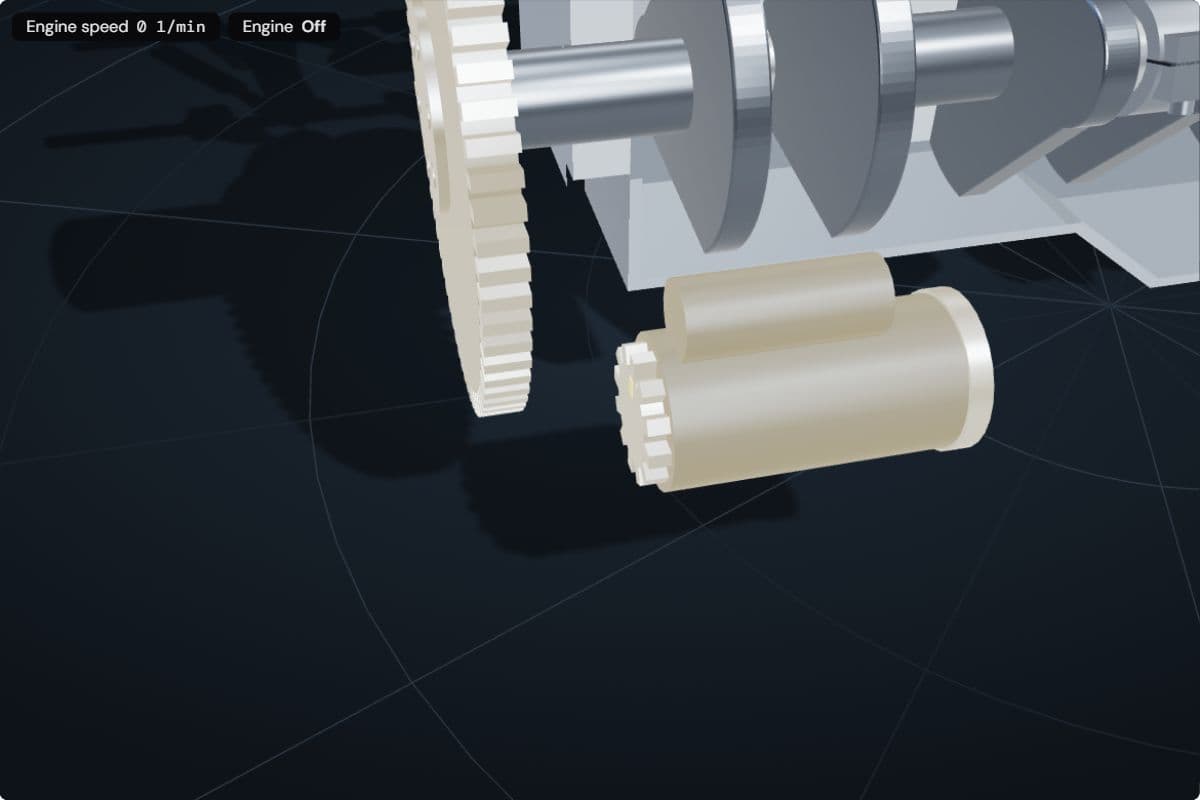
A common idea is that the starter makes the fire, because turning the key "starts" the engine, or that it keeps pushing for as long as the engine runs. Neither is true. The starter only turns the crankshaft. The spark plugs light the mixture, and they already fire while the starter is turning: in the model the Engine chip says Cranking, the pinion is meshed with the ring gear, and the first cylinders are already burning fuel.
As soon as the engine runs on its own power, the starter's job is done. The pinion slides back out of the ring gear and the motor stops, while the engine speed climbs on towards idle, about 850 rpm in the model. From then on the starter just sits there until the next start.
Step 5 of 7 · Explain
The flywheel evens out the pushes
The flywheel is more than a carrier for the ring gear. Each cylinder pushes in only one stroke of four. A one-cylinder engine, as in a lawnmower, coasts on its flywheel through the other three strokes. In an inline-four the cylinders take turns in the order 1-3-4-2, so one of them is always in its power stroke, but each push still rises to a peak and fades again.
The heavy flywheel stores energy at every peak and gives it back in the dips, so the crankshaft turns evenly instead of in jerks. Switch the engine off and the stored energy shows: the sparks stop at once, yet the engine keeps turning for a moment before it comes to rest.
What happens when you turn the key
The starter draws far more current than a switch in the dashboard could carry, so the key or start button only sends a small current to the solenoid, an electromagnet mounted on the starter. Its pull-in winding draws in an iron plunger; a hold-in winding keeps it there with less current. The plunger does two jobs: through a lever it pushes the pinion forward into the ring gear, and at the end of its travel it closes the heavy contacts that connect the 12-volt battery straight to the motor.
The motor then draws well over 100 amps at the start of cranking and turns the engine over. When you let go of the key, the solenoid lets go too: a spring pulls the plunger back, the heavy current stops and the pinion is pulled out of the ring gear. This pre-engaged design is the one in almost every car today. Older inertia (Bendix) starters threw the pinion forward on a spiral thread as the motor spun up and let the engine throw it back once it started.
The one-way clutch: why the engine can't drag the starter along
Once the engine fires, it speeds up faster than the starter can follow. With the pinion still in mesh, the engine would now drive the starter, through the same gearing that helped the starter turn the engine. At 10 to 20 : 1, an idle of 850 rpm would spin the pinion at 8,500 to 17,000 rpm, and the motor behind the starter's internal reduction gear several times faster still.
To protect it, the pinion sits on an overrunning clutch, a one-way clutch. It locks when the pinion drives the ring gear and slips when the ring gear tries to drive the pinion, so the engine can overtake the starter without harm until the solenoid pulls the pinion back.
What does a flywheel do?
A flywheel is a heavy disc bolted to the end of the crankshaft, and it has three jobs. First, it stores rotational energy. Combustion pushes the crankshaft in bursts, one power stroke per cylinder every two turns, so the turning force rises and falls all the time. The flywheel's mass soaks up energy when the push is strong and hands it back when it fades, which keeps the engine turning smoothly at idle and lets a single-cylinder engine get through its three strokes without power at all.
Second, it carries the ring gear the starter meshes with. Third, in a car with a manual gearbox, its flat face is where the clutch presses on to pass the engine's power to the gearbox. Its stored energy is also what you see when you switch an engine off: it doesn't stop dead but coasts down for a moment, until friction and the compression in the cylinders bring it to rest.
Signs of a failing starter
A single click when you turn the key, and the engine doesn't turn, is often not the starter at all: a flat or weak battery or a corroded cable can't deliver the current, so only the solenoid clicks. If the battery is fine, the solenoid or the motor itself may be worn. Rapid clicking usually points to the battery.
Slow, laboured cranking means too little current reaches the motor, from a weak battery, bad connections or a worn motor. A grinding or screeching noise points to a worn pinion or ring gear, or a pinion that doesn't engage or let go properly. And if nothing happens at all, check the battery, the fuses and, on automatics, that the gear selector is in park or neutral.
FAQ
Frequently asked questions
- Does the starter ignite the fuel?
- No. The starter only turns the crankshaft so the cylinders can draw in and compress fuel and air. In a petrol engine the spark plugs light the mixture; in a diesel the heat of compression does. The plugs already fire while the starter is cranking, and the starter lets go as soon as the engine runs on its own.
- Can I start my car with a dead starter?
- With a manual gearbox, often yes: push or roll the car to walking pace or a bit faster in second gear with the clutch pressed, then let the clutch out, and the wheels turn the engine over instead of the starter. A car with an automatic gearbox can't be started this way. If the problem is a flat battery rather than the starter, jump-starting helps.
- How do you tell if a starter is bad?
- First rule out the battery: if the lights are bright and a jump-start doesn't help, the starter is the likely cause. Typical signs are a single click with no cranking, slow cranking with a good battery, or grinding when the pinion engages.
- How long should you crank an engine?
- No more than about 10 to 15 seconds at a time, then let the starter rest before trying again. Cranking draws well over 100 amps, which heats the starter motor and drains the battery quickly. If the engine doesn't start after a few tries, look for the cause instead of cranking on.
- What does a flywheel do?
- It stores rotational energy and smooths out the pushes of the pistons, so the crankshaft turns evenly. It also carries the ring gear the starter meshes with, and in cars with a manual gearbox its face is where the clutch presses on.
- Why do start-stop cars need a stronger starter?
- A start-stop system switches the engine off at every stop and restarts it when you move on, so the starter works many times more often than in a car without it. That is why these cars have reinforced starters built for the extra starts. In return, switching off at stops saves fuel, up to about 8 % in the European city test cycle (ECE 15).
Keep exploring
Not the question you had in mind?
More on Four-stroke engine
- Question 1
How does a four-stroke engine work?
Follow one cylinder through intake, compression, power and exhaust, and find out why it takes four strokes.
9 steps · BeginnerStart - Question 2
What does a throttle do?
Open the throttle and see what changes: how much air gets in, the pressure in the cylinder, and the engine speed.
6 steps · BeginnerStart - Question 3
What does a camshaft do?
Turn the crank by hand and watch the camshaft's lobes open each valve, then find out why it turns at only half the crankshaft's speed.
7 steps · BeginnerStart