What does a throttle do?
The throttle is a flap in the engine's air intake, inside the throttle body. It decides how much air the engine can draw in. The gas pedal doesn't pump fuel, it only opens this flap. More air lets the engine burn more fuel, so every power stroke pushes harder and the engine speeds up.
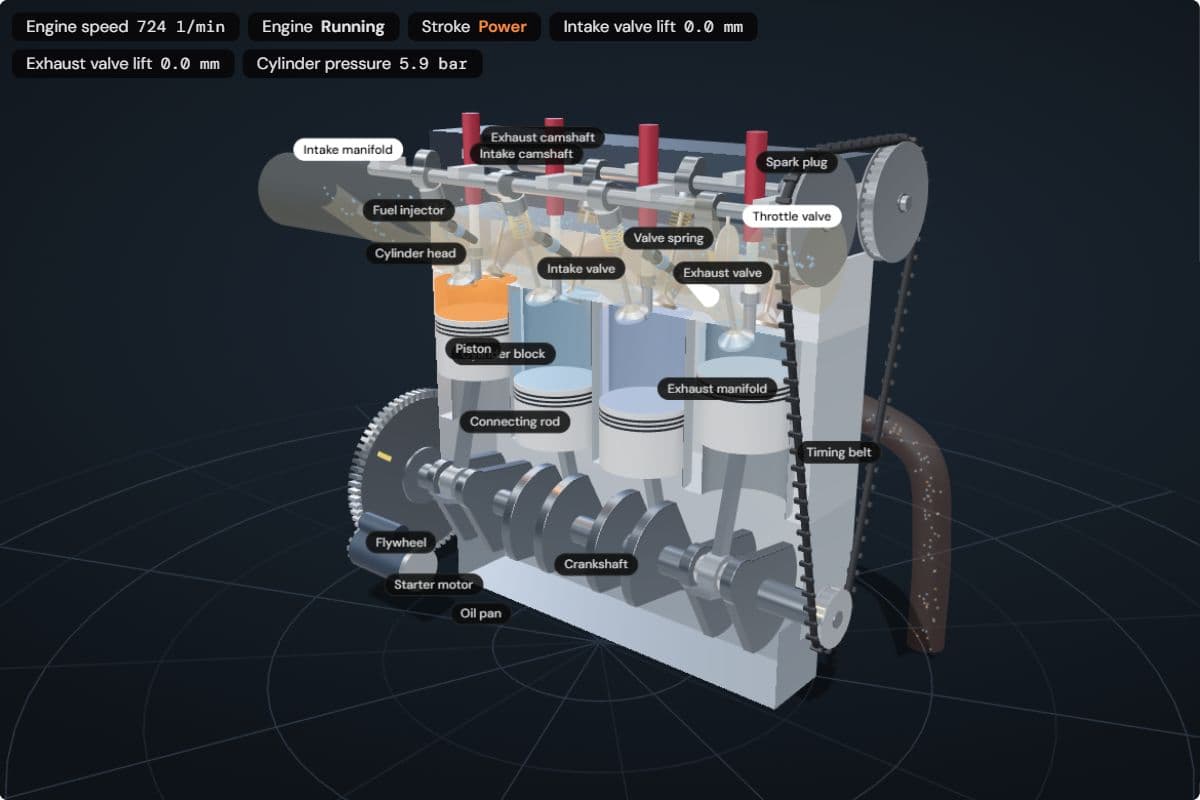
In this tour you open the throttle of a running 3D engine and watch the airflow, the pressure in the cylinder and the engine speed change.
6 steps · Beginner · free, no account
 Start the 3D tour here
The gas pedal controls air, not fuel
A common picture of driving is that pressing the gas pedal squirts more fuel into the engine. Many guides still describe it that way. In a modern petrol car, the pedal does not touch the fuel at all. It opens the throttle, and the throttle only lets air through.
The fuel follows the air. Sensors measure how much air flows in, and the engine computer sets the injectors so that there is about 14.7 g of air for every 1 g of petrol. That ratio burns cleanly and is what the catalytic converter is built for. Too much fuel for the air would waste it and smoke; too little would misfire. So the only way to get more fuel burned, and more power, is to let in more air first. That is the throttle's job.
Step by step
The throttle is a flap in the air intake
Air enters the engine through the air filter, flows through the throttle body and then into the intake manifold, which splits it between the cylinders. Inside the throttle body sits a round metal plate on a shaft, the throttle valve or butterfly valve. Turned edge-on, it barely blocks the pipe. Turned flat across the pipe, it almost closes it.
The pedal turns this plate through about 90°. With your foot off the pedal, the plate stands nearly closed and the engine idles. Press the pedal to the floor and the plate turns edge-on: wide open throttle.
At idle, the engine sucks against a nearly closed flap
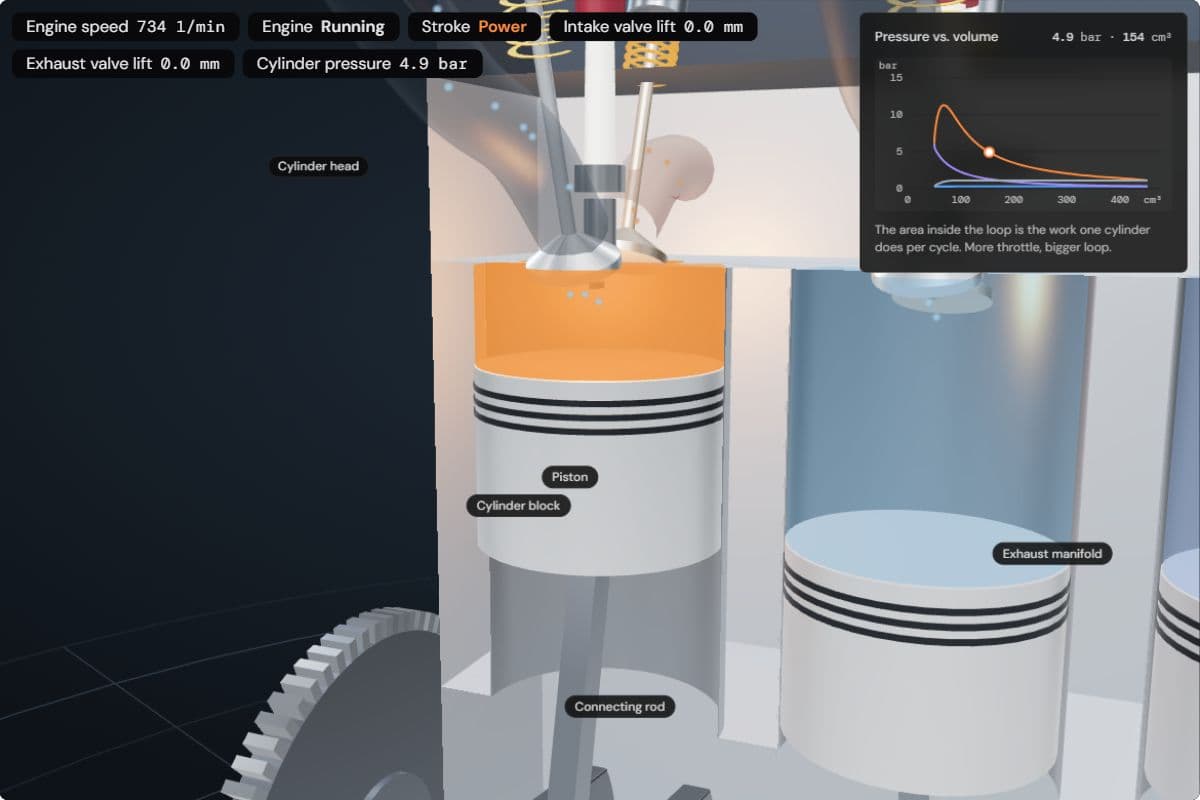
The pistons don't care where the throttle is. On every intake stroke each one moves down and tries to fill its cylinder. With the flap nearly closed, not enough air can follow, so the pressure in the intake manifold and the cylinder drops far below the 1 bar outside. In the model it falls to about 0.3 bar; real petrol engines at idle sit at about 0.3 to 0.4 bar. This partial vacuum is the engine vacuum that mechanics measure and that the brake booster uses.
A cylinder holding a third of the air also gets only a third of the fuel. Each power stroke is weak, just strong enough to keep the engine turning at idle speed, under 1,000 rpm. In the pressure–volume diagram this shows as a small loop: the pressure peaks at around 11 bar.
Wide open: more air, more fuel, more push
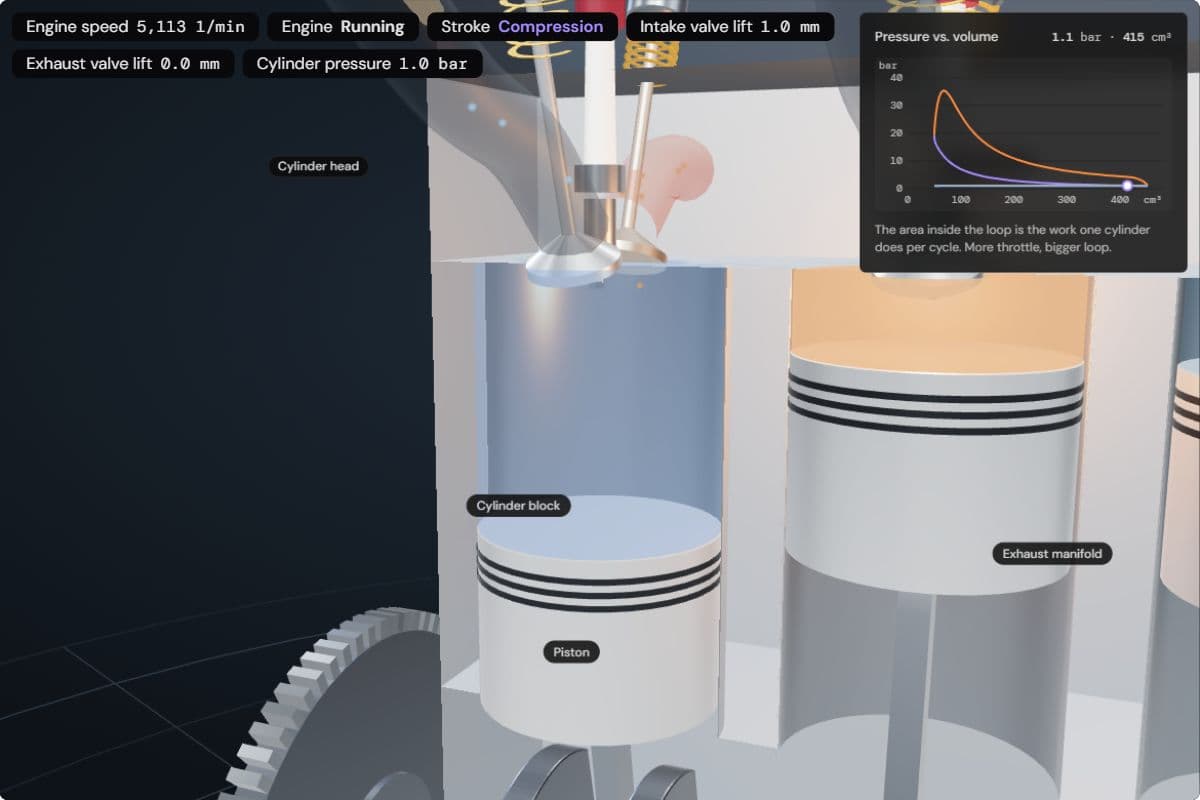
Open the throttle and the vacuum disappears. Air flows freely and each cylinder fills to almost 1 bar, about three times as much air as at idle. The injector adds three times as much fuel to match, and the bigger charge burns with a much harder push on the piston.
In the model the pressure peak rises from about 11 bar at idle to about 35 bar, and the loop in the pressure–volume diagram grows many times larger. The area inside that loop is the work one cylinder does per cycle. More work per cycle makes the engine speed up, here to over 5,000 rpm. This is all a throttle does: it sets how much air, and therefore how much fuel, each cylinder gets.
Inside the throttle body
Besides the plate and its shaft, a throttle body holds a throttle position sensor that tells the engine computer how far the plate is open. A spring pulls the plate back towards closed when you let go of the pedal. At idle the plate can't be fully shut, or the engine would stall. Older engines feed idle air through a small bypass with its own valve, the idle air control valve. In newer ones the throttle motor simply holds the plate open by a small gap and adjusts it to keep the idle steady.
Most cars have one throttle body. Some high-revving engines and many motorcycles have one per cylinder, so each cylinder gets its air through a short, direct path.
Cable or drive-by-wire
In older cars a steel cable runs from the pedal to the throttle body and turns the plate directly. Almost every new petrol car uses drive-by-wire instead, also called electronic throttle control. The pedal only carries a sensor. The engine computer reads it and moves the plate with a small electric motor.
With no cable in between, the computer can do more than copy your foot. It opens the throttle by itself for cruise control, closes it when traction control detects spinning wheels, and smooths jerky pedal movements. For safety, both the pedal and the throttle body carry two position sensors that must agree. If they don't, the car goes into limp mode: the throttle stays barely open and the engine gives only enough power to reach a garage.
Why throttling costs fuel, and why diesels don't throttle
Pulling air through a nearly closed flap takes work. At part throttle the pistons spend some of their effort sucking against the vacuum instead of driving the car. Engineers call these pumping losses. They are one reason why a petrol engine is least efficient when it is lightly loaded, in town and at steady low speeds.
A diesel avoids most of this. It doesn't need an exact air–fuel ratio, so it always takes in a full cylinder of air and sets its power by how much fuel it injects. The pedal there controls fuel directly. Many modern diesels still have a flap in the intake, but it is not for power: it helps the exhaust gas recirculation, the cleaning of the particulate filter, and a smooth shutdown. Some petrol engines, such as BMW's Valvetronic, also skip most of the throttling and control the air with how far the intake valves open.
Signs of a dirty or failing throttle body
Over time oily vapour from the crankcase ventilation and, on some engines, the exhaust gas recirculation leave a dark layer of deposits around the edge of the plate. Since the idle gap is so small, even a thin layer chokes it. Typical signs are a rough or unsteady idle, an engine that stalls when you stop, hesitation when you press the pedal, and a warning light. A failing motor or position sensor shows the same signs and often triggers limp mode.
A dirty throttle body can be cleaned with throttle body cleaner. On drive-by-wire cars the plate must not be forced open by hand, and the engine computer often needs to relearn the plate's closed position afterwards. If the fault is electrical, a scan tool reading the stored fault codes tells the two cases apart.
Frequently asked questions
Is the throttle the same as the gas pedal?
Not quite. The gas pedal, or accelerator, is what your foot presses. The throttle is the valve in the engine's air intake that the pedal opens, through a cable or through a sensor and an electric motor. People often use "throttle" for both.
What happens when you take your foot off the gas?
The throttle closes almost completely and the engine has to suck against a strong vacuum, which slows the car down: engine braking. Modern engines also cut the fuel completely while you coast in gear above idle speed, so rolling downhill in gear uses no fuel.
Can you drive with a bad throttle body?
Often only in limp mode, with very little power, a high or unsteady idle and a warning light. That is meant to get you to a garage, not for normal driving. A throttle stuck open or closed is a safety risk, so it should be checked soon.
How often should a throttle body be cleaned?
There is no fixed interval for most cars; it depends on the engine and how it is driven. Many manufacturers don't list it as maintenance at all. Cleaning is worth it when the typical signs appear, such as a rough idle or stalling.
Do electric cars have a throttle?
No. An electric motor doesn't breathe air, so there is nothing to throttle. The accelerator pedal sends a signal to the power electronics, which set how much current flows to the motor.