Heat pump · Question 2 of 3
How does a refrigerator work?
A refrigerator doesn't make cold, it pumps heat out. Inside, a refrigerant boils at about −13 °C on a cold plate and takes heat from the food. A compressor squeezes the vapour until it is hot, and the black grille at the back gives that heat to the kitchen: about 130 W out for 80 W taken from inside.
In this tour you find out why an open fridge warms the kitchen, follow the refrigerant once round the loop, see the same loop in a heat pump and heat up the kitchen.
12 steps · Beginner · free, no account
A fridge moves heat, it doesn't make cold
Cold isn't a substance a machine can produce. Cold only means less heat. A fridge keeps food cold by taking heat out of its inside and getting rid of it somewhere else: at the back, into your kitchen.
The trouble is that heat flows from warm to cold on its own, never the other way. Heat from the 5 °C inside won't walk into a 22 °C kitchen by itself. Something has to lift it, and that takes work: this is the compressor's job, and the reason a fridge needs electricity at all.
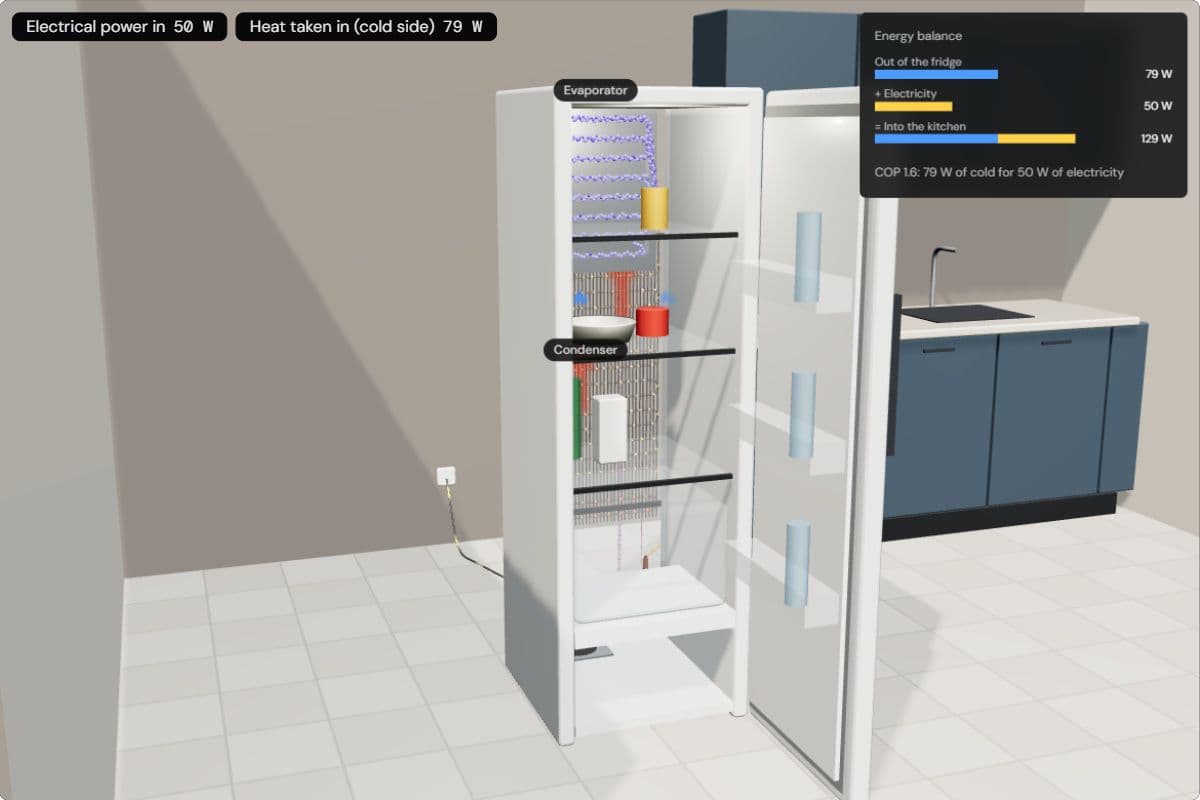
The balance is simple. The heat given off at the back is the heat taken from inside plus the electricity the compressor uses. In the model, running in a 22 °C kitchen, that is about 80 W from inside plus about 50 W of electricity, so about 130 W into the kitchen. Real household compressors draw 50 to 120 W while they run, and a fridge moves about 1 to 2 watts of heat per watt of electricity (its coefficient of performance for cooling).
The tour, retold
Step by step
Step 2 of 12 · Predict
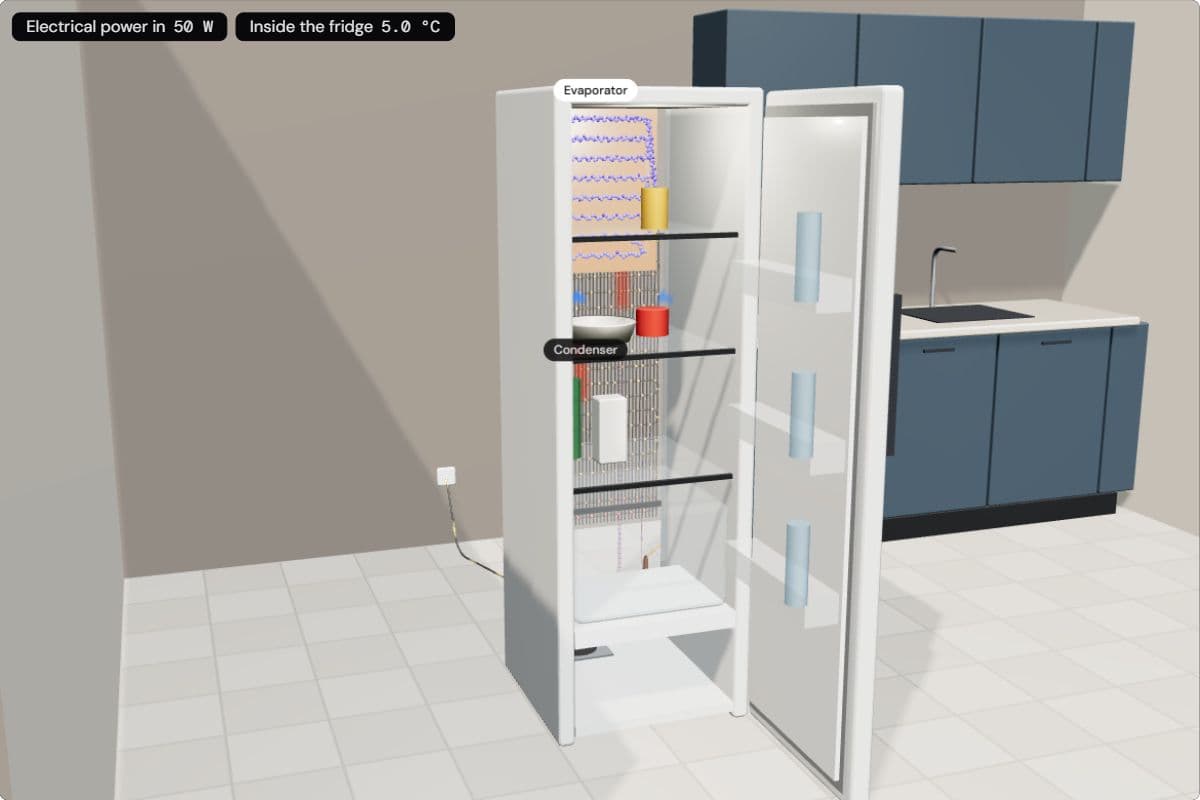
An open fridge warms the kitchen
A common idea is that on a hot day you could cool the kitchen by leaving the fridge door open: cold air pours out, so the room should get cooler. Another is that nothing changes, because the cold coming out and the warm air going in cancel out. Both miss the back of the fridge.
With the door open, the cold plate inside takes its heat from the kitchen air, and the grille at the back hands that same heat straight back to the kitchen, plus all the electricity the compressor uses. In the model that is about 80 W out of the kitchen at the front and about 130 W back in at the back. The kitchen slowly gets warmer, by the amount of the electricity.
Step 3 of 12 · Explain
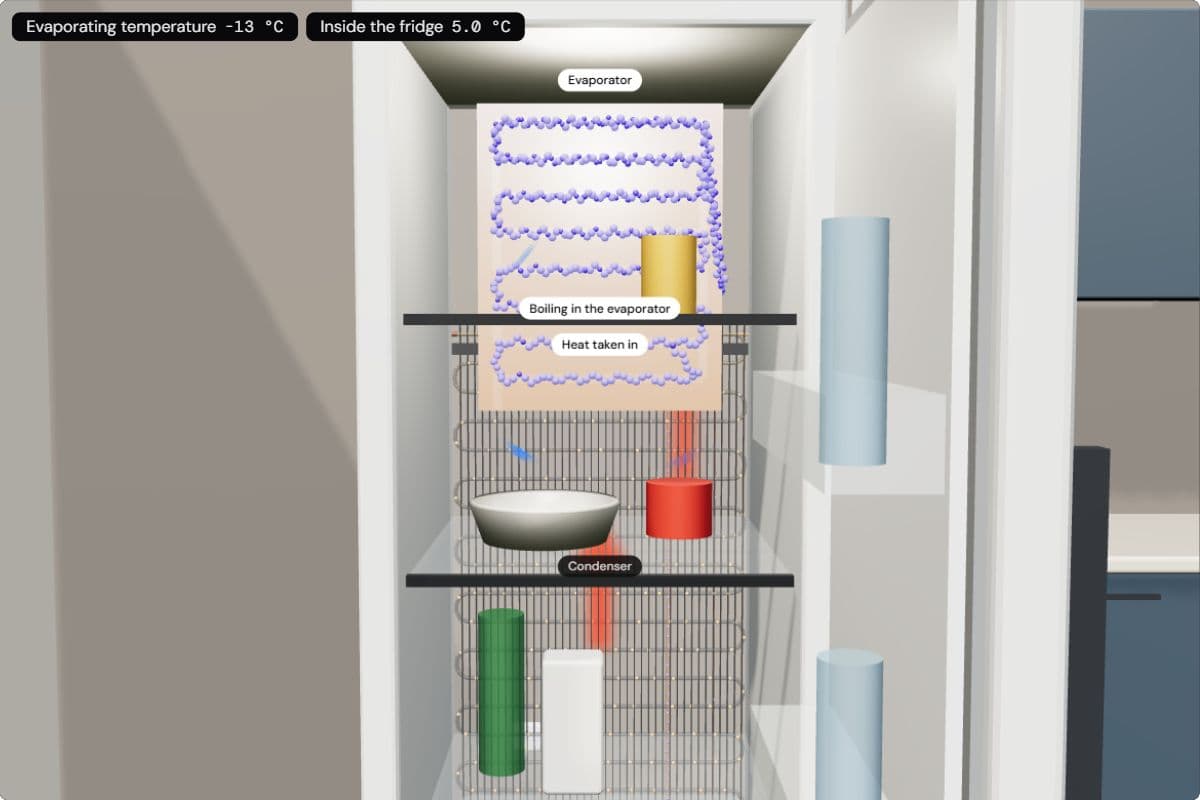
The cold plate inside: boiling far below zero
The cold part of a fridge is a plate or a set of tubes on the inner back wall, the evaporator. A refrigerant runs through it and boils there. In the model it boils at about −13 °C, much colder than the 5 °C food, so heat flows from the food and the air into it. Real fridges evaporate at about −20 to −10 °C.
Boiling doesn't mean hot. It only means a liquid turns into gas, and the temperature at which that happens depends on the pressure. Water boils at 100 °C at normal air pressure, at about 70 °C on Mount Everest and at about 120 °C in a pressure cooker. The model's refrigerant, propane, boils at −42 °C at normal air pressure; in the plate its pressure is held just right for about −13 °C. Turning a liquid into gas swallows a lot of heat, which is why sweat cools your skin and a spray can gets cold as you spray.
Step 5 of 12 · Explain
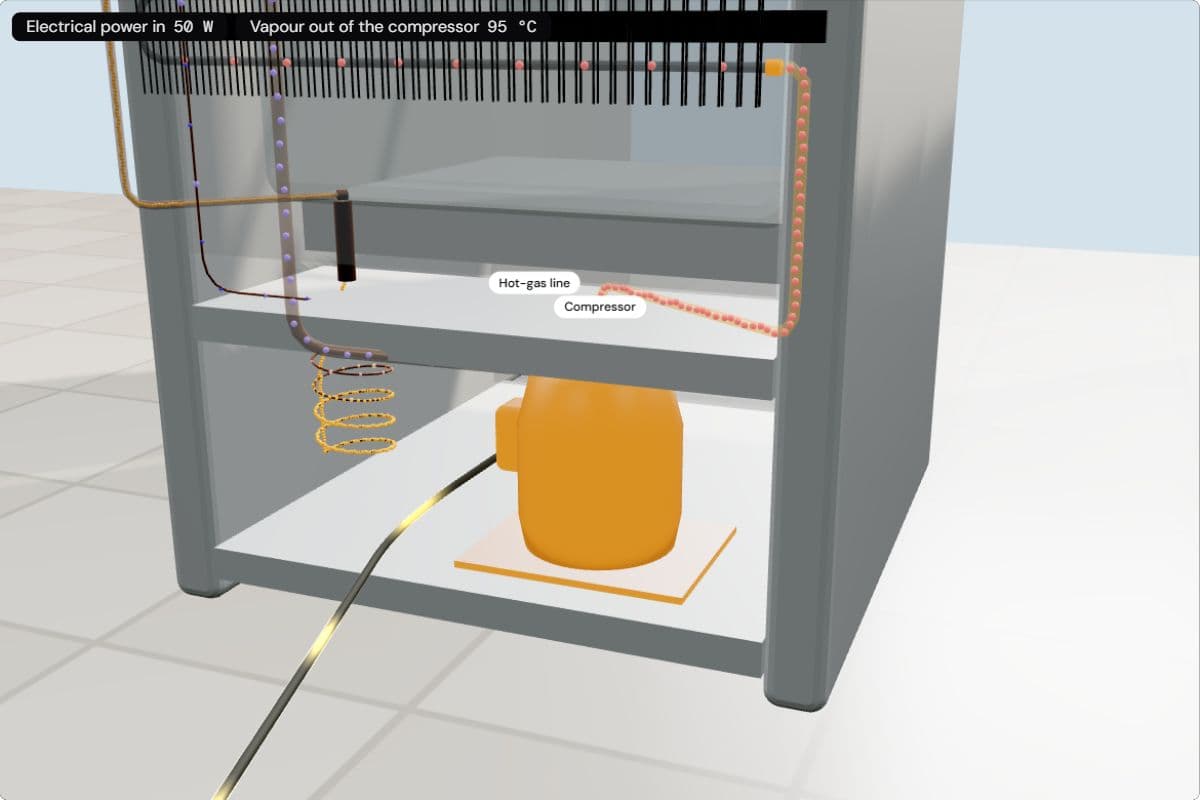
The compressor makes the vapour hot
The vapour from the plate flows to the compressor, the small black unit at the bottom of the back. It is the only part of a fridge that uses electricity worth mentioning, in the model about 50 W.
The compressor squeezes the vapour to a much higher pressure, and squeezing a gas heats it, like the air in a bicycle pump that gets warm when you pump hard. In the model the vapour goes in at about −8 °C and comes out at about 95 °C. Now it is far hotter than the kitchen, so it can give heat away.
Step 6 of 12 · Explain
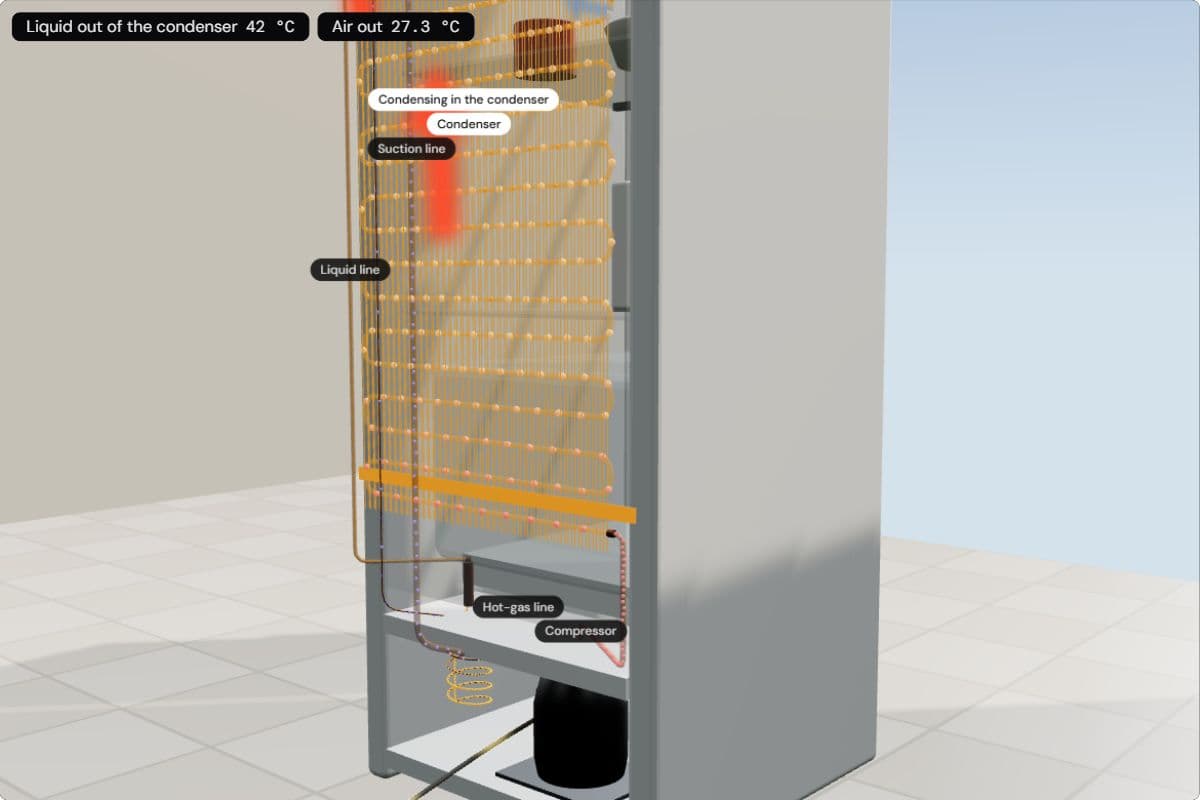
The black grille at the back is the condenser
The hot vapour runs into the black grille of tubes and wires on the back of the fridge, the condenser. At the high pressure the refrigerant turns back into liquid at about 45 °C in the model; real fridges condense at 40 to 50 °C. That is much warmer than the kitchen, so heat flows from the grille into the air, and turning back into liquid gives back all the heat that boiling took up inside.
The air rising past the grille gets a few degrees warmer, and the liquid leaves at about 42 °C. This is why the back of a fridge feels warm, and why it needs a gap to the wall and a grille free of dust: the heat has to get away.
Halfway
See it for yourself in 3D
Reading is one thing. In the tour you change it yourself and watch what happens, step by step.
Start the 3D tourStep 7 of 12 · Explain
A thin tube makes it cold again
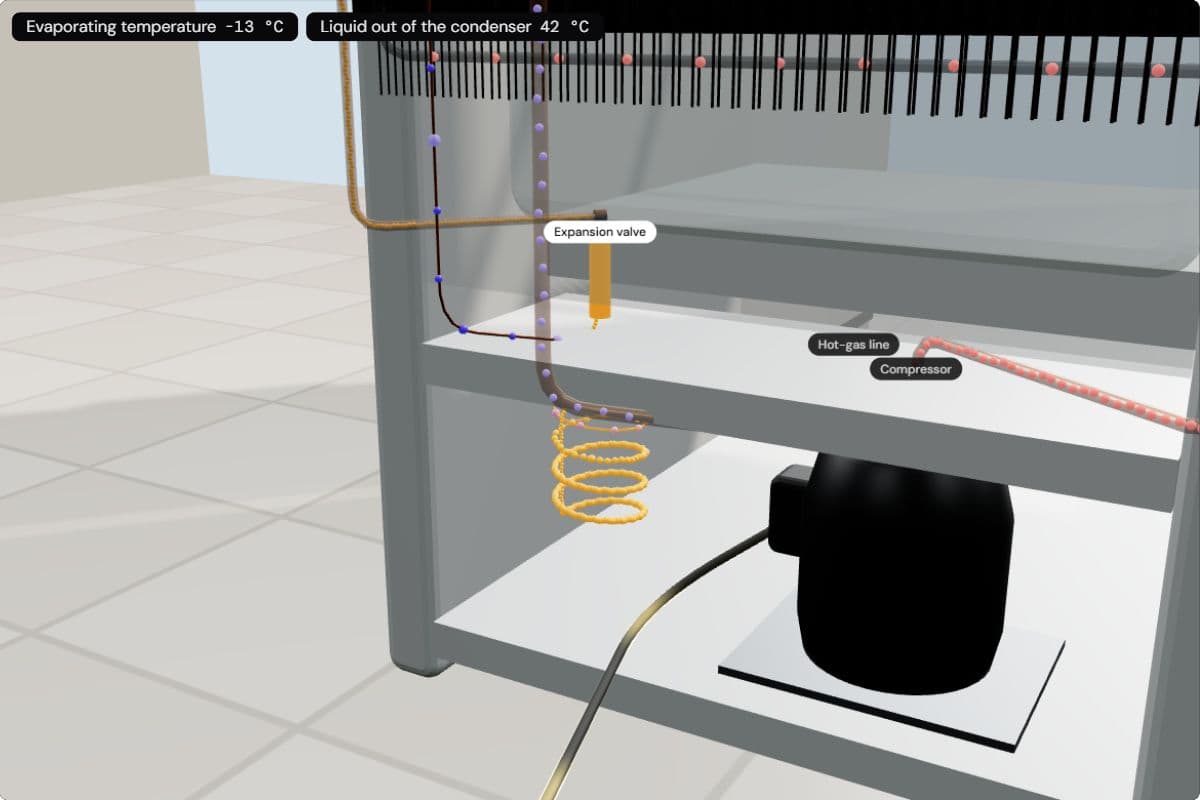
The warm liquid now has to get cold. It squeezes through a very thin, coiled tube, the capillary tube, which does the job an expansion valve does in a heat pump. Behind it the pressure drops. In the model about a third of the liquid boils off at once and takes the heat for that from the rest, which cools far below zero. The cold mixture flows back into the plate, and the loop starts again.
So one lap has four stages, the ones school books name: evaporate in the plate, compress in the compressor, condense in the grille, expand in the capillary tube. The refrigerant is never used up; it goes round and round in a sealed loop.
Step 10 of 12 · Try it
A hot kitchen makes the fridge work harder
The warmer the kitchen, the hotter the grille has to get to give its heat away, and the harder the compressor has to work. In the model, going from a 22 °C to a 30 °C kitchen raises the compressor's power from about 50 to about 54 W, while the heat it takes from inside falls from about 79 to about 70 W. More heat also leaks in through the walls. So the fridge runs about three quarters of the time instead of just under half, and its energy use almost doubles, from about 0.53 to about 0.96 kWh a day.
In a cool 15 °C room the same fridge needs only about a quarter of a kWh a day. Below about 6 °C room temperature, the model's fridge never starts at all: the inside never warms to the thermostat's switch-on point.
Step 11 of 12 · Try it
The thermostat switches the compressor on and off
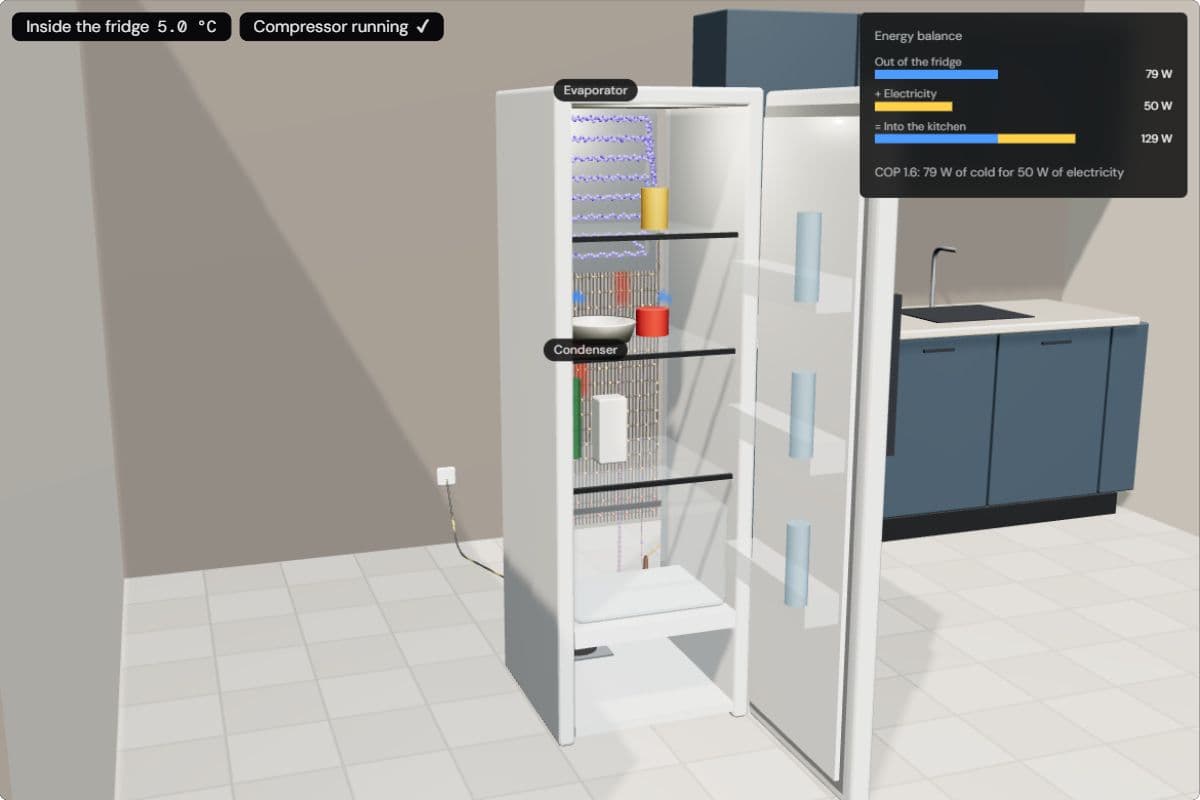
A fridge doesn't run all the time. A thermostat stops the compressor when the inside is cold enough and starts it again when it has warmed up. In the model it switches off at 3 °C and on at 6 °C. In a 22 °C kitchen it then runs for about 24 minutes and rests for about 29, almost half the time, and uses about 0.5 kWh a day, about 16 kWh a month. Real efficient fridges often run about a third of the time and use about 0.5 kWh a day too.
While the compressor rests, nothing moves: no electricity, no heat in, no heat out, and the two pressures in the loop slowly even out.
A fridge is a heat pump turned inside out
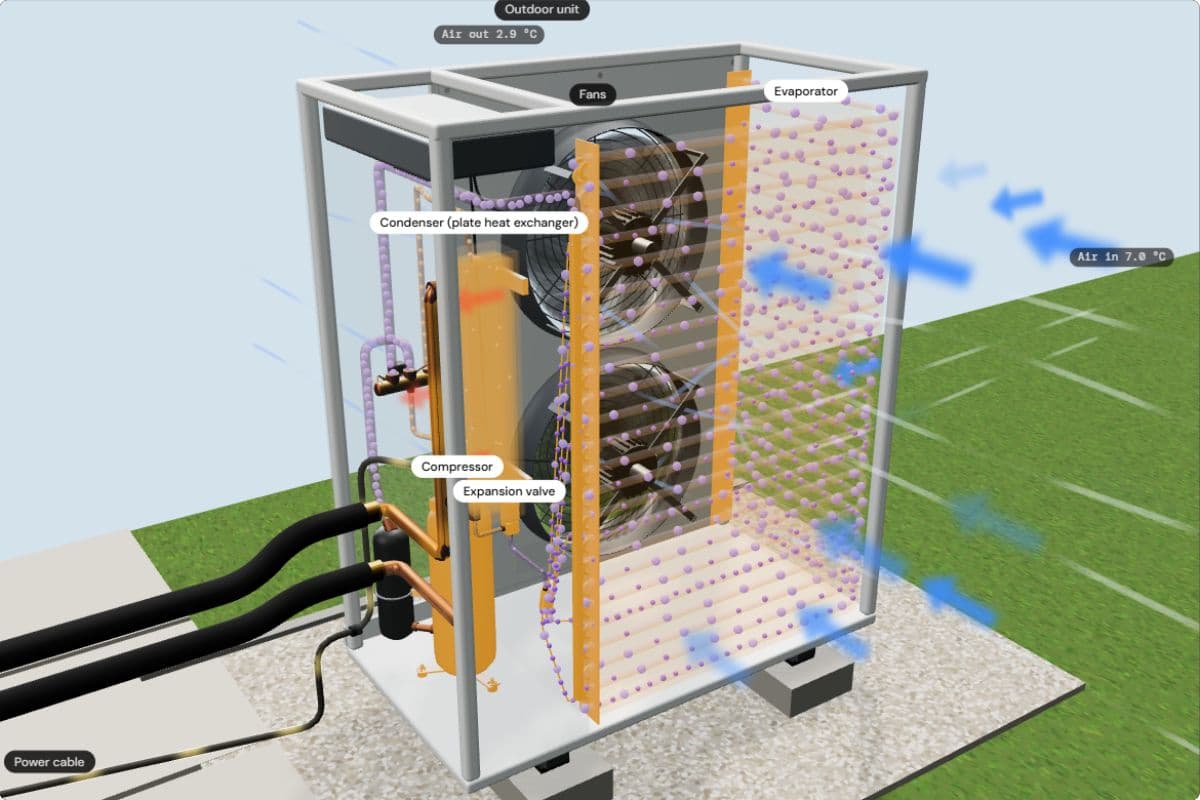
A heat pump for a house is the same machine. It has the same four parts on the same loop: an evaporator (in the heat pump, the finned coil behind the fans), a compressor, a condenser (a plate heat exchanger that warms the heating water) and an expansion valve where the fridge has its capillary tube. The fridge takes heat from its inside and gives it to the kitchen; the heat pump takes heat from the garden air and gives it to the house. A heat pump is a fridge whose inside is the garden.
Only the useful side differs. For a fridge it is the cold side, the heat taken from inside; for a heat pump it is the warm side, the heat given off. For the same cycle the warm side is always bigger by the electricity, so the heat pump's coefficient of performance is the fridge's plus one. An air conditioner is the same machine again, cooling a room and warming the outdoor air. How a heat pump heats a house, step by step, is the topic of the tour “How does a heat pump work?”.
Fridges without a compressor: absorption and thermoelectric
Gas fridges in caravans and campers, and many hotel minibars, work without a compressor. In an absorption fridge, ammonia is the refrigerant, water absorbs it and hydrogen helps it evaporate. Heat instead of a compressor drives the cycle: a gas flame, a 12 V heater or a mains heater. Such fridges are silent but use much more energy than a compressor fridge (Wikipedia; hea.de).
Small electric cool boxes often use a thermoelectric (Peltier) element: a current through a semiconductor pumps heat from one face to the other. It has no moving parts and no refrigerant, but it moves little heat for its electricity and can cool only a limited amount below the room temperature (Wikipedia).
What this model simplifies
The model uses propane (R290) as the refrigerant for the fridge too; real household fridges use isobutane (R600a). The pressures differ, the picture doesn't. The door is drawn open so you can look in, but it is not modelled: the inside warms and cools as if it were closed. The fridge has one compartment and no fan or defrost, the thermostat is fixed at 3 and 6 °C, and the refrigerant moves about ten times slower than in a real fridge so you can follow one lap.
FAQ
Frequently asked questions
- Does leaving the fridge door open cool the room?
- No, it warms it. The heat the fridge takes from the room at the front comes straight back out at the back, plus the electricity the compressor uses. In the model that is about 80 W out and 130 W back in.
- What refrigerant is in a fridge?
- Most fridges in Europe use isobutane (R600a), a hydrocarbon like the propane in the model. Many older fridges in the US use R-134a; the older R-12 was banned in the US in 1994 because it damages the ozone layer (Wikipedia).
- Why is the back of my fridge warm?
- The black grille at the back is the condenser, where the fridge gets rid of the heat it took from inside, plus the compressor's electricity. Real condensers run at about 40 to 50 °C, so the back feels warm and needs some air around it.
- How many hours a day does a fridge run?
- It depends on the room. The model's fridge runs almost half the time in a 22 °C kitchen, about 11 hours a day, and about three quarters of the time at 30 °C. Real efficient fridges often run about a third of the time.
- Will a fridge work in a cold garage?
- Not reliably. In the model, below about 6 °C room temperature the thermostat never starts the compressor, and the inside simply takes on the room's temperature. Check the allowed room temperature range on the fridge’s label.
- How does a propane (gas) fridge work?
- A gas fridge is an absorption fridge: heat from a flame or a heater drives a cycle of ammonia, water and hydrogen instead of a compressor. It is silent and runs without mains power, but uses much more energy than a compressor fridge.
Keep exploring
Not the question you had in mind?
More on Heat pump
- Question 1
How does a heat pump work?
Meet the four parts of a heat pump, ride along with the refrigerant and find out why 1.4 kW of electricity brings 7.4 kW of heat into the house.
15 steps · BeginnerStart - Question 2
How does a heat pump work in winter?
Drag the air down to −15 °C and watch the heat pump keep heating, find out why its output and COP fall, cover a cold house, watch the unit ice up and defrost, and switch to ground heat.
15 steps · BeginnerStart