Four-stroke engine · Question 3 of 5
What does a camshaft do?
A camshaft opens and closes an engine's valves. It is a shaft with egg-shaped lobes: as it turns, each lobe pushes a valve open, and a spring snaps it shut again. The crankshaft drives it through a timing belt or chain at exactly half its speed, so each valve opens once every two crank turns.
In this tour you turn the crank of a 3D engine by hand, watch the lobes push the valves and count how far the camshaft turns.
7 steps · Beginner · free, no account
Why the camshaft turns at half the crankshaft's speed
Because the timing belt joins the two shafts, it is easy to picture them spinning together, one turn for one turn. They don't. In every four-stroke engine the camshaft makes one turn while the crankshaft makes two, a ratio of 2:1.
The reason lies in the four strokes. Intake, compression, power and exhaust each move the piston once, up or down, so a full cycle takes the crankshaft round twice, through 720°. In that time each valve has to open exactly once: the intake valve to fill the cylinder, the exhaust valve to empty it. A lobe opens its valve once per turn of the camshaft, so one camshaft turn per cycle is exactly right. If the camshaft ran at crank speed, every valve would open a second time in the middle of compression or power, and the burning gas would escape.
The ratio is fixed by the teeth. In the engine of the tour the crank pulley has 18 teeth and each camshaft pulley 36. For every tooth the belt moves, the small pulley turns twice as far as the large ones. A two-stroke engine, which completes its cycle in one crank turn, works the other way: where it has a camshaft at all, it runs at crank speed, 1:1.
The tour, retold
Step by step
Step 2 of 7 · Try it
Lobes push the valves open
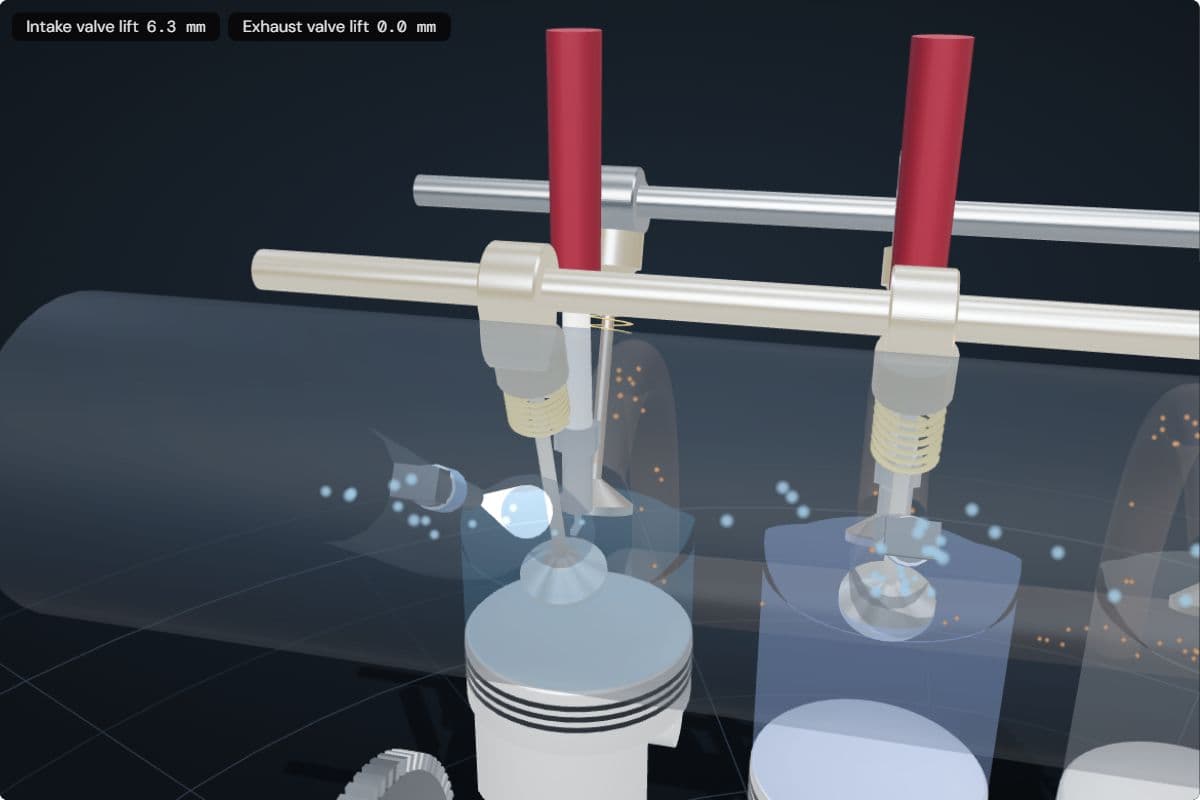
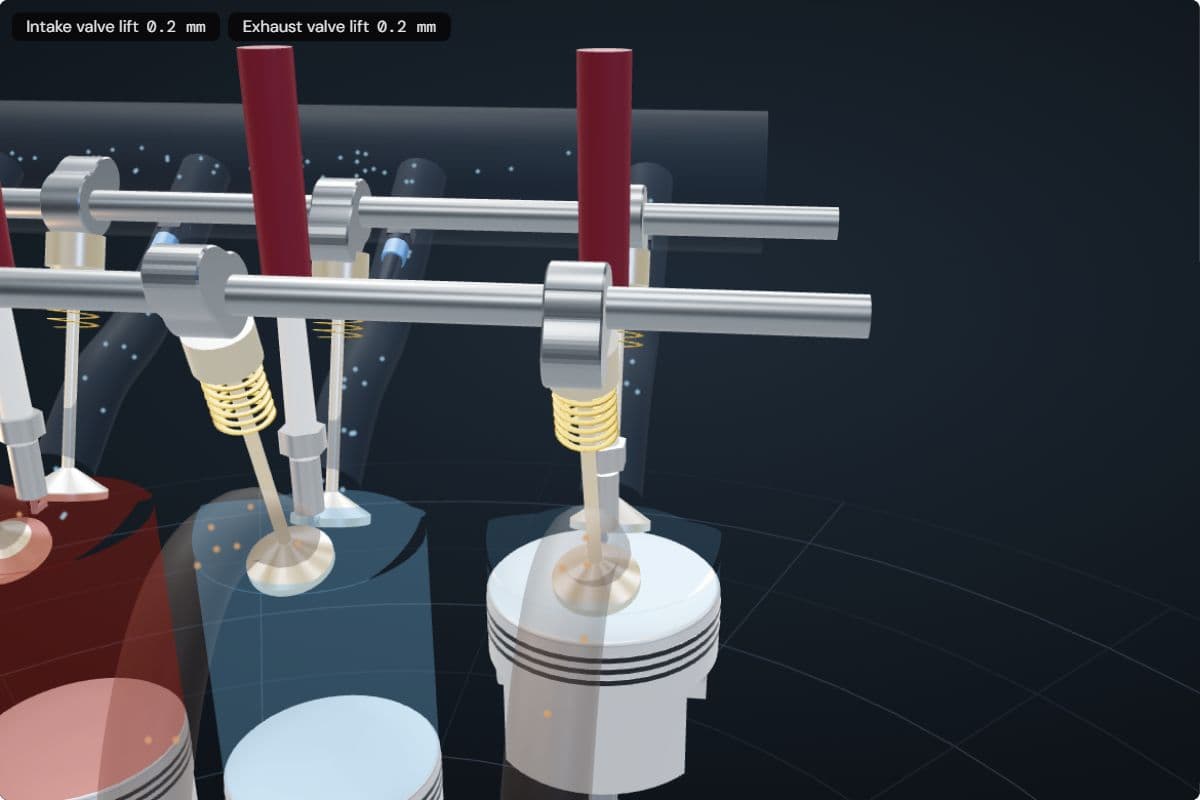
A camshaft is a straight steel shaft with one egg-shaped bump, a lobe or cam, above each valve. Most of each lobe is a perfect circle around the shaft, the base circle. Only the nose sticks out. While the base circle faces the valve, nothing happens. When the nose comes round, it presses on a cup-shaped bucket tappet sitting on top of the valve stem and pushes the valve down, away from its seat and into the cylinder. The tappet takes the sideways rub of the lobe so that the thin valve stem only moves straight.
How far the valve opens is set by the height of the nose. In the model the peak lift is 10 mm for both the intake and the exhaust valves, a typical figure for a petrol car engine. The shape of the flanks decides how quickly the valve opens and closes.
Step 3 of 7 · Predict
The timing belt keeps crank and camshaft in step
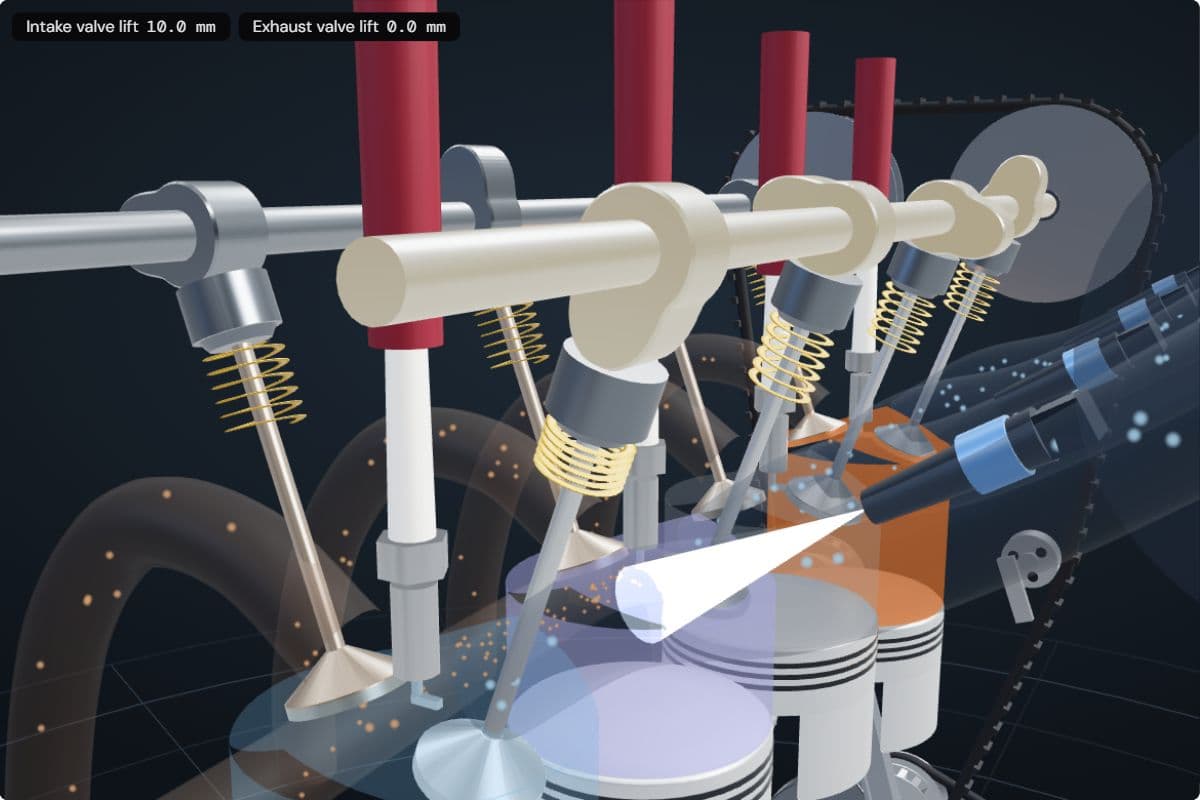
The crankshaft drives the camshafts. In the tour's engine a toothed rubber belt, the timing belt, runs from a small pulley on the front of the crankshaft up to a large pulley on each camshaft, and on the way it also turns the water pump. Because the belt has teeth, it cannot slip: every position of the pistons belongs to exactly one position of the lobes.
One full turn of the crank in the tour brings cylinder 1's piston back to where it started. Over the same turn, its intake lobe goes only half way round: from pointing straight down at the tappet to pointing straight up, away from it. That is the 2:1 ratio made visible.
Step 4 of 7 · Explain
A spring closes them again
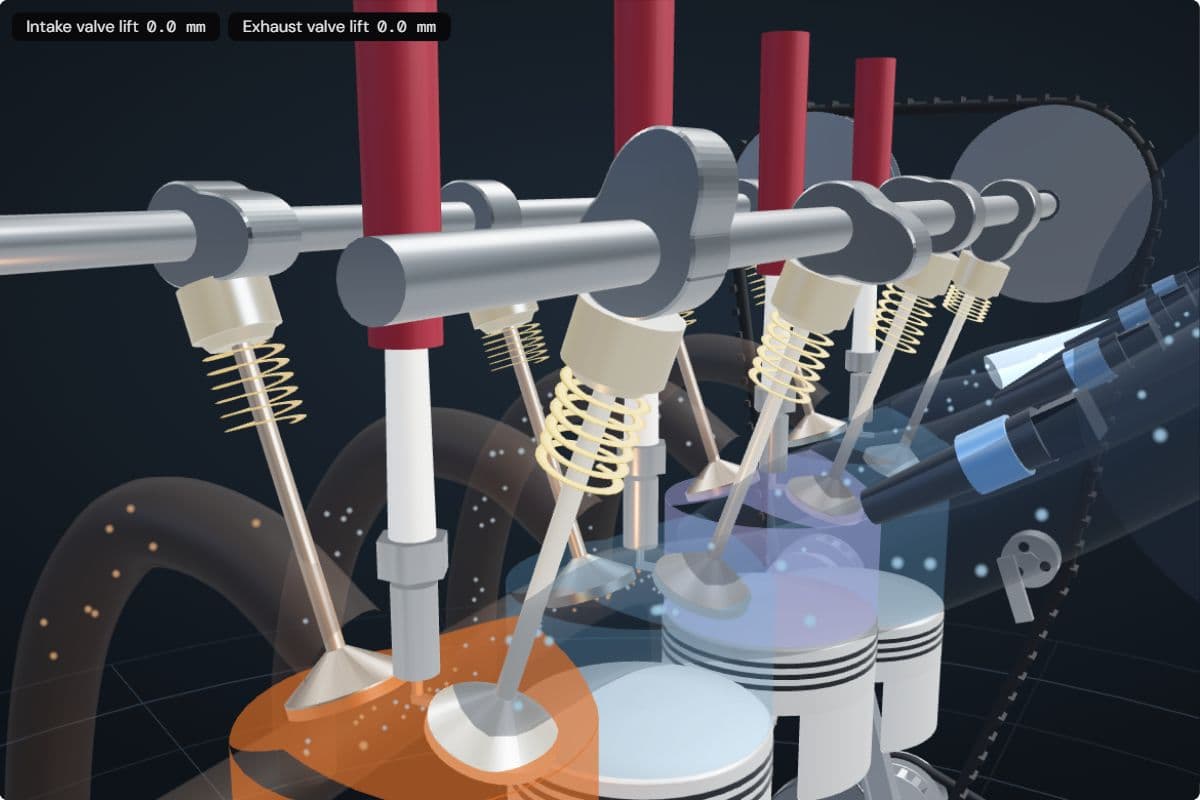
The camshaft can only push, never pull. Closing is the job of the valve spring, a steel coil around the stem. As the lobe pushes the valve open, the spring gets squeezed; as the nose turns away, the spring pushes the valve back up onto its seat and holds it shut against the pressure in the cylinder. At high rpm the spring has to be stiff enough for the valve to follow the lobe instead of floating off it.
In the model each valve stays open for 240° of crank rotation, two thirds of a crank turn, which is only 120° of camshaft rotation. Between the intake closing (50° after BDC) and the exhaust opening (50° before BDC), about 260° of crank rotation, both valves are shut, so the mixture can be compressed and burnt without leaking out.
Halfway
See it for yourself in 3D
Reading is one thing. In the tour you change it yourself and watch what happens, step by step.
Start the 3D tourStep 5 of 7 · Try it
Each valve opens once per cycle
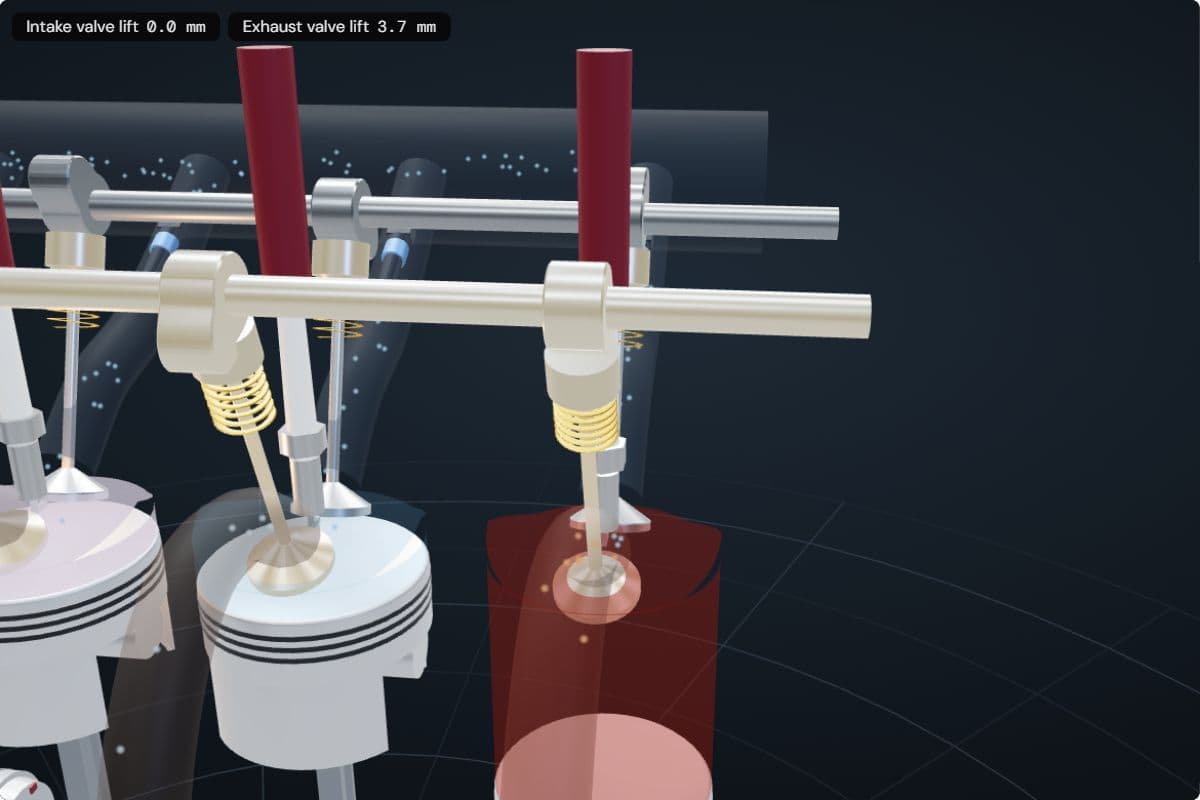
Following one cylinder through a whole cycle shows why half speed is enough. Cylinder 1's intake valve opens during the crank's first turn, while the piston moves down and draws in fresh mixture. Then come compression and the power stroke with both valves shut. Only in the crank's second turn, near the end of the power stroke and just before the piston starts back up to push out the burnt gas, does the exhaust lobe reach its valve.
Over the 720° of the cycle each valve has opened once and each lobe has gone round once. The other three cylinders do the same, a quarter of a camshaft turn apart: the four lobes on each shaft point 90° away from each other, which spaces the firing strokes evenly, and their order around the shaft sets the firing order 1-3-4-2.
Step 6 of 7 · Explain
Valve timing and valve overlap
The exact moments when the valves open and close are the valve timing, and the lobes fix them. They are given in degrees of crank rotation before or after the piston's top and bottom positions, top dead centre (TDC) and bottom dead centre (BDC). In the engine of the tour the intake valve opens 10° before TDC and closes 50° after BDC. The exhaust valve opens 50° before BDC and closes 10° after TDC.
Neither valve opens exactly at a dead centre. The exhaust opens early, while the gas still pushes, so much of it rushes out by itself. The intake closes late because the incoming mixture keeps flowing for a moment after the piston has turned round. Around TDC between exhaust and intake, the two windows overlap: for 20° both valves are open a crack, 0.2 mm each in the model at TDC. The outgoing exhaust pulls the fresh charge in behind it. This valve overlap is small in a car engine and much larger in a racing engine.
Camshaft vs crankshaft: the difference
Both are long shafts that turn inside the engine, and their names sound alike, but they do opposite jobs. The crankshaft sits at the bottom of the engine block. The connecting rods push on its offset crank pins and turn the up-and-down motion of the pistons into rotation; it delivers the engine's power to the gearbox. The camshaft sits up in the cylinder head (or, in older designs, in the block) and does no work on the car. It only takes a little power from the crankshaft to open the valves at the right moments.
Their motion is linked but not equal. The crankshaft is the driver, the camshaft the driven one, through a belt, a chain or gears, at half the speed. A crankshaft carries crank pins and counterweights; a camshaft carries lobes. Both are watched by sensors: the engine computer compares the camshaft and crankshaft position signals to know which cylinder is on its compression stroke and when to fire the spark plug and the injector.
SOHC, DOHC and pushrod engines
Where the camshaft sits gives engine designs their names. The engine in the tour is DOHC, double overhead camshaft: two camshafts in the cylinder head, one for the intake valves and one for the exhaust valves, each pressing straight down on bucket tappets. That is the most common layout in today's car engines, usually with two intake and two exhaust valves per cylinder; the model keeps it to one of each.
An SOHC engine, single overhead camshaft, has one camshaft in the head for both rows of valves. It often reaches them through rocker arms, little levers that pivot between the lobe and the valve. In an OHV or pushrod engine the camshaft sits low in the block next to the crankshaft. Long pushrods carry each lobe's motion up to rocker arms on the head. Pushrod engines are compact and simple, which is why many large American V8s still use them, but the extra moving parts limit how fast they can rev.
Timing belt, chain or gears, and why the timing matters
Three things can carry the drive from crank to camshaft. A toothed rubber belt is quiet, light and cheap, but it wears and has to be replaced at the interval the carmaker sets, often somewhere between about 60,000 and 160,000 km. A steel timing chain runs in oil and is meant to last the engine's life, though chains and their tensioners can stretch and rattle. Gears are used where the camshaft sits close to the crankshaft, as in pushrod engines and many trucks.
In many engines a broken belt does more than stop the car. In an interference engine, a fully open valve reaches into space that the piston fills at the top of its stroke; only the timing keeps the two apart. If the belt snaps, the camshafts stop with some valves open while the crankshaft keeps spinning, and the pistons smash into them: bent valves, damaged pistons, often a new cylinder head. That is why the belt's replacement interval matters, and why the timing marks have to line up exactly when a new belt goes on.
Lift, duration and variable valve timing
Two numbers describe a lobe. Lift is how far it opens the valve, duration is how long it holds the valve open, in degrees of crank rotation. More lift and longer duration let more air in at high rpm, where each stroke lasts only a few thousandths of a second. That is why sports and racing engines use 'hot' camshafts. At low rpm the same long overlap lets fresh mixture slip straight out into the exhaust, so such engines idle roughly and pull weakly at low speed.
A fixed camshaft is always a compromise between low and high rpm. Variable valve timing gets around it: an oil-pressure actuator on the camshaft pulley turns the camshaft against its pulley, by up to several tens of crank degrees, while the engine runs. That shifts when the valves open and close without changing the 2:1 ratio. Some systems also switch between two lobe profiles or vary the lift.
Signs of a worn camshaft
Camshaft lobes and tappets slide against each other under the full force of the valve springs, so they depend on clean oil. When a lobe wears down, its valve opens less than it should. Typical signs are a ticking or tapping noise from the top of the engine, a rough idle, misfires, less power, higher fuel use, and a check-engine light, often with a camshaft position or timing fault code. A faulty camshaft position sensor can give similar symptoms. A worn camshaft is a job for a workshop: it usually means replacing the camshaft together with its tappets.
FAQ
Frequently asked questions
- How fast does a camshaft spin?
- At exactly half the speed of the crankshaft in a four-stroke engine. With the crankshaft at 3,000 rpm, the camshaft turns at 1,500 rpm, and each valve opens 1,500 times a minute. At an idle of about 850 rpm the camshaft turns at about 425 rpm.
- Can you drive with a bad camshaft?
- For a short while, often yes, but not safely for long. A worn lobe opens its valve too little, so the engine runs rough and loses power, and the metal particles from the wear spread through the oil. If the camshaft or its drive fails completely, the engine stops, and in an interference engine the valves can hit the pistons. Have it checked as soon as you notice ticking or misfires.
- What's the difference between a cam and a camshaft?
- A cam is one lobe: the egg-shaped bump that pushes one valve open. The camshaft is the whole shaft that carries all the cams. A four-cylinder engine with two valves per cylinder and two camshafts has four cams on each shaft.
- What is camshaft duration?
- Duration is how long a lobe holds its valve open, measured in degrees of crank rotation. In the tour's engine each valve is open for 240°, from the first bit of lift until it closes again; this is called advertised duration. Camshaft makers often quote duration at 0.050 in (1.27 mm) of lift instead, which leaves out the gentle start and end of the lift and gives smaller numbers.
- What happens if the timing belt breaks?
- The camshafts stop turning and the engine dies at once. In a free-running engine there is no further damage, and a new belt gets it going again. In an interference engine, the pistons hit the valves that the stopped camshaft left open, which bends valves and can damage pistons and the cylinder head. Replacing the belt on schedule is far cheaper.
Keep exploring
Not the question you had in mind?
More on Four-stroke engine
- Question 1
How does a four-stroke engine work?
Follow one cylinder through intake, compression, power and exhaust, and find out why it takes four strokes.
9 steps · BeginnerStart - Question 2
What does a throttle do?
Open the throttle and see what changes: how much air gets in, the pressure in the cylinder, and the engine speed.
6 steps · BeginnerStart - Question 3
What does a spark plug do?
Turn a 3D engine by hand, find the moment its spark plug fires and see why it fires before the piston reaches the top.
7 steps · BeginnerStart