Four-stroke engine · Question 4 of 5
What does a spark plug do?
A spark plug lights the fuel in a petrol engine. The ignition coil sends it up to 40,000 volts, and a spark jumps the 1 mm gap between its electrodes. It fires once per cycle, just before the piston reaches the top, when the air-fuel mixture is squeezed tight, and the burning gas pushes the piston down.
In this tour you turn the crank of a 3D engine by hand, guess when the plug fires and watch the pressure it sets off.
7 steps · Beginner · free, no account
How a spark plug makes its spark
A spark plug does not make electricity. The car's battery supplies only 12 volts, far too little to jump through air. The ignition coil, one per plug in most modern engines, turns that into a short pulse of 10,000 to 40,000 volts and sends it down the plug's centre electrode at the moment the engine computer orders.
The plug's job is to give that pulse a safe path and a gap to jump. A tube of ceramic insulates the centre electrode from the metal body, which is screwed into the cylinder head and so is connected to the engine's ground. At the tip, the centre electrode ends a short distance from the ground electrode, a small hook welded to the body: about 1 mm in most car engines, anywhere from 0.6 to 1.8 mm depending on the engine. The voltage builds until the gas in the gap breaks down and conducts, and a spark jumps across.
The spark is over in an instant, but it heats a tiny ball of mixture so far that it starts to burn by itself. From this flame kernel a flame front spreads through the whole combustion chamber. The plug only lights the fire; the burning fuel does the work.
The tour, retold
Step by step
Step 1 of 7 · Explain
One spark plug in the roof of every cylinder
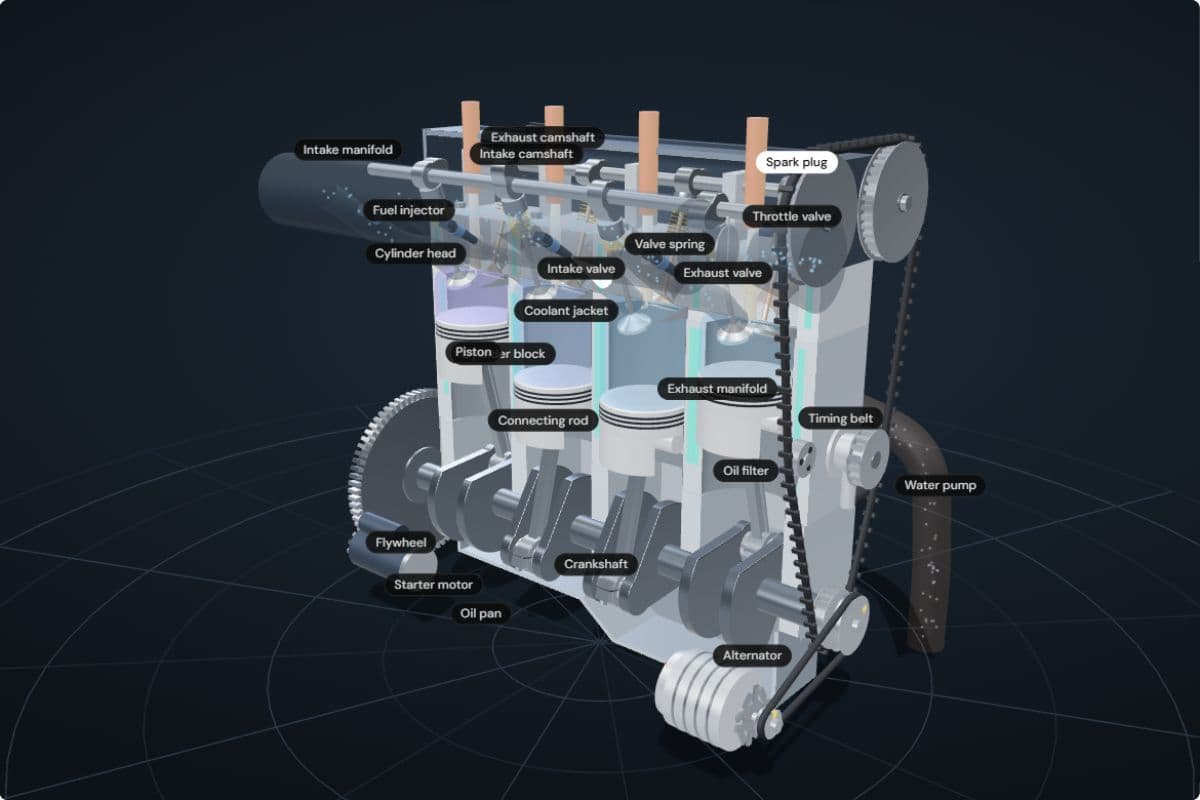
A petrol engine has one spark plug per cylinder, so an inline-four like the one in the tour has four. Each is screwed into the cylinder head from above and sits in the roof of the combustion chamber, between the intake and exhaust valves. Only its tip reaches into the chamber, right where the mixture is squeezed together at the end of the compression stroke.
What you see of a plug from outside is the long ceramic body and the boot on top, red in the model. The boot connects it to the ignition coil and keeps the high voltage from arcing to the cylinder head on the outside.
Step 4 of 7 · Try it
The spark comes at the end of the compression stroke
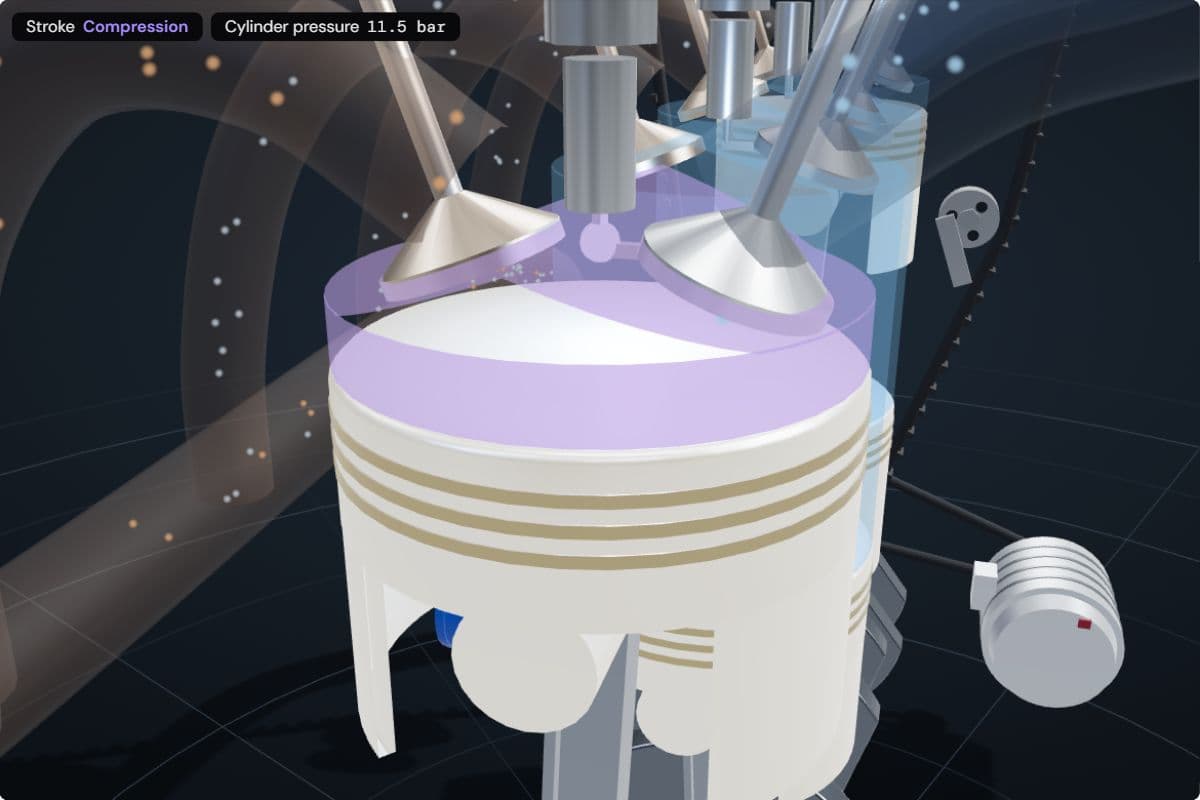
A common idea is that the plug fires when the piston is at the bottom, with the cylinder full of fresh mixture, or that the spark is what throws the piston down from wherever it is. Neither works. At the bottom the mixture is loose, at about the pressure of the outside air, and the piston is about to rise: lit then, the flame would push against the rising piston and the energy would be wasted.
Instead the plug fires near the end of the compression stroke, just before the piston reaches the top, top dead centre (TDC). In the model this happens at 350° of the 720° cycle, 10° before TDC. By then the rising piston has squeezed the mixture from 452 cm³ into 54 cm³, and the pressure has climbed from 0.7 bar to 11.5 bar. Tightly packed and hot from the squeeze, the mixture burns fast and completely.
Halfway
See it for yourself in 3D
Reading is one thing. In the tour you change it yourself and watch what happens, step by step.
Start the 3D tourStep 5 of 7 · Explain
The pressure peaks just after the top, so the spark comes early
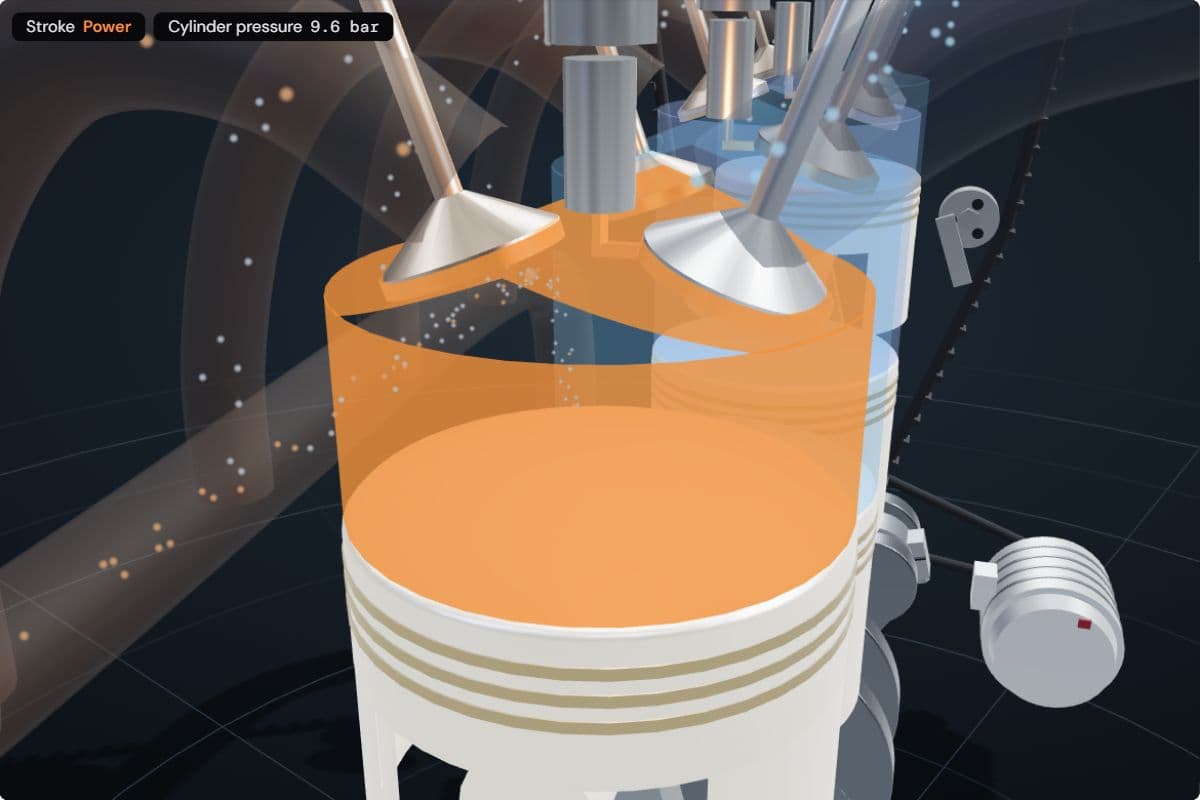
A spark is not an explosion. The flame needs time to spread from the plug to the far side of the chamber, and the pressure keeps rising while it does. In the model it peaks at 25.8 bar at about 381°, roughly 30° after the spark and 20° after TDC. By then the piston has turned round and is starting down, so the gas pushes it in the direction it is moving, which turns the most pressure into work. In the model's numbers, the same squeeze without any spark would only reach 12.7 bar at TDC.
That is why the plug has to fire before the top: the head start puts the peak in the right place. The faster the engine turns, the more crank degrees the same burn takes, so real engines move the spark earlier as rpm rises. The flame also speeds up at high rpm, because the mixture swirls harder, so the advance doesn't keep growing: it ends up at about 30° before TDC. The model keeps it fixed at 10°.
Step 6 of 7 · Explain
Four plugs take turns: firing order 1-3-4-2
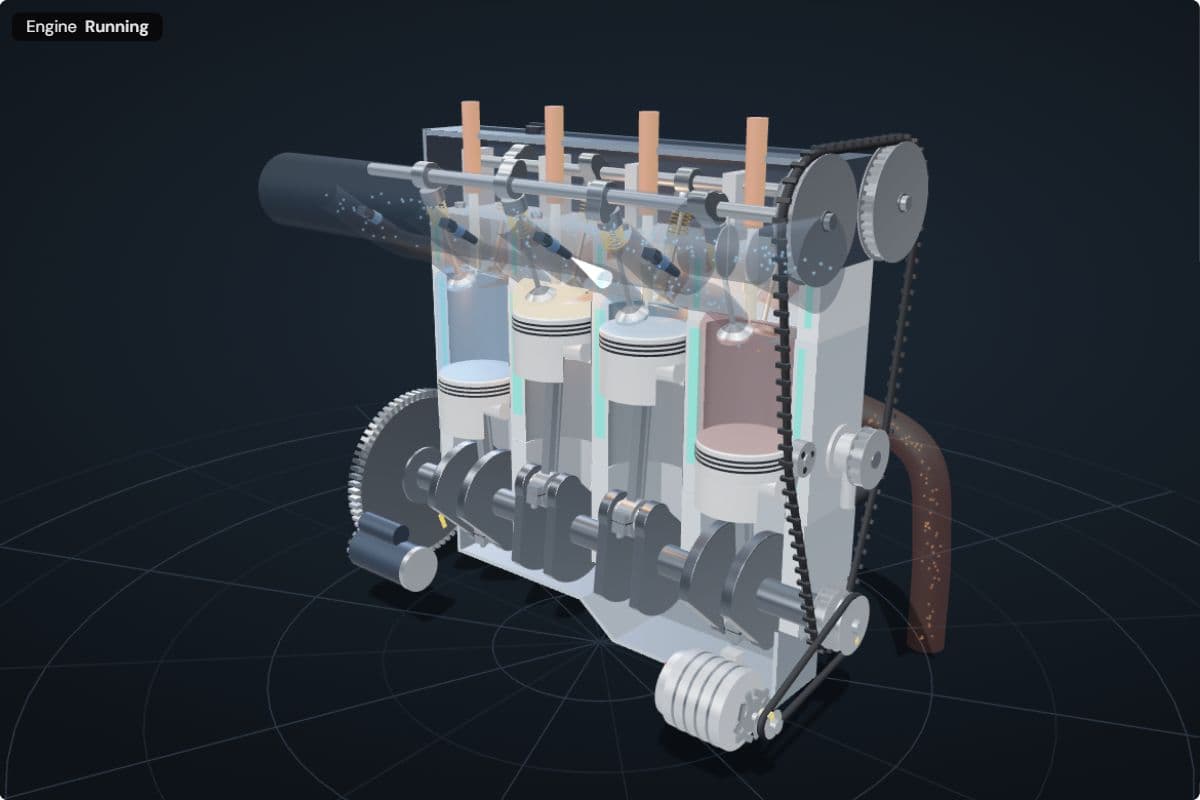
Each plug fires once per cycle, and a cycle takes two turns of the crankshaft. The four cylinders are spaced a quarter of a cycle apart, so a spark comes every half turn, 180°, and one cylinder is always in its power stroke. In the tour's engine the order is 1, 3, 4, 2, the most common firing order for an inline-four.
That makes two sparks per crank turn. At an idle of about 850 rpm each plug fires 425 times a minute, and the engine 1,700 times. In the model, cylinder 1 is the one at the flywheel end. On most real inline engines it is the other way round: cylinder 1 sits at the end with the timing belt or chain, opposite the flywheel, and the count goes from there.
Ignition timing: why the spark moves
The moment of the spark is the ignition timing, given in degrees of crank rotation before TDC. Real petrol engines fire somewhere between about 10° before TDC at idle and about 30° at high rpm. Load matters too: with the throttle wide open the cylinder is fuller, the mixture burns faster and the engine is closer to knocking, so it needs less advance than when cruising on light throttle.
Get it wrong and the engine notices. Fire too early and the pressure rises while the piston is still coming up; the unburnt rest of the mixture can then explode on its own, which you hear as a metallic pinging or knock and which can damage pistons. Fire too late and the peak comes when the piston is already far down: the engine loses power, uses more fuel and the exhaust runs hot. Older engines set the timing with a distributor; today the engine computer works it out for every spark from rpm, load and temperature, and knock sensors on the block let it pull the timing back the moment knocking starts.
Inside a spark plug
A spark plug is built in layers around the centre electrode. At the top is the terminal, where the coil or its boot clips on. Below it, the white ceramic insulator, usually aluminium oxide, holds the centre electrode and keeps tens of thousands of volts from leaking to the body; the ribs on its outside lengthen the path along the surface so the current can't creep over it. Many plugs have a resistor inside the insulator that damps radio interference from the spark.
The metal shell holds everything together. Its hexagon takes the spark plug wrench, its thread screws into the cylinder head, and a sealing ring or a tapered seat keeps the combustion gas in. At the bottom, the ground electrode bends over towards the end of the centre electrode, leaving the gap the spark jumps. The plug also has to carry heat away from its tip into the cylinder head, which is where heat range comes in.
Heat range: hot enough to clean itself, cool enough not to glow
The insulator tip sits in the fire, so its temperature matters. Below about 450 °C, soot and oil deposits don't burn off and build up on the tip until they form a conducting path, and the spark leaks away instead of jumping the gap: the plug fouls. Above about 850 °C, the tip itself gets hot enough to light the mixture before the spark does. That glow ignition, or pre-ignition, comes too early and can melt electrodes and pistons. A plug should run between these two limits.
How hot a plug runs is its heat range. A hot plug has a long insulator nose that takes a long path to shed heat, so it stays hot and cleans itself, which suits engines that run cool and slow. A cold plug has a short nose that passes heat quickly to the head, which suits engines that run hot under high load, such as turbocharged ones. Makers number heat ranges differently, so the right plug is the one the engine maker specifies.
Copper, platinum or iridium, and when to change them
Every spark wears away a little electrode metal, so the gap slowly grows and the coil needs more voltage to jump it. Plain plugs with a nickel-alloy electrode around a copper core are cheap and conduct heat well but wear fastest: they are usually changed every 30,000 to 50,000 km (about 20,000 to 30,000 miles). Plugs with a thin platinum or iridium tip on the centre electrode resist wear far better and last about 100,000 km (60,000 miles) and more; many modern engines come with them from the factory.
These figures are typical ranges, not rules. The interval that counts is the one in the car's service schedule, and it is worth fitting the plug type the maker specifies, because a different gap or heat range can make the engine run worse.
Signs of a worn spark plug
A worn or fouled plug sparks weakly or not every time. The cylinder it serves then misfires: the engine shakes or idles roughly, hesitates when you accelerate, starts badly, especially in the cold, and uses more fuel because unburnt mixture goes out of the exhaust. The check-engine light often comes on with a misfire code for that cylinder, and the unburnt fuel can overheat the catalytic converter.
A mechanic can read a lot from the plug's face: light grey-brown deposits mean it is running right, black soot points to a rich mixture or a plug that runs too cold, and white, blistered or melted tips to overheating.
FAQ
Frequently asked questions
- Why doesn't a diesel engine need spark plugs?
- A diesel lights its fuel by compression alone. It squeezes plain air far harder than a petrol engine, at a compression ratio of about 15:1 to 23:1 instead of around 10:1, which heats the air to several hundred degrees. Diesel injected into that hot air ignites by itself, so no spark is needed. Diesels do have glow plugs, but these only preheat the chamber to help cold starts; they don't time the combustion.
- Can a car run without spark plugs?
- A petrol engine can't: without a spark the mixture never burns. If one plug fails, its cylinder stops working while the others carry on, and the engine runs roughly with a misfire and less power. Driving on for long like that can damage the catalytic converter. Diesel engines have no spark plugs at all.
- When does a spark plug fire?
- Near the end of the compression stroke, just before the piston reaches the top: in real petrol engines about 10° to 30° of crank rotation before top dead centre, earlier at higher rpm. In the 3D engine of the tour it fires at 10° before top dead centre, and the pressure peaks about 20° after it.
- What is the firing order of a 4-cylinder engine?
- Most inline-four engines fire in the order 1-3-4-2; some use 1-2-4-3. Either way one cylinder fires every half turn of the crankshaft. Cylinder 1 is usually the one at the timing-belt or chain end, opposite the flywheel, but check the manual or the markings for your engine before you work on it.
- How do I know if my spark plugs need changing?
- Look at the mileage first: the service schedule gives the interval, typically 30,000 to 50,000 km (20,000 to 30,000 miles) for copper plugs and about 100,000 km (60,000 miles) or more for platinum and iridium. Signs that they are due earlier are a rough idle, misfires, hesitation when accelerating, hard starting, higher fuel use and a check-engine light.
- How many volts does a spark plug need?
- Typically 10,000 to 40,000 volts, depending on the gap, the pressure in the cylinder and how worn the plug is. The plug doesn't produce this voltage. The ignition coil turns the battery's 12 volts into a short high-voltage pulse, and the plug only gives it a gap to jump.
Keep exploring
Not the question you had in mind?
More on Four-stroke engine
- Question 1
How does a four-stroke engine work?
Follow one cylinder through intake, compression, power and exhaust, and find out why it takes four strokes.
9 steps · BeginnerStart - Question 2
What does a throttle do?
Open the throttle and see what changes: how much air gets in, the pressure in the cylinder, and the engine speed.
6 steps · BeginnerStart - Question 3
What does a camshaft do?
Turn the crank by hand and watch the camshaft's lobes open each valve, then find out why it turns at only half the crankshaft's speed.
7 steps · BeginnerStart