Physics of flight · Question 1 of 7
How do planes fly?
A plane flies because its wings push the air they pass through downwards, and the air pushes the wings up: that's lift. In cruise it exactly balances the weight, about 64 tonnes for an A320. The engines don't lift anything: they push forward with about a sixteenth of that force, to keep the speed the wings need.
In this tour you fly an A320 in 3D, cut its wing open, watch the air flow around it, change the angle and the speed, and find out what happens when the engines stop.
8 steps · Beginner · free, no account
The engines don't push a plane up
Many people picture the engines doing the hard work: they are loud, they roar at takeoff, and without them a plane surely drops out of the sky. It is an easy belief to hold, because the engines are the only part of a plane that visibly does anything.
The numbers say otherwise. An A320 in cruise at 11 km weighs about 64 tonnes, so gravity pulls it down with about 628 kN. Its two engines together push with about 40 kN, and they push forward, not up. That is about a sixteenth of the weight. The force that carries the plane comes from the wings, and the engines only keep up the speed the wings need. Balloons and airships float because they are lighter than the air around them; an airliner is far heavier than the air it displaces and has to make its lift by moving.
The tour, retold
Step by step
Step 7 of 8 · Predict
Four forces in balance: lift = weight, thrust = drag
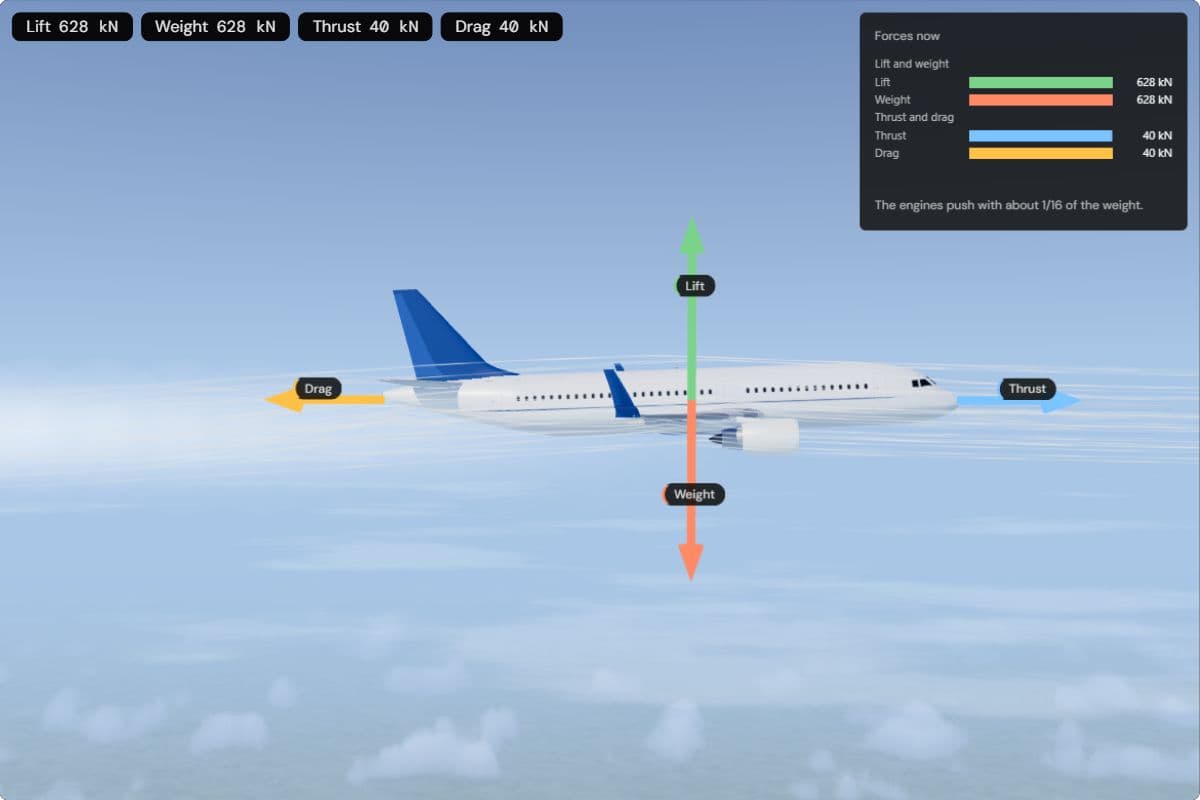
Four forces act on a plane in flight. Weight pulls it down. Lift, from the wings, acts at right angles to the oncoming air, so in level flight it points up. Thrust from the engines pushes it forward, and drag, the resistance of the air, holds it back.
In steady cruise these forces cancel in pairs. In the model of an A320 at 11 km and Mach 0.78, lift and weight are both 628 kN, thrust and drag both 40 kN. Up there the air has a density of only 0.36 kg/m³, under a third of the 1.225 kg/m³ at sea level, and the plane still gets enough lift from it because it moves at about 830 km/h. Gravity is not noticeably weaker at 11 km: a plane in cruise is not floating, it is being held up all the time.
Step 4 of 8 · Explain
The air over the top doesn't wait for the air below
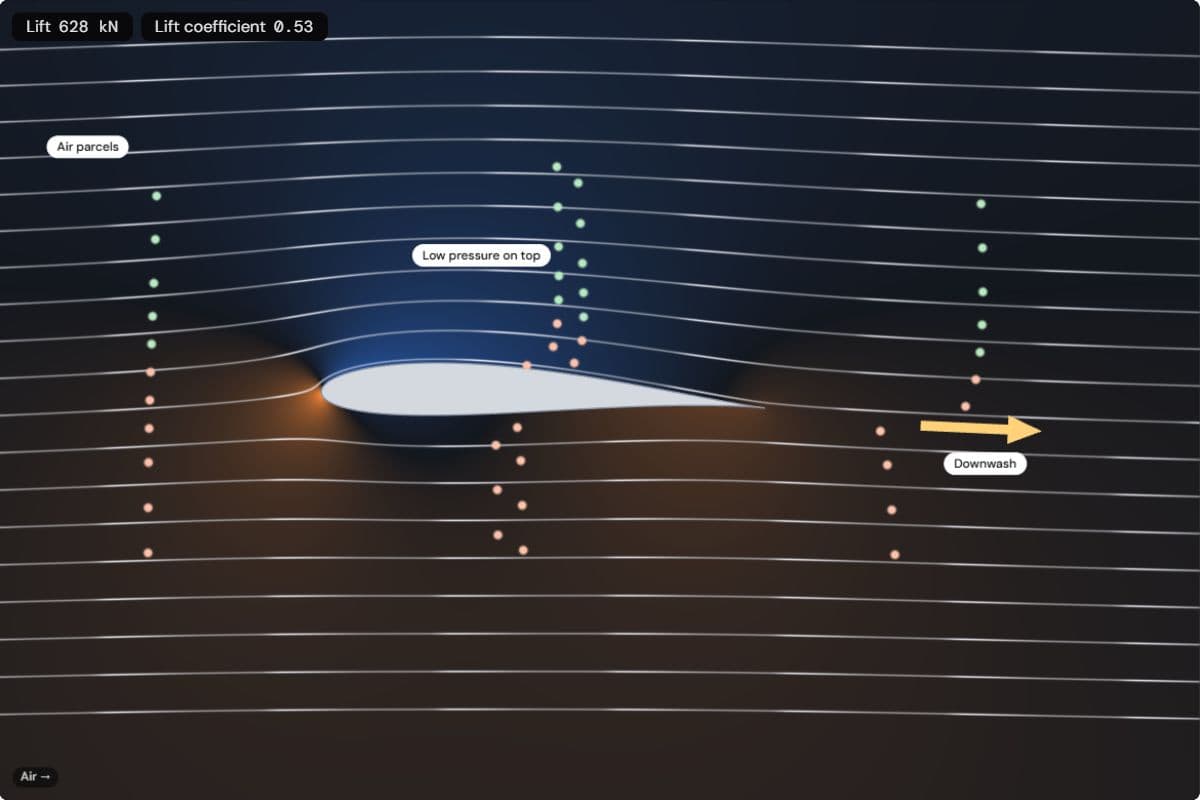
A popular explanation of lift goes like this: the top of the wing is curved, so the air over it has a longer way to go. To meet the air from underneath again at the back edge, it has to move faster, and faster air means lower pressure. It is widely repeated, and it is wrong.
Nothing makes the two halves of the air meet again. Release markers side by side in front of a wing, as smoke pulses in wind tunnel experiments do, and the ones that go over the top reach the trailing edge first, clearly ahead of the ones underneath. The air on top really is faster, but not because of any appointment at the back: the wing, tilted a little and curved, bends the whole flow around it and lowers the pressure above itself, and that low pressure pulls the air over the top. The speed difference the equal-transit story predicts would also be far too small to carry a plane.
Step 5 of 8 · Try it
The wing turns the air downwards
Look at the air behind a wing and it no longer flows straight: it leaves heading slightly downwards. This is the downwash. To turn a stream of air downwards, the wing has to push on it, and by Newton's third law the air pushes back on the wing, upwards.
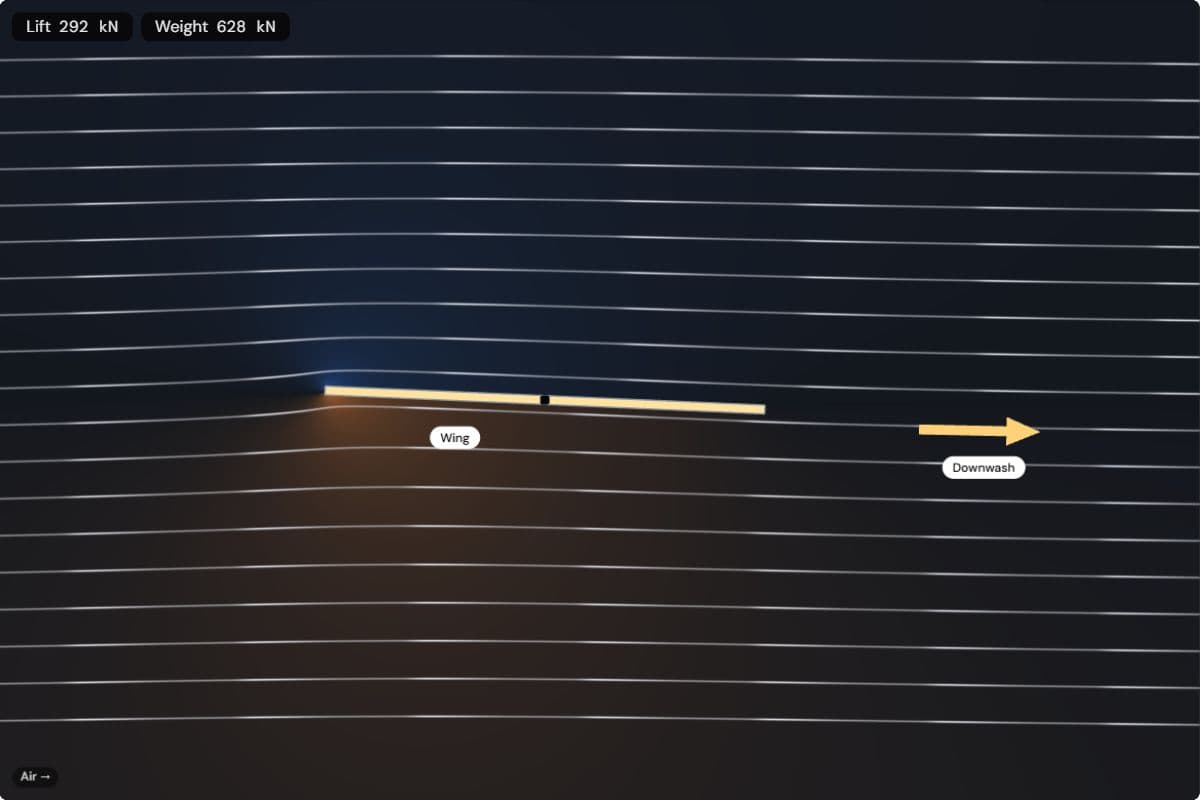
The same flow, described as pressure, gives the same answer. Above the wing the pressure drops, below it is slightly higher, and that difference over 123 m² of wing is the lift. Most of it comes from the suction on top, not from the air hitting the underside. The curved shape helps, but it is not the secret: even a flat board turns the air down once it is tilted, and so it lifts as well.
Halfway
See it for yourself in 3D
Reading is one thing. In the tour you change it yourself and watch what happens, step by step.
Start the 3D tourStep 6 of 8 · Try it
Angle and speed decide how much lift
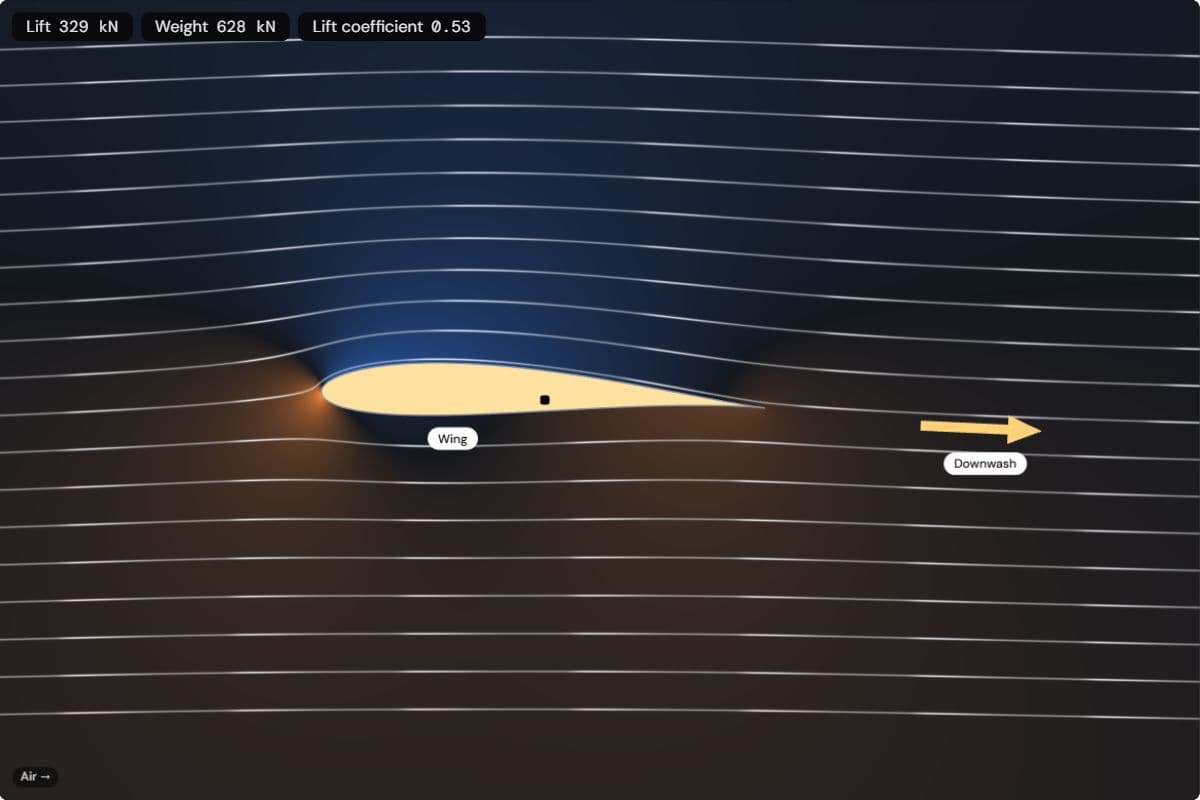
Lift grows with the density of the air, the wing area, the square of the speed and the angle at which the wing meets the air (the angle of attack). Engineers write it as L = ½ ρ v² S C_L, where the lift coefficient C_L rises by roughly 0.09 for every degree of angle.
In the model, a flat plate at 3 km and 500 km/h gives no lift at 0°, 292 kN at 3°, and carries the whole 628 kN from about 6.5°. The curved airliner wing in the same air already lifts 269 kN at 0° and carries the plane at under 4°. Speed counts twice: back at 11 km but at 600 km/h instead of 830, the wing at 3.1° makes only 329 kN, about half, and needs about 8.5° to carry the plane again. That is why slow planes fly nose up. There is a limit: at too steep an angle the air can no longer follow the top of the wing, and the lift breaks down. That is a stall, and it has nothing to do with the engines.
Step 8 of 8 · Quiz
Without engines a plane glides
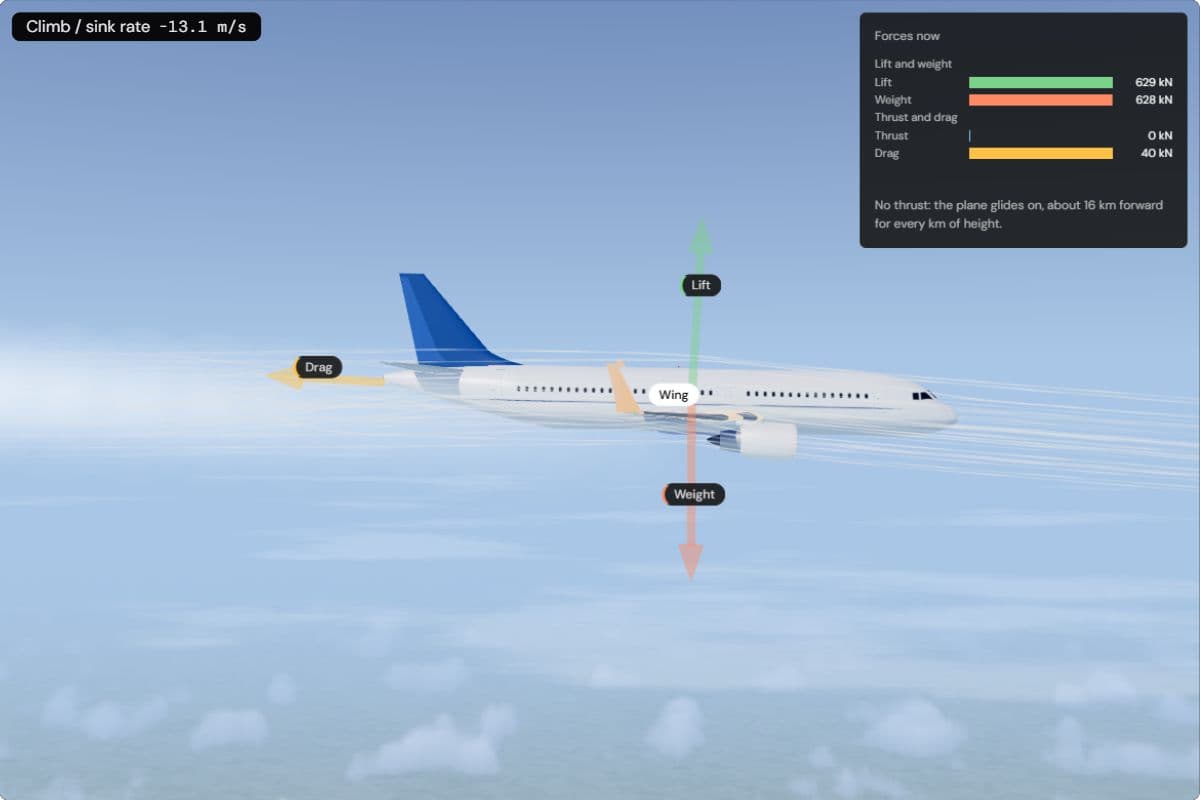
If both engines stop, the wings keep making lift as long as the plane moves through the air. What changes is who keeps it moving: instead of the engines, gravity does, along a slightly sloping path. The plane becomes a glider.
An airliner glides about 16 to 18 km forward for every km of height it loses, its glide ratio. In the model the A320 at first sinks about 13 m/s, and from 11 km it glides almost 190 km before it reaches the ground. An engine failure is a problem pilots train to manage, not a fall.
Bernoulli or Newton? Two views of the same flow
Explanations of lift often take sides. One camp says Bernoulli: faster air on top, lower pressure, lift. The other says Newton: the wing pushes air down, the air pushes the wing up. Some pages say the two work together, as if each provided part of the lift.
Both describe the same flow. The pressure difference around the wing is exactly what turns the air downwards, and the air turned downwards is exactly what that pressure difference does to the flow. Bernoulli's equation follows the speed and pressure along the flow; Newton's laws follow the force and the momentum of the air. Done properly, both give the same lift. What fails is not either law but the shortcuts: the equal-transit story, or the idea that air bounces off the underside like stones.
How pilots steer: ailerons, elevator, rudder
A plane is steered by changing the lift on its surfaces. The ailerons near the wing tips move in opposite directions: one wing gets more lift, the other less, and the plane rolls into a bank. Tilted, the wings' lift now pulls partly sideways, and that is what turns the plane.
The elevator on the horizontal tail lifts or lowers the nose and so sets the wing's angle of attack, which decides how much lift the wing makes. The rudder on the tail fin swings the nose left or right and keeps a turn clean, but it doesn't steer like a boat's rudder: on its own it makes the plane skid rather than turn.
FAQ
Frequently asked questions
- How can something as heavy as a plane fly?
- Because its wings move a lot of air. Lift grows with the square of the speed, so at about 830 km/h the 123 m² wing of an A320 makes 628 kN, enough for 64 tonnes, even in the thin air at 11 km. A plane heavier than that needs more speed, more wing or a bigger angle of attack, not more upward push from the engines.
- Why are airplane wings curved?
- A curved (cambered) wing already makes lift at no angle and makes more lift at a small angle, with less drag than a flat board. In the model, at 3 km and 500 km/h, the airliner wing lifts 269 kN at 0° where a flat plate lifts nothing. The curve is an improvement, not the cause: a flat plate lifts too once it is tilted.
- Can a plane fly upside down?
- Yes, if its wing can be set at a positive angle to the air while inverted. Aerobatic planes have symmetric wings, curved the same on both sides, which lift equally well either way up. That alone shows that the curved top is not what makes a wing lift: the angle of attack is.
- What happens if both engines fail?
- The plane glides. In January 2009 US Airways flight 1549, an A320, lost thrust in both engines after hitting a flock of birds at 2,818 ft (about 860 m) above the ground, shortly after leaving LaGuardia. The crew glided it for about three and a half minutes and set it down on the Hudson River. All 155 people on board survived (NTSB report AAR-10/03).
- Is it fully known how planes fly?
- Yes. The physics of lift is well understood, and engineers compute it precisely for every new wing. What causes confusion are the simplified stories, such as the equal-transit explanation, which are wrong. The full picture (the wing bends the flow, lowers the pressure above it and sends air downwards) is not mysterious, just harder to put into one sentence.
Keep exploring
Not the question you had in mind?
More on Physics of flight
- Question 1
Why do planes leave trails, and only on some days?
Find out what the white lines behind planes are made of, and why they vanish in seconds on one day and stay for hours on the next.
8 steps · BeginnerStart - Question 2
What causes a plane to stall?
Push an airliner past the critical angle of attack, see the air break away from the wing, and find out why full power and a fast turn don't protect it.
8 steps · BeginnerStart - Question 3
How fast do planes fly?
Push an A320 towards the speed of sound and watch the drag shoot up, then find out what really lifts it off the runway at about 280 km/h.
8 steps · BeginnerStart