Physics of flight · Question 3 of 7
What causes a plane to stall?
A plane stalls when its wings meet the air at too steep an angle, past the critical angle of attack, about 15° for an airliner wing. The air can no longer follow the curved top of the wing, it breaks away, and lift drops. It has nothing to do with the engines, and it can happen at any speed.
In this tour you fly an A320 into a stall: at full power, too slow and in a steep turn, find the angle where the lift gives up, and get the wing flying again.
8 steps · Beginner · free, no account
A stall is not an engine failure
In a car, a stall means the engine dies. So when people hear that a plane stalled, many picture the engines cutting out and the plane dropping. Others take "stall speed" to be a fixed minimum speed, and think a stall can only happen when a plane flies too slowly. Both ideas are common, and both miss what a stall is.
In aviation, a stall happens at the wing. When the wing meets the air at too steep an angle, the air stops following its top surface, and the lift drops. In German it is called Strömungsabriss or Überziehen, the flow tearing away. The engines can be running at full power the whole time. In the model of an A320 at 3,000 m and 350 km/h, level flight needs 43 kN of thrust. Push the thrust to full, 143 kN, more than three times as much, and pull the wing to 17°: the wing stalls anyway, and the plane sinks about 5 m/s with its nose high in the air.
The tour, retold
Step by step
Step 1 of 8 · Explain
The angle of attack: how steeply the wing meets the air
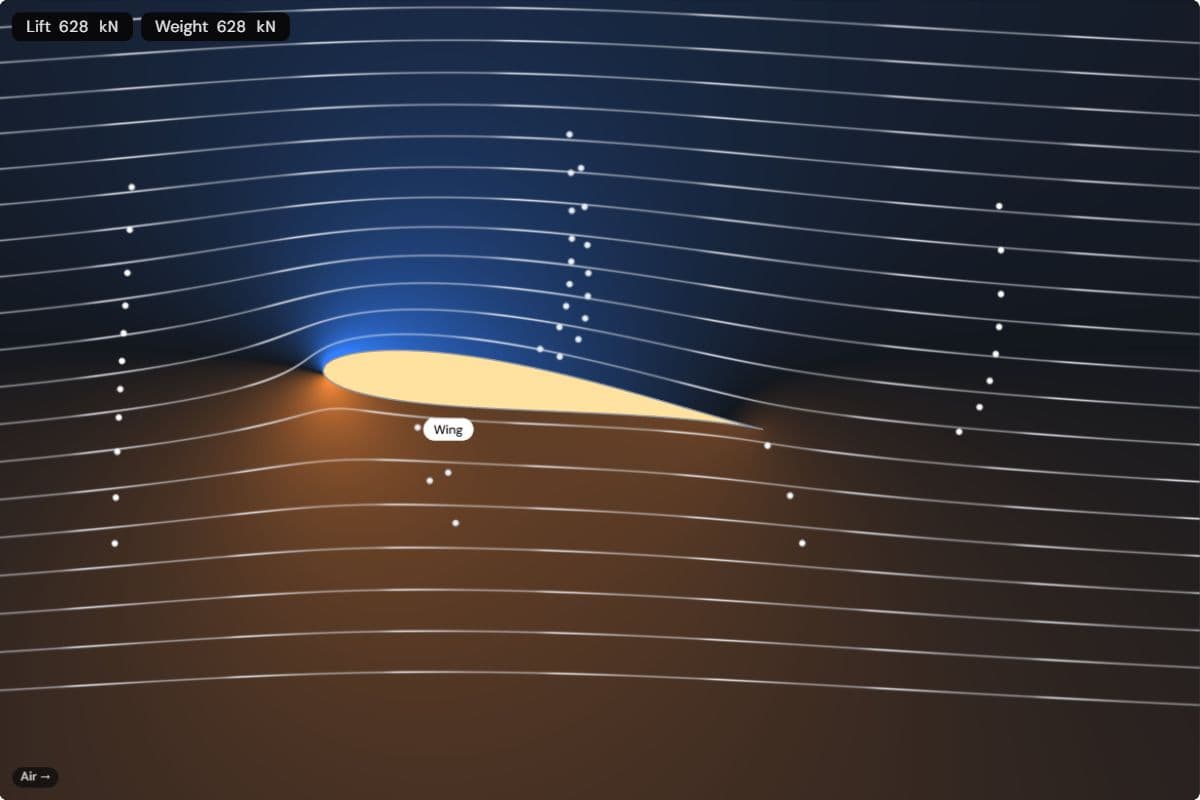
The angle of attack is the angle between the wing and the air flowing towards it. It is not the angle of the plane to the ground: a plane can point its nose up and still be sinking, and then the air comes at the wing from below, which makes the angle larger than the nose suggests.
The angle decides how much lift a wing makes at a given speed. An A320 weighing 64 tonnes needs 628 kN of lift to fly level. At cruise, 11 km up and about 830 km/h, its wing gets that at about 3°. Slowed down to 350 km/h at 3,000 m, it needs about 10°. At that angle the air still flows smoothly along the curved top of the wing: the flow is attached.
Step 3 of 8 · Try it
Lift grows with the angle, up to about 15°
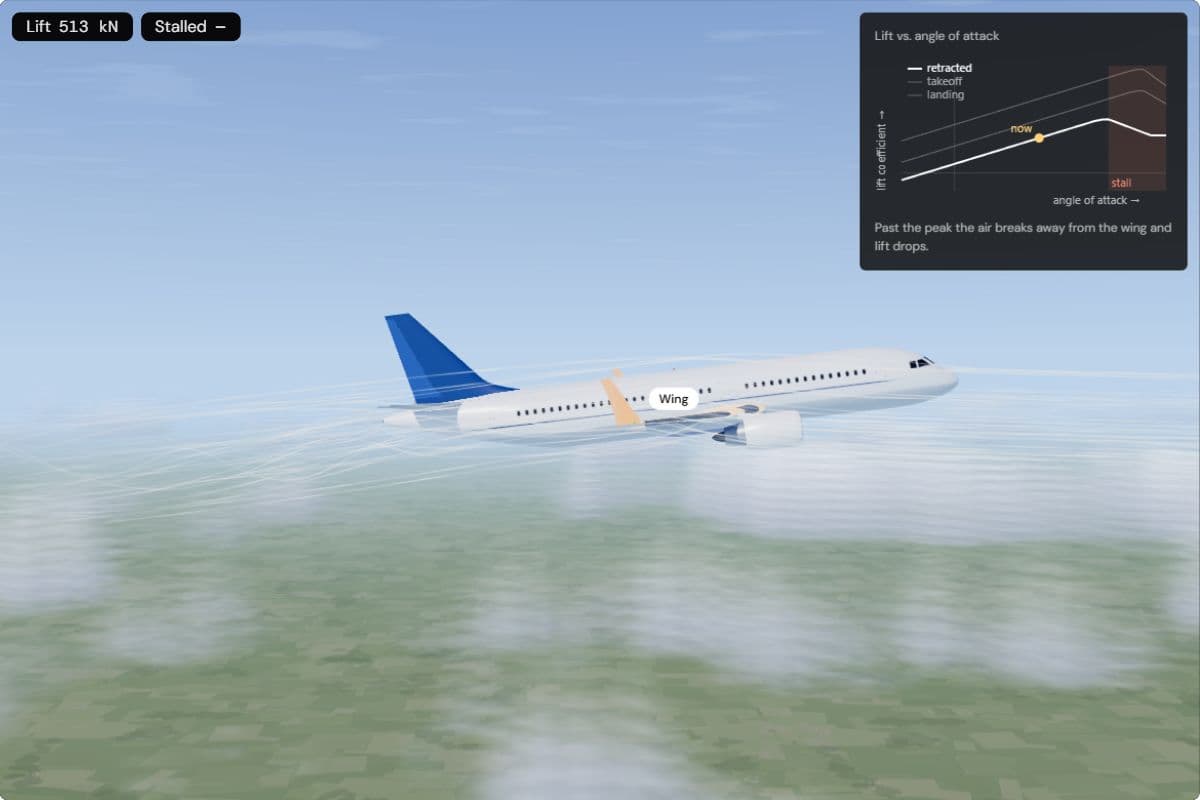
Tilt the wing further into the air and it turns more air downwards, so it lifts more. In the model, at 350 km/h and 3,000 m, the A320's wing lifts 513 kN at 8°, 704 kN at 12° and 790 kN at 14.5°: each degree adds about 45 kN.
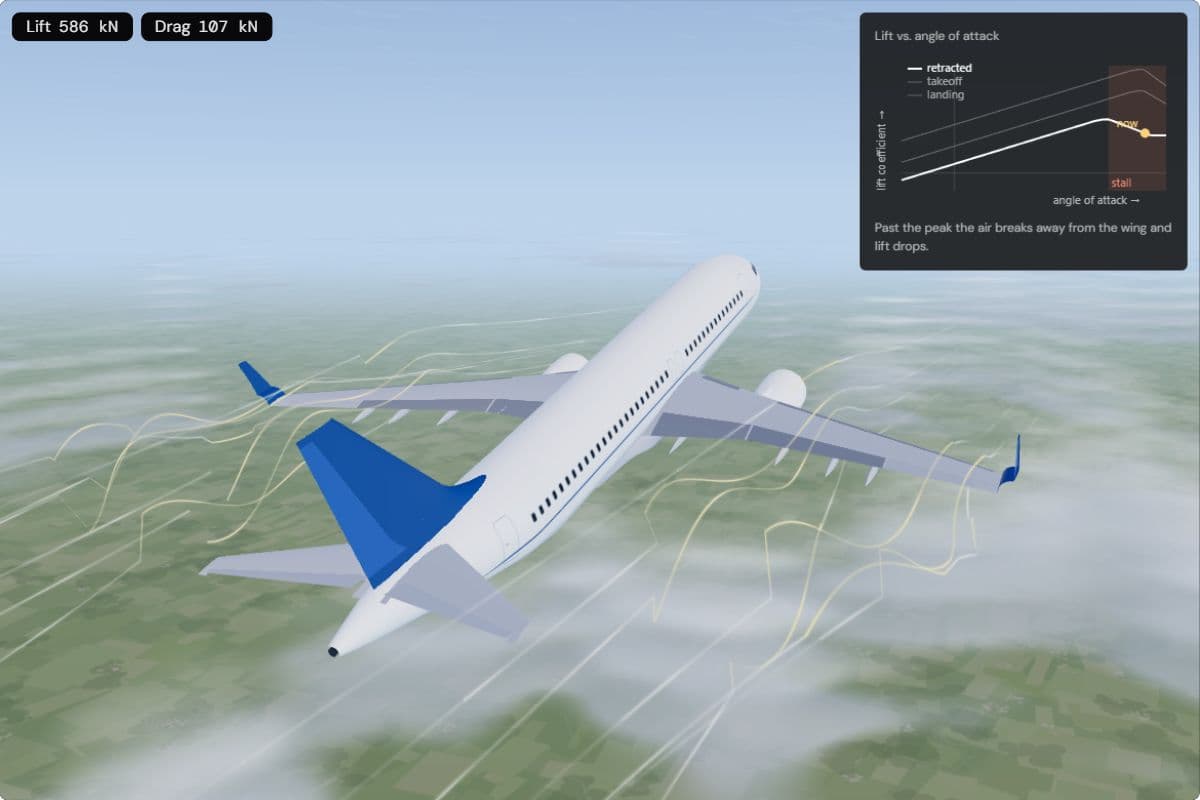
Then the curve bends over. Past its peak, more angle gives less lift: 704 kN at 16°, 586 kN at 18°. The angle at the peak is the critical angle of attack, about 15° for a clean airliner wing (14.5° in the model). Slats and flaps push it higher, to about 18° in the model with everything extended. Every wing has such a limit; for light aircraft wings it is often somewhat higher.
Step 4 of 8 · Explain
Past the critical angle the air breaks away
Why does the lift break down? Most of a wing's lift comes from low pressure over its curved top, where the air speeds up. Towards the back of the wing the air has to slow down again against rising pressure. At small angles it manages. Past the critical angle the climb is too steep: the air separates from the surface, starting at the back, and rolls up into swirls. The suction on top collapses.
In the model at 18°, lift falls to 586 kN, below the 628 kN weight, and drag jumps from 43 kN in level flight to 107 kN. The plane starts to sink, and pulling the nose up further only makes the angle bigger. More power doesn't change this: with the engines at full power the wing stalls at the same angle. What a stall depends on is the angle, not the engines and not, directly, the speed.
Halfway
See it for yourself in 3D
Reading is one thing. In the tour you change it yourself and watch what happens, step by step.
Start the 3D tourStep 5 of 8 · Try it
Why slow planes stall: the stall speed
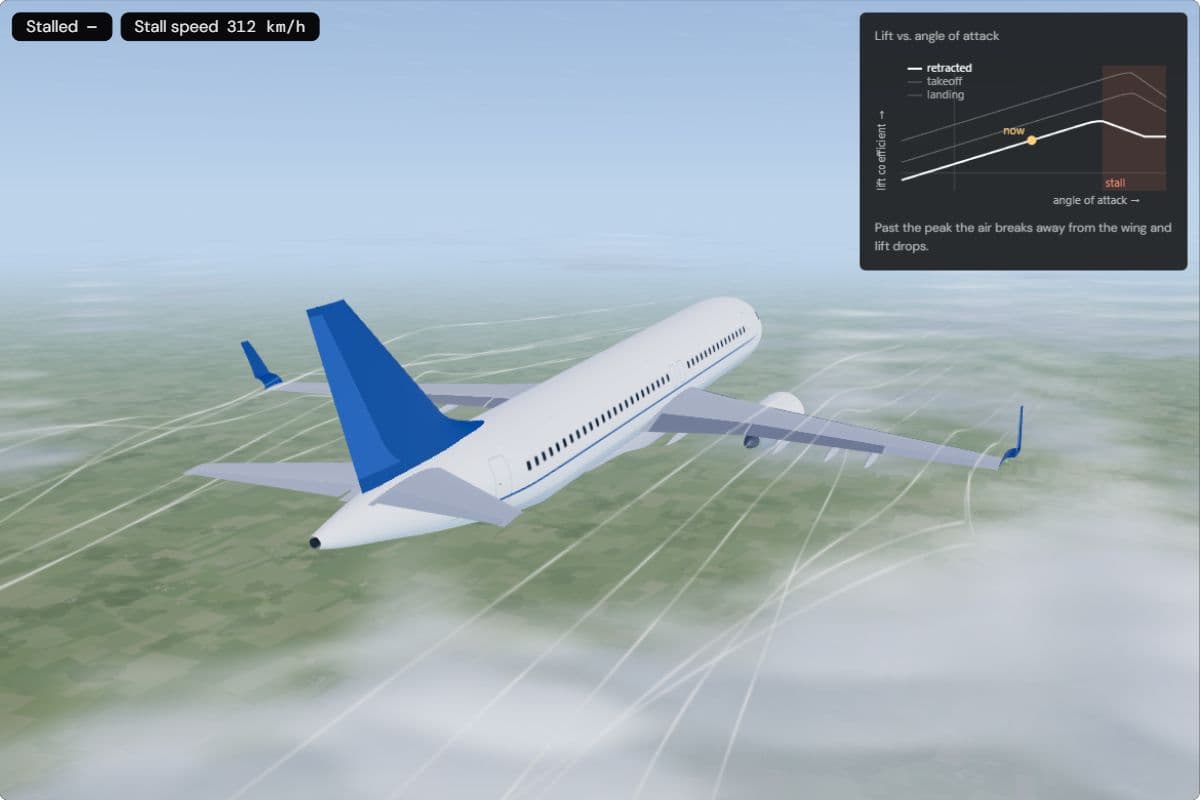
Lift grows with the square of the speed. A plane that slows down and wants to hold its height has to make up for it with a bigger angle. In the model the A320 needs 7.3° at 400 km/h, 10.4° at 350 km/h, 13° at 320 km/h and 14.4° at 312 km/h. One step slower, at 310 km/h, the angle it needs is past the critical one, and the wing stalls.
That speed, 312 km/h for this plane at 64 tonnes and 3,000 m with the flaps retracted, is its stall speed. It is not a speed limit built into the wing. It is the speed at which flying level needs exactly the critical angle. Change what the wing has to carry, or how it is shaped, and the stall speed changes with it.
Step 7 of 8 · Try it
A steep turn raises the stall speed
In a banked turn, the wing's lift tilts with the plane. Only part of it still holds the plane up, the rest pulls it round the turn. To keep its height in a 45° bank, the wing has to lift 1.41 times the weight; at 60° it has to lift twice the weight. This factor is the load factor, and the stall speed grows with its square root: by 7 % at 30°, 19 % at 45° and 41 % at 60°.
In the model, the A320 at 350 km/h is comfortably above its 312 km/h stall speed in level flight. Bank it 45° and hold the height, and the stall speed jumps to about 375 km/h. To make the extra lift the wing would need more than its critical angle: it stalls at once, at a speed that was safe a moment before. Pilots call this an accelerated stall. At 30° the same plane would still fly, with a stall speed of 335 km/h. A stall can happen at any speed, whenever the wing is asked for more lift than it can give.
How pilots recover from a stall
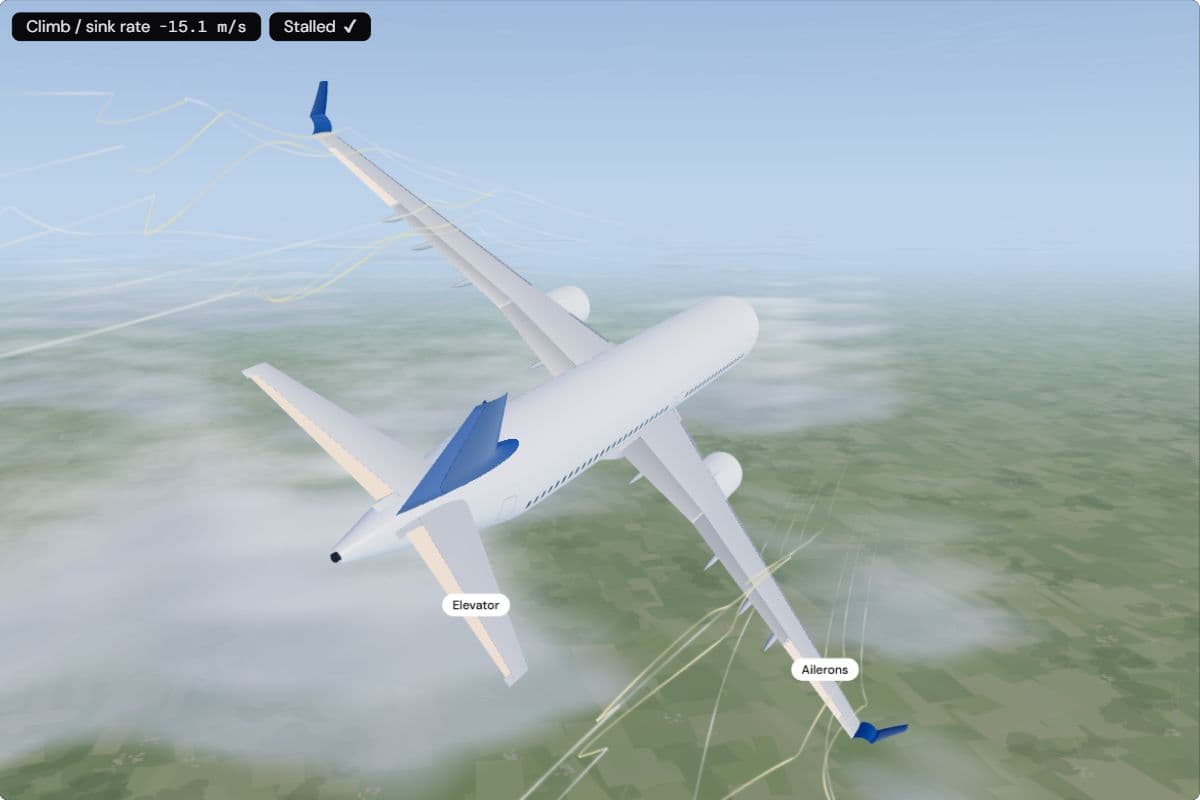
Because a stall is caused by the angle, the cure is the angle too. The pilot pushes the nose down to reduce the angle of attack, until the air follows the wing again. Only then are the wings rolled level, and power is added to regain speed and climb back. This order is the core of the stall recovery taught in the FAA's Airplane Flying Handbook.
The instinct does the opposite. A plane that sinks with its nose up seems to need more nose up, but pulling back only holds the wing past its limit. In the model, a stalled A320 in a 45° turn stays stalled as long as the angle is held, even while it gains speed; lowering the angle to about 12° or rolling the wings level makes the wing fly again. Real stalls are messier than the model shows: one wing often stalls before the other, the plane rolls towards it, and in light aircraft that can lead into a spin. The model doesn't show spins.
Warning signs before a stall
A wing usually warns before it stalls. As the air starts to separate, the swirls shake the wing and tail, and the plane buffets. Controls feel soft, and the plane sinks although the nose is up. Most planes also have a stall warning, triggered by an angle-of-attack sensor or a vane at the wing's leading edge: a horn or a voice calling "stall".
Many jets, among them the Boeing 737, add a stick shaker that rattles the pilots' control column shortly before the stall (SKYbrary: Stall Warning Systems). Airbus airliners like the A320 work differently: their flight controls normally limit the angle of attack, and they warn with an aural "stall" call.
What changes the stall speed: weight, flaps, altitude, ice
A heavier plane needs more lift, so it reaches the critical angle at a higher speed. In the model, at 3,000 m, the A320's stall speed is 276 km/h at 50 tonnes, 312 km/h at 64 tonnes and 344 km/h at its maximum of 78 tonnes. Flaps and slats work the other way: they make the wing more curved and larger and let it reach higher angles, so the plane can fly slower. At sea level and 64 tonnes the stall speed falls from 269 km/h clean to 193 km/h with full flaps, which is why they come out for takeoff and landing.
Altitude raises the true stall speed, the speed through the air, because thinner air gives less lift at the same speed: 269 km/h at sea level, 312 km/h at 3,000 m and about 550 km/h at 11 km, where the A320 cruises at about 830 km/h. The airspeed indicator measures how hard the air pushes, not the true speed, so it shows about the same stall speed at every height. Near the speed of sound the wing's maximum lift also shrinks, so in the model the critical angle at cruise is only 7.4°. Ice on the wing spoils its shape and can make it stall at a smaller angle and a higher speed; the model doesn't simulate ice.
FAQ
Frequently asked questions
- Can a plane recover from a stall?
- Yes. As soon as the angle of attack is reduced, usually by pushing the nose down, the air flows along the wing again and it lifts. The plane loses some height in the process, which is why stalls are dangerous close to the ground and why pilots learn to recognise them early.
- Is a stall dangerous for passengers on an airliner?
- Stalls in airline service are very rare. Airliners warn well before the critical angle, and many, like the Airbus family, limit the angle of attack in normal flight. Turbulence, the bumps passengers usually feel, is not a stall: the wing keeps flying through it.
- Why do pilots practise stalls?
- So that they recognise a stall early and react the right way without thinking: nose down first, then wings level, then power. Student pilots fly stalls in training at a safe height, and airline pilots practise approaches to stalls and recoveries in the simulator.
- Can an airliner stall at cruising altitude?
- Yes. Up high the air is thin and the plane flies close to the speed of sound, so the margin between cruise and the stall is smaller. On 1 June 2009, Air France 447, an A330, lost its airspeed readings over the Atlantic, probably because ice crystals blocked its pitot probes, and the autopilot disconnected. The plane climbed to about 38,000 ft and stalled. According to the French BEA's final report (July 2012), it stayed stalled until it hit the sea, about four and a half minutes after the autopilot had disconnected, and the crew never understood that it was stalled. All 228 people on board died.
- What is an engine stall then?
- A compressor stall is a different thing that happens inside a jet engine: the air breaks away from the blades of the compressor, which are small wings too, and the engine can bang, lose power or flame out for a moment (SKYbrary: Compressor Stall). It has nothing to do with the wing stall that makes a plane lose lift.
Keep exploring
Not the question you had in mind?
More on Physics of flight
- Question 1
How do planes fly?
Find out what really holds a 64-tonne airliner up, why the air over the wing doesn't wait for the air below, and what happens when both engines stop.
8 steps · BeginnerStart - Question 2
Why do planes leave trails, and only on some days?
Find out what the white lines behind planes are made of, and why they vanish in seconds on one day and stay for hours on the next.
8 steps · BeginnerStart - Question 3
How fast do planes fly?
Push an A320 towards the speed of sound and watch the drag shoot up, then find out what really lifts it off the runway at about 280 km/h.
8 steps · BeginnerStart