Physics of flight · Question 2 of 7
Why do planes leave trails, and only on some days?
Planes leave white trails because their engines make water vapour. At cruise height, where the air is colder than about −40 to −50 °C, it freezes at once into a cloud of ice crystals: a contrail. Whether it fades in seconds or stays for hours depends on how humid the air is up there, which changes from day to day.
In this tour you fly an airliner in 3D, change its height and the humidity at flight level, and watch the trail form, fade or stay.
8 steps · Beginner · free, no account
Not smoke and not a spray: a cloud of ice
The white line behind a plane looks like exhaust smoke, and some people believe planes spray chemicals. The usual argument goes: on some days the sky is criss-crossed with long trails, on other days the same planes leave none, so something must be switched on and off.
Neither idea fits what the trail is made of. Burning jet fuel produces mostly carbon dioxide and water vapour: about 1.25 kg of water for every kilogram of kerosene. Up at cruise height that water freezes into tiny ice crystals. A contrail (short for condensation trail) is a thin cloud of ice, and whether it appears and how long it stays is decided by the weather up there, not by anything on board.
The tour, retold
Step by step
Step 5 of 8 · Predict
Water vapour from the engines freezes into ice
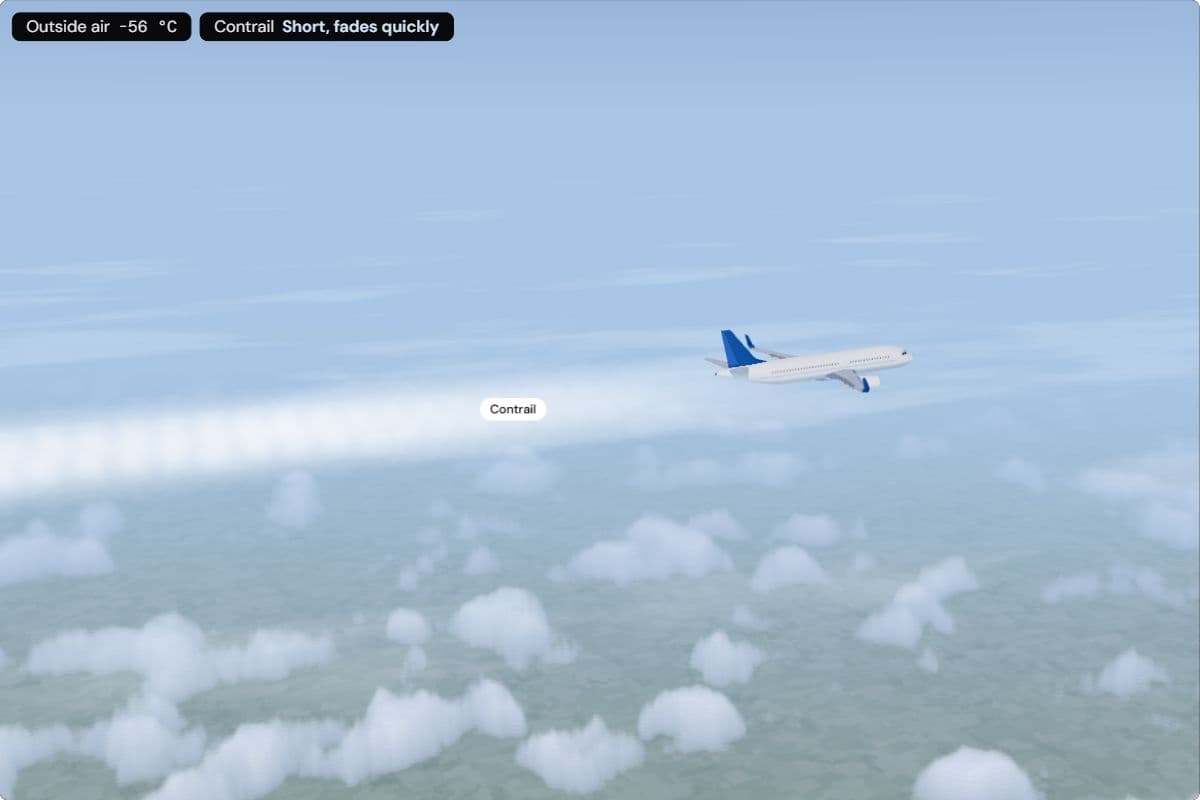
Behind each engine, hot and very moist exhaust mixes with the outside air. At 11 km that air is about −56.5 °C. As the two mix, the mixture cools so fast that it holds more water vapour than it can carry. The water condenses on the tiny soot particles from the engine and freezes at once. The trail starts a short distance behind the engines, where enough cold air has mixed in.
It is the same thing you see when you breathe out on a frosty morning: warm, moist air meets cold air and turns into a small cloud. At cruise height it is simply much colder, so the cloud is made of ice instead of droplets.
Step 4 of 8 · Explain
A trail needs air colder than about −40 to −50 °C
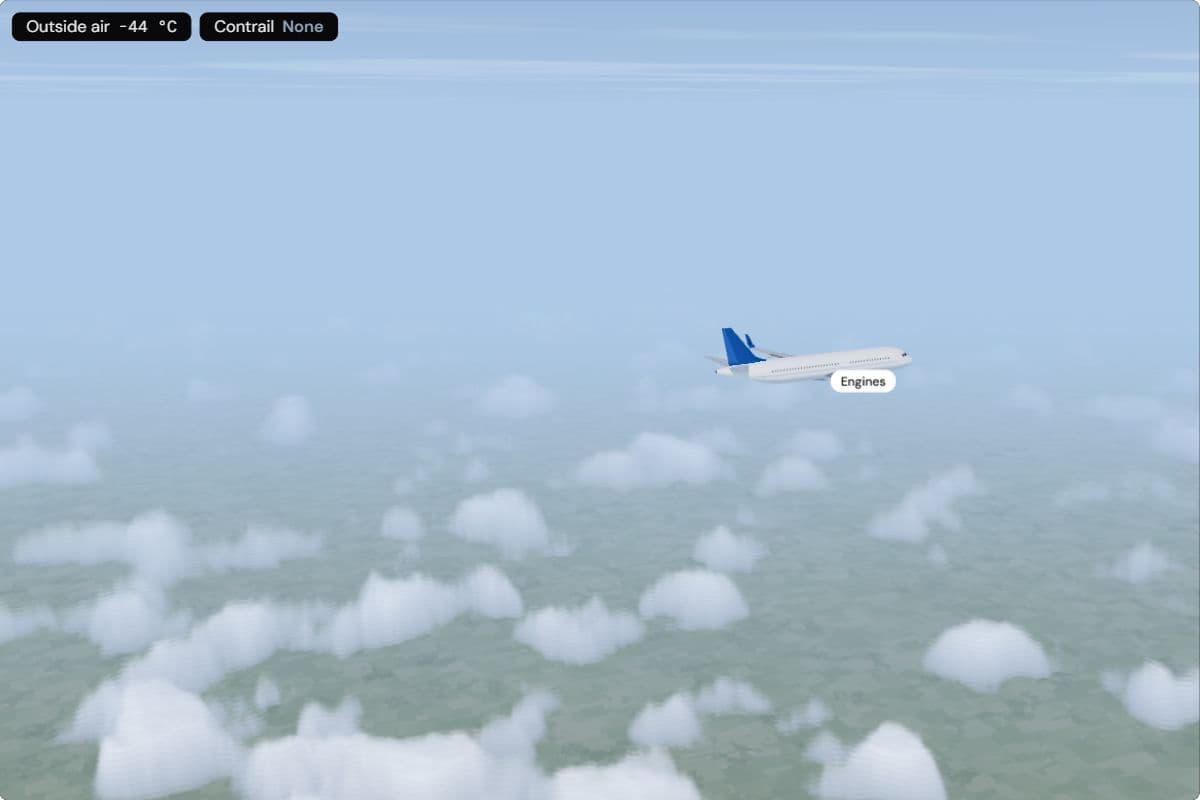
A contrail only forms if the outside air is cold enough. Lower down, the mixture of exhaust and air never gets wet enough for water to condense, and the plane flies on without a trail. At the pressure of cruise height the limit is about −51 °C in very dry air and about −42 °C in air saturated with water (the Schmidt–Appleman criterion, worked out by Ulrich Schumann in 1996).
In the standard atmosphere that puts the limit at about 10.2 km in dry air, 9.6 km when the air is saturated with respect to ice, and 8.2 km in very humid air (lower down the air pressure is higher, which moves the limit to warmer temperatures, about −38 °C there). Airliners cruise at 10 to 12 km, right around this line. A few hundred metres of height or a slightly warmer day can decide whether a trail forms at all. Planes far below, such as small propeller planes, almost never make one.
Halfway
See it for yourself in 3D
Reading is one thing. In the tour you change it yourself and watch what happens, step by step.
Start the 3D tourStep 6 of 8 · Try it
Humidity decides whether the trail stays
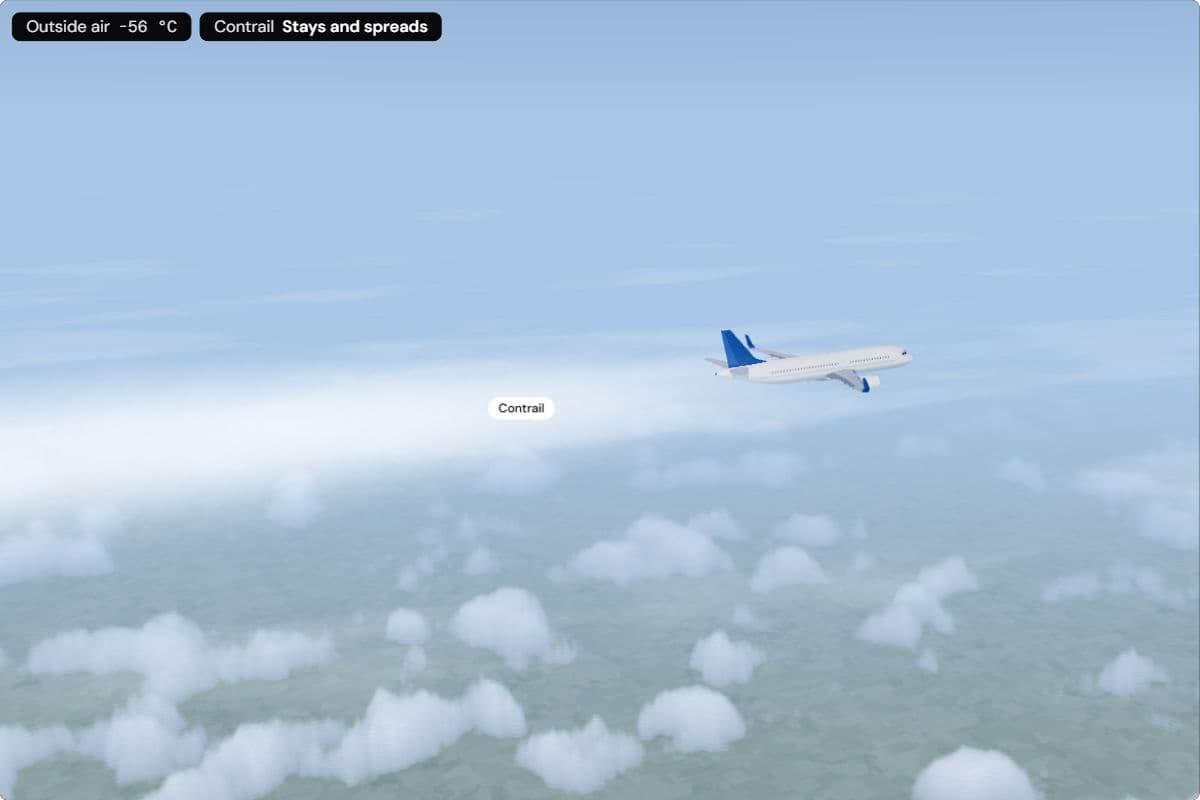
Forming is one condition, staying is another. Once the ice crystals are made, their fate depends on how much water vapour the surrounding air holds. If the air is drier than ice saturation, the crystals evaporate again, and the trail fades within seconds to a minute. If the air is supersaturated with respect to ice, above 100 % humidity over ice, the crystals don't evaporate: they take up more water from the air and grow, and the trail stays.
Humidity over ice sounds odd, but it matters. Ice holds on to water molecules more tightly than liquid water, so air at −56 °C is already saturated over ice at only about 58 % humidity over water. Such air looks perfectly clear, yet every plane flying through it leaves a trail that stays. That humidity changes from day to day and from one layer of air to the next. So on one day all trails fade, and on the next the same planes leave lines that last for hours.
Step 7 of 8 · Explain
Long trails spread into ice clouds
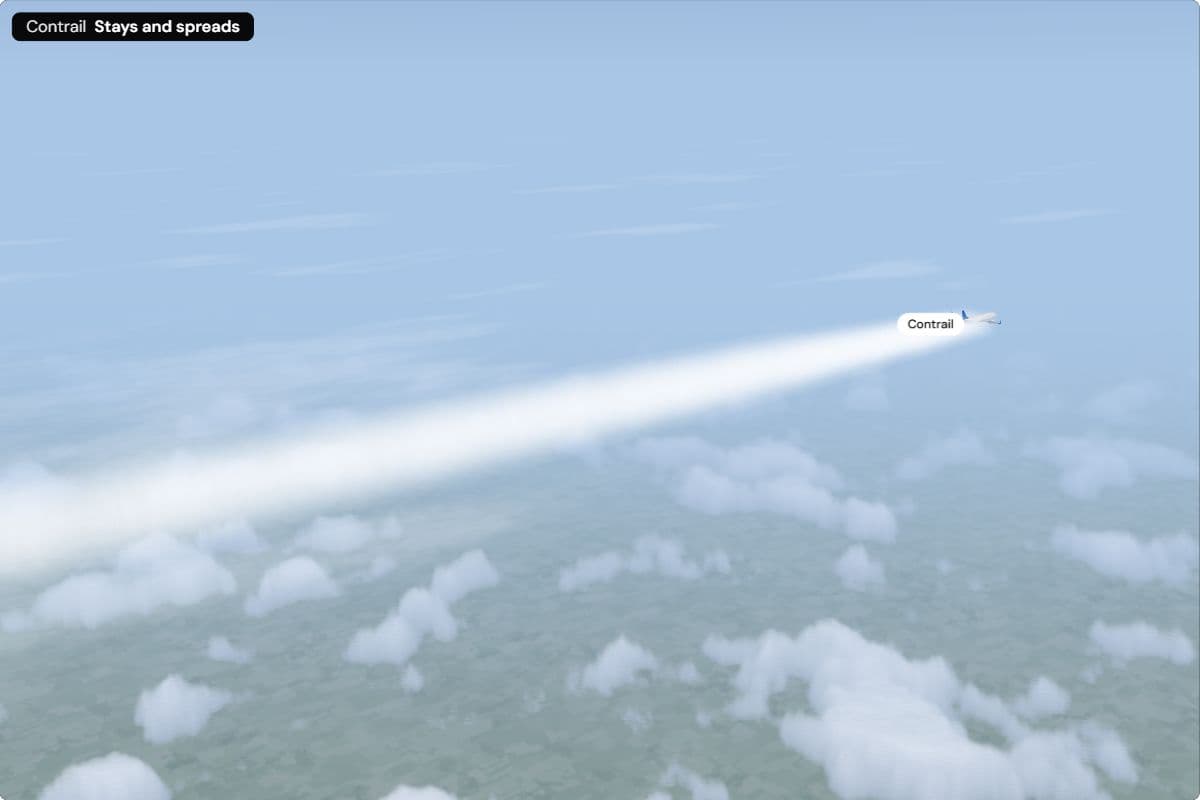
A trail that stays keeps widening. Winds at different heights pull it apart, and the ice crystals keep growing. Over an hour or more a sharp line can widen into a band several kilometres across and finally into thin, feathery cirrus that is hard to tell from natural clouds. Researchers call it contrail cirrus. On busy days over Europe it can cover a noticeable part of the sky.
Why two planes in the same sky can look different
Sometimes one plane leaves a long trail while another, a few minutes later, leaves none. The air is not the same everywhere: humid layers at cruise height are often only a few hundred metres thick, and planes fly at different heights. A plane in a moist layer leaves a trail that stays; one just above or below it in drier air leaves a short trail or none. If the layer sits right at the temperature limit, a small difference in height decides whether a trail forms at all.
The engines matter a little too. Modern, more efficient engines turn more of the fuel's energy into thrust and less into heat, so their exhaust is cooler. They make trails at slightly warmer temperatures than older engines did.
Contrails and the climate
Contrails that stay are not harmless. Like thin natural cirrus, they let most sunlight through but hold back heat that Earth would otherwise lose to space, especially at night. A large assessment of aviation and the climate (Lee and colleagues, 2021) put the warming effect of contrail cirrus in 2018 at about 57 mW/m², more than the 34 mW/m² from all the CO₂ planes had emitted until then. The uncertainty is large: the range runs from about 17 to 98 mW/m².
Because only a small share of flights cross ice-supersaturated air, avoiding those layers could help a lot. A study of flights over Japan (Teoh and colleagues, 2020) found that changing the height of about 1.7 % of flights by around 600 m could cut the warming from their contrails by up to 59 %, for less than 0.1 % extra fuel. Airlines and researchers are now testing such forecasts in real flights.
FAQ
Frequently asked questions
- Are contrails chemtrails?
- No. The idea that long-lasting trails are chemicals sprayed in secret has been checked: in a survey of 77 atmospheric chemists and geochemists, 76 had found no evidence of a secret spraying programme, and the things cited as evidence are explained by ordinary contrail physics (Shearer et al., 2016). Germany's Umweltbundesamt comes to the same conclusion. Trails on some days and none on others is exactly what the changing humidity at cruise height predicts.
- Do propeller planes leave contrails?
- Rarely. Any engine that burns fuel makes water vapour, but small propeller planes fly low, where the air is far warmer than the −40 to −50 °C a trail needs. High-flying piston bombers in the Second World War did leave long contrails, and that is when contrails were first studied systematically.
- Can contrails tell you what the weather will do?
- A little. Trails that stay and spread show that the air at cruise height is humid, which often happens ahead of an approaching weather front. Trails that vanish quickly point to dry air up there. It's a hint, not a forecast: humid layers also come and go without any change in the weather on the ground.
- Why do airlines try to avoid contrails?
- Because contrails that stay and spread warm the climate, by some estimates more than the CO₂ from aviation. Most of that warming comes from a few flights through ice-supersaturated air, so flying a few hundred metres higher or lower can avoid it at a small fuel cost. Airlines and researchers are testing contrail forecasts for this.
- Do military jets leave contrails?
- Yes, when they fly high enough. The physics is the same for every jet engine: water vapour from burning fuel freezes in very cold air. Fighter jets sometimes also make short white streaks off their wing tips in tight turns, but those come from the low pressure over the wing, not from the exhaust.
Keep exploring
Not the question you had in mind?
More on Physics of flight
- Question 1
How do planes fly?
Find out what really holds a 64-tonne airliner up, why the air over the wing doesn't wait for the air below, and what happens when both engines stop.
8 steps · BeginnerStart - Question 2
What causes a plane to stall?
Push an airliner past the critical angle of attack, see the air break away from the wing, and find out why full power and a fast turn don't protect it.
8 steps · BeginnerStart - Question 3
How fast do planes fly?
Push an A320 towards the speed of sound and watch the drag shoot up, then find out what really lifts it off the runway at about 280 km/h.
8 steps · BeginnerStart