Heat pump · Question 5 of 5
Why is the COP of a heat pump so high?
The COP (coefficient of performance) is the heat a heat pump gives for each unit of electricity, usually 3 to 5, which is why people call it 300–500 % efficient. It isn't making heat from nothing: it carries two to four units in from the outdoor air. Count that heat too, and the balance stays below 100 %.
In this tour you watch the energy balance in 3D, raise the heating water from 35 to 55 °C, meet the ideal limit and drag the air below zero.
12 steps · Beginner · free, no account
COP: heat out per unit of electricity
The coefficient of performance (COP) of a heat pump is the heat it delivers divided by the electricity it uses over the same time: COP = heat delivered ÷ electricity used. A heat pump that gives 3 kWh of heat for 1 kWh of electricity has a COP of 3, and that is what people mean when they call it "300 % efficient". Air source heat pumps reach a COP of about 3 to 5 at the standard test point, 7 °C outdoor air and 35 °C heating water.
For comparison: an electric fan heater or a heating rod turns 1 kWh of electricity into exactly 1 kWh of heat, a COP of 1, or 100 %. A modern condensing gas boiler turns about 90–98 % of the energy in the gas into heat; old boilers manage 60–75 %. A heat pump gives three to five times as much heat as the electricity it uses.
A common objection is that more than 100 % is impossible, so the 300 % must be a marketing trick. The objection mixes up two different ratios. An efficiency compares all the energy that goes into a machine with what comes out, and that can never exceed 100 %. The COP leaves out the biggest input, the heat taken from the outdoor air, because nobody pays for it. Calling the COP an "efficiency" in per cent is common, but loose; the physics behind it is the energy balance below.
The tour, retold
Step by step
Step 1 of 12 · Explain
Most of the heat comes from the outdoor air
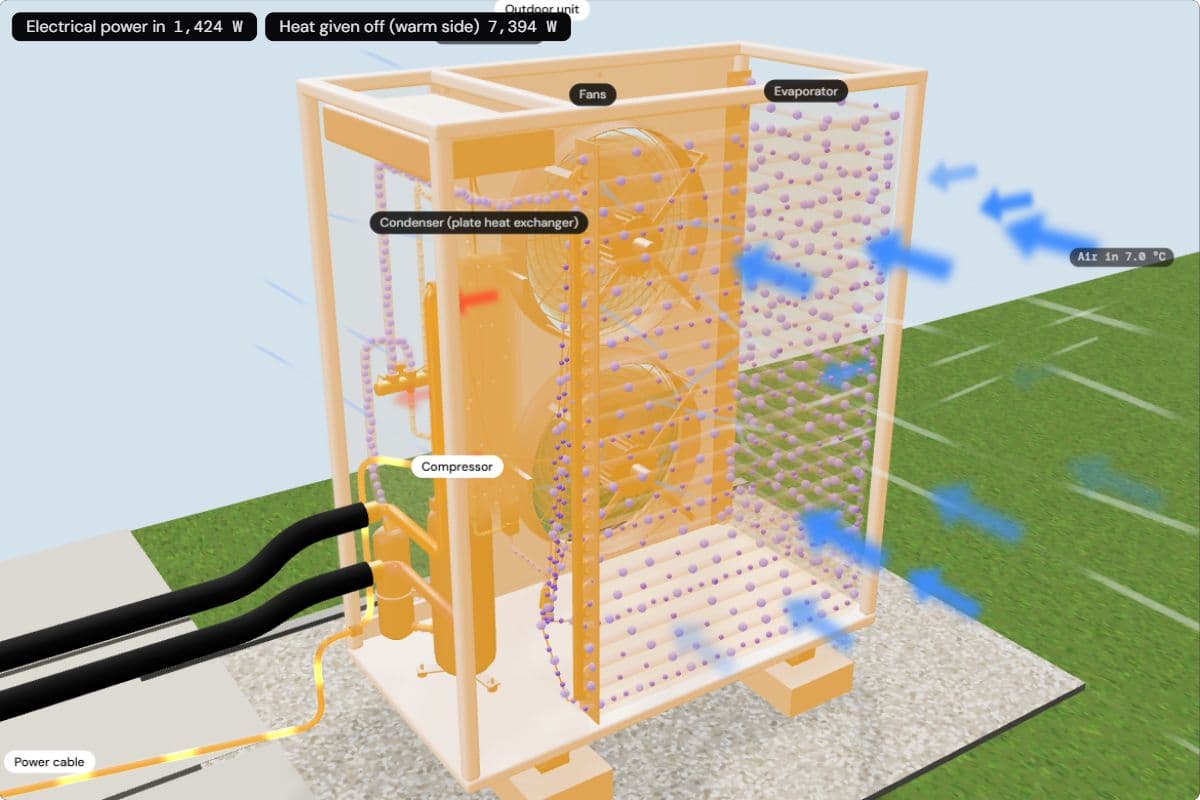
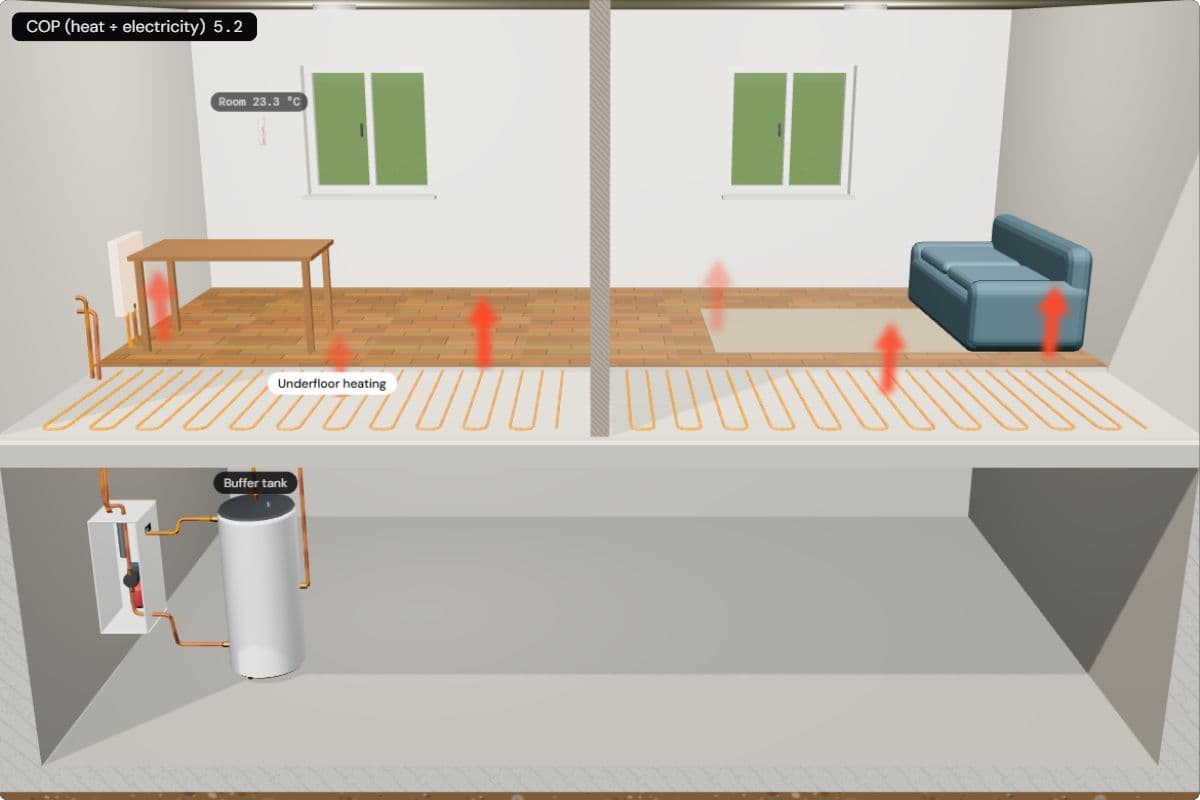
Take a heat pump heating a house on a mild 7 °C day, with 35 °C water for underfloor heating. The box in the garden is the outdoor unit; inside it the compressor is the only part that uses much electricity. In the model it draws about 1.4 kW of electricity and delivers about 7.4 kW of heat to the house: five times as much, a COP of about 5.2.
Where do the other 6 kW come from? Not from the electricity. About 6.1 kW come out of the 7 °C outdoor air, which leaves the unit colder than it came in. The real unit the model follows shows the same in its datasheet: 7.3 kW of heat for 1.38 kW of electricity at 7 °C, and even at −7 °C about 6.6 of its 9.7 kW of heat come from the air (Viessmann Vitocal 250-A).
Step 3 of 12 · Explain
The energy balance: nothing is created
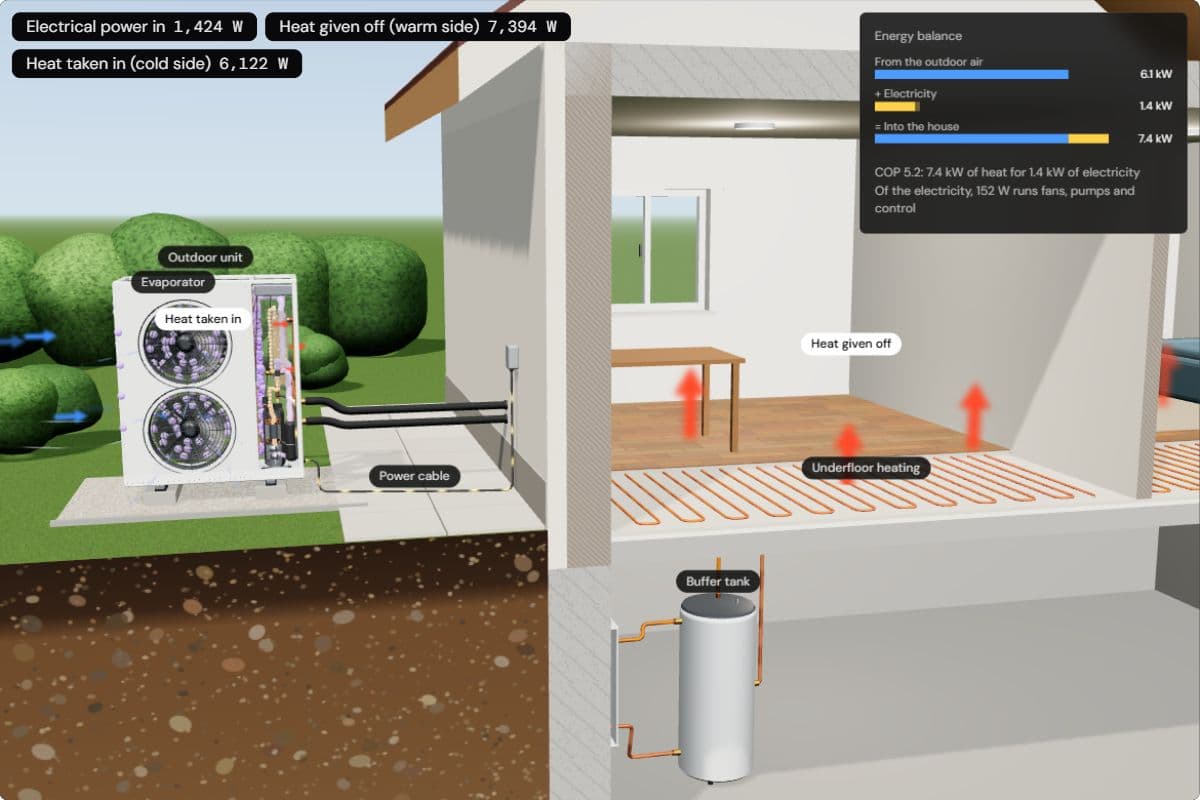
Read the heat pump's energy flows like a bill. In: about 6.1 kW of heat from the outdoor air and about 1.4 kW of electricity. Out: about 7.4 kW of heat into the house. Of the electricity, about 1.3 kW runs the compressor and the water pump and ends up in the house too; the remaining 150 W or so run the fans and the control and leave with the outdoor air.
Compare everything that goes in, air and electricity together, about 7.55 kW, with the heat that comes out, 7.39 kW, and you get about 98 %: below 100 %, as the conservation of energy demands. The "500 %" is a different ratio: it compares the heat only with the part you pay for. The heat in the air is free.
That is why the COP has its own name. A heat pump isn't a better heater; it is a pump. With a water pump you pay for lifting the water, not for the water itself. A heat pump's electricity pays for lifting heat, not for the heat.
Step 5 of 12 · Explain
The electricity pays for the temperature lift
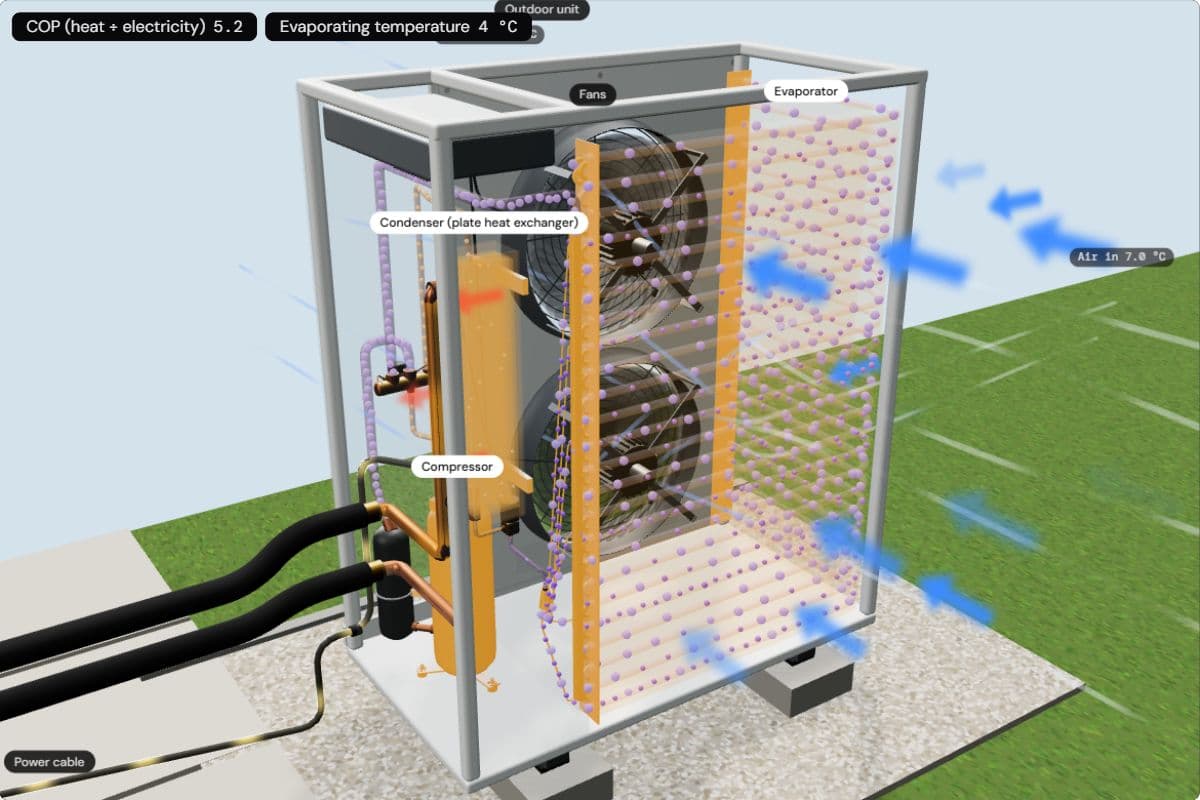
What exactly does the electricity buy? On its own, heat only flows from warm to cold, never from 7 °C air into 35 °C water. So the heat pump lifts it. Its refrigerant boils in the outdoor coil a little colder than the air, at about 4 °C in the model, so heat flows from the air into it. The compressor then squeezes the vapour until it is hotter than the heating water, about 37 °C, and there the heat flows into the water.
The gap between the cold side and the warm side is the temperature lift: here about 28 degrees between air and water, a few more inside the refrigerant. The smaller the lift, the less electricity each kilowatt-hour of heat costs, just as carrying water up one floor takes less work than carrying it up three. Everything that follows comes down to this lift.
Step 7 of 12 · Try it
Hotter heating water costs about a third
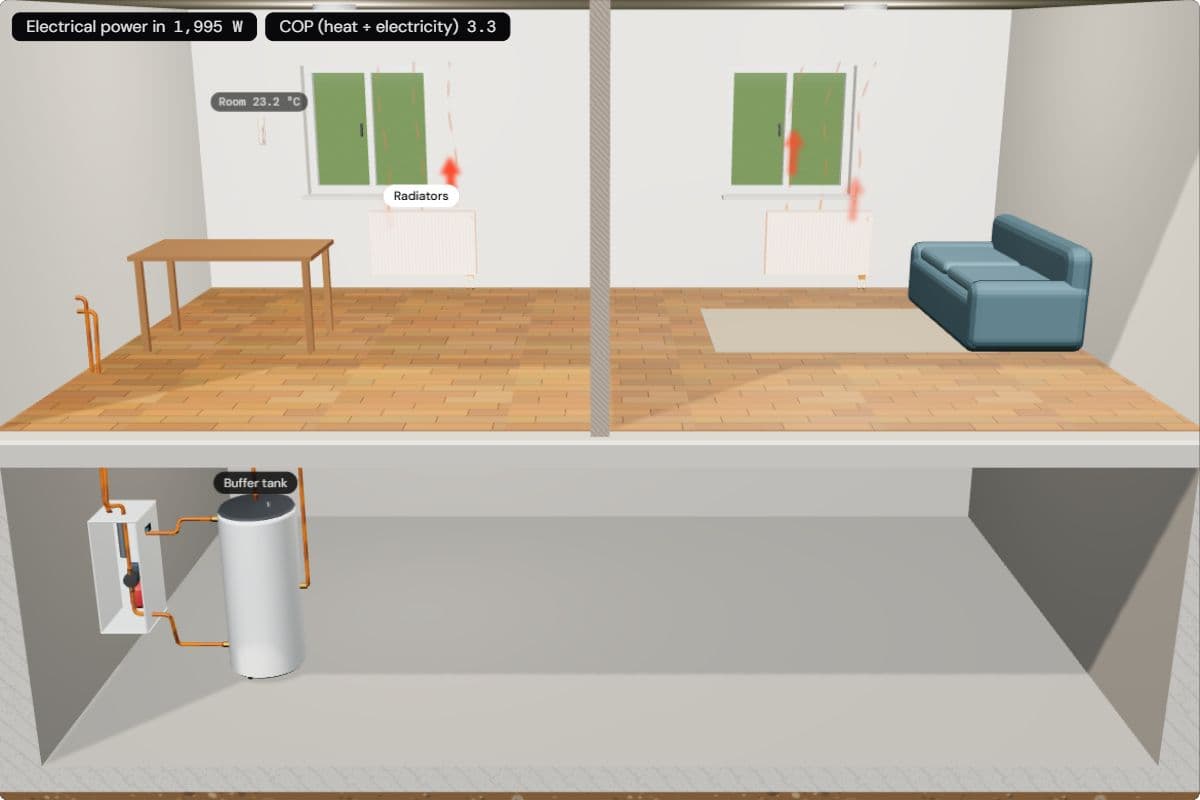
A common assumption is that the water temperature is just a matter of comfort, or that hotter water even makes the heat pump better because it carries more heat. The opposite is true. Many older houses have radiators that need water at about 55 °C instead of 35 °C. On the same 7 °C day the lift grows from about 28 to 48 degrees. In the model the compressor then needs about 2.0 kW instead of 1.4 for slightly less heat, about 6.7 kW, and the COP falls from about 5.2 to 3.3: about a third less.
The datasheet of the real unit shows the same at −7 °C: a COP of 3.16 with 35 °C water and 2.13 with 55 °C water. As a rule of thumb, every degree less on the water saves about 2–3 % of the electricity. In the model the COP is about 4.6 at 40 °C and about 4.5 at 41 °C.
Halfway
See it for yourself in 3D
Reading is one thing. In the tour you change it yourself and watch what happens, step by step.
Start the 3D tourStep 6 of 12 · Predict
Why radiators need hotter water than underfloor heating
How low the water can go depends on how the heat gets into the rooms. Underfloor heating gives off its heat through the whole floor, so water at 30–35 °C is enough even on a cold day. A radiator has a much smaller surface, and its output drops steeply as the water cools. A common double-panel radiator 600 mm high and 1 m wide gives about 1.6 kW with 75 °C water, about 0.85 kW at 55 °C and only about 0.27 kW at 35 °C (EN 442 rating): about a sixth.
That is why radiators sized for an old gas boiler often need 55–70 °C. Real houses usually need less than their radiators were sized for, though: in Fraunhofer ISE field tests in existing houses with radiators, the heat pumps needed about 44–45 °C on the coldest days, on average. Larger radiators in a few rooms, or better insulation, bring the temperature down further.
Step 9 of 12 · Explain
The Carnot limit: the best a heat pump could do
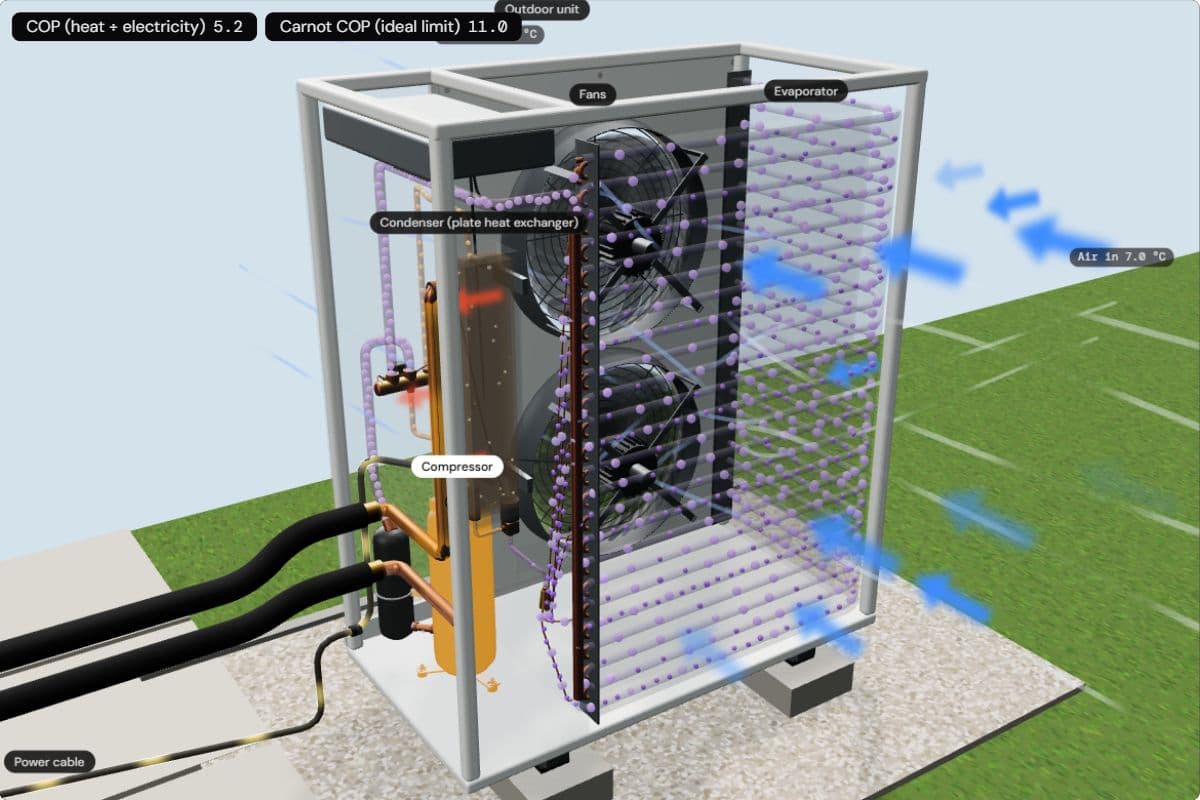
Is there a highest possible COP? Yes, and it depends only on the two temperatures. A perfect heat pump, with no losses at all, would reach the Carnot COP: the warm temperature divided by the difference between warm and cold, both in kelvin (degrees Celsius plus 273). Between 7 °C air and 35 °C water that is 308 ÷ 28 = 11.
Real heat pumps reach about half of that. The model gets 5.2, and textbooks give 45–55 % of the Carnot COP for real machines. The rest is lost because heat needs a temperature difference to flow through the two heat exchangers (the refrigerant boils at about 4 °C, not 7, and condenses at about 37 °C, not 35), because the compressor isn't ideal, and because motors, fans and pump use some electricity too. With 55 °C water the ceiling itself drops to about 6.8.
Step 10 of 12 · Try it
Cold air raises the lift too
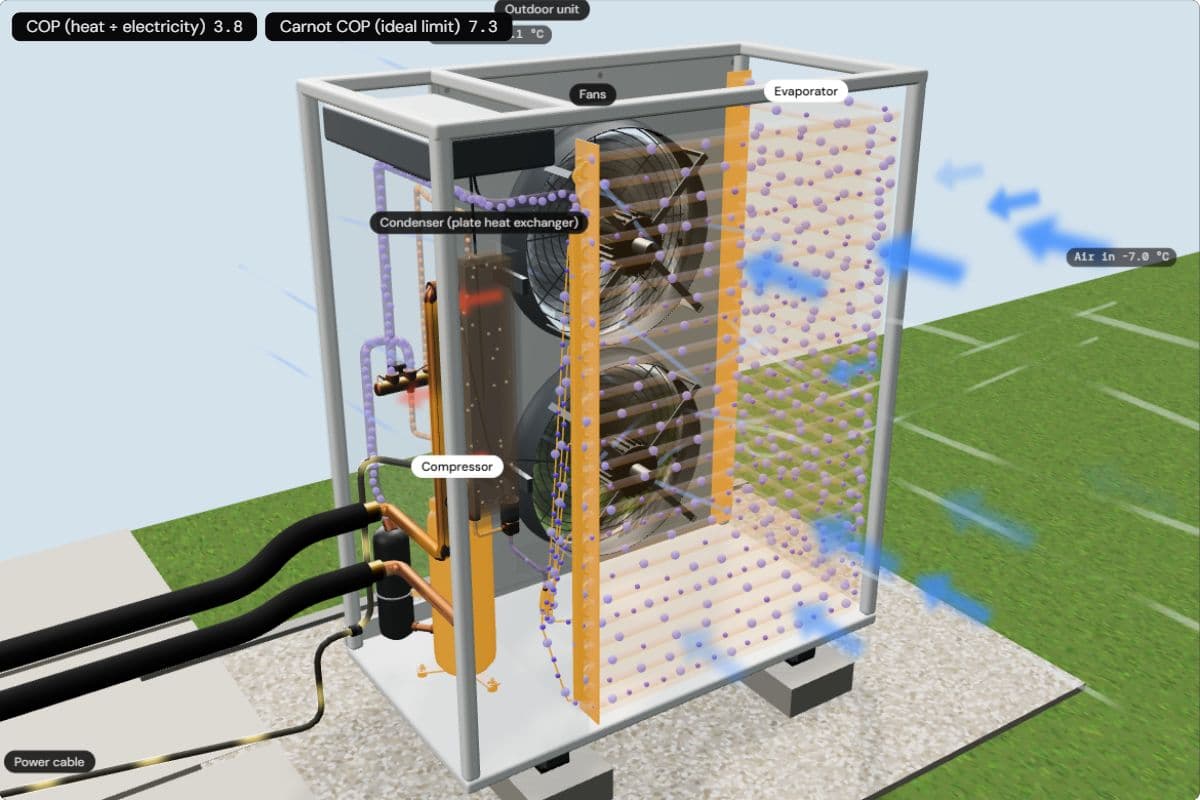
The lift has two ends, and the outdoor air is the other one. At −7 °C the gap to 35 °C water is 42 degrees instead of 28. The Carnot ceiling falls from 11 to about 7.3, and the model's real COP from about 5.2 to 3.8. The heat pump keeps heating, just at a higher price per kilowatt-hour; the separate question of how a heat pump works in winter shows why it never stops.
In the model the COP is about 4.6 at 2 °C, 4.4 at 0 °C and 3.8 at −7 °C, with floor heating at 35 °C. Hot water on a cold day is the worst case: at −7 °C with 55 °C water the model's COP is about 2.6.
Step 11 of 12 · Explain
From the moment to the year: COP, SCOP and seasonal performance
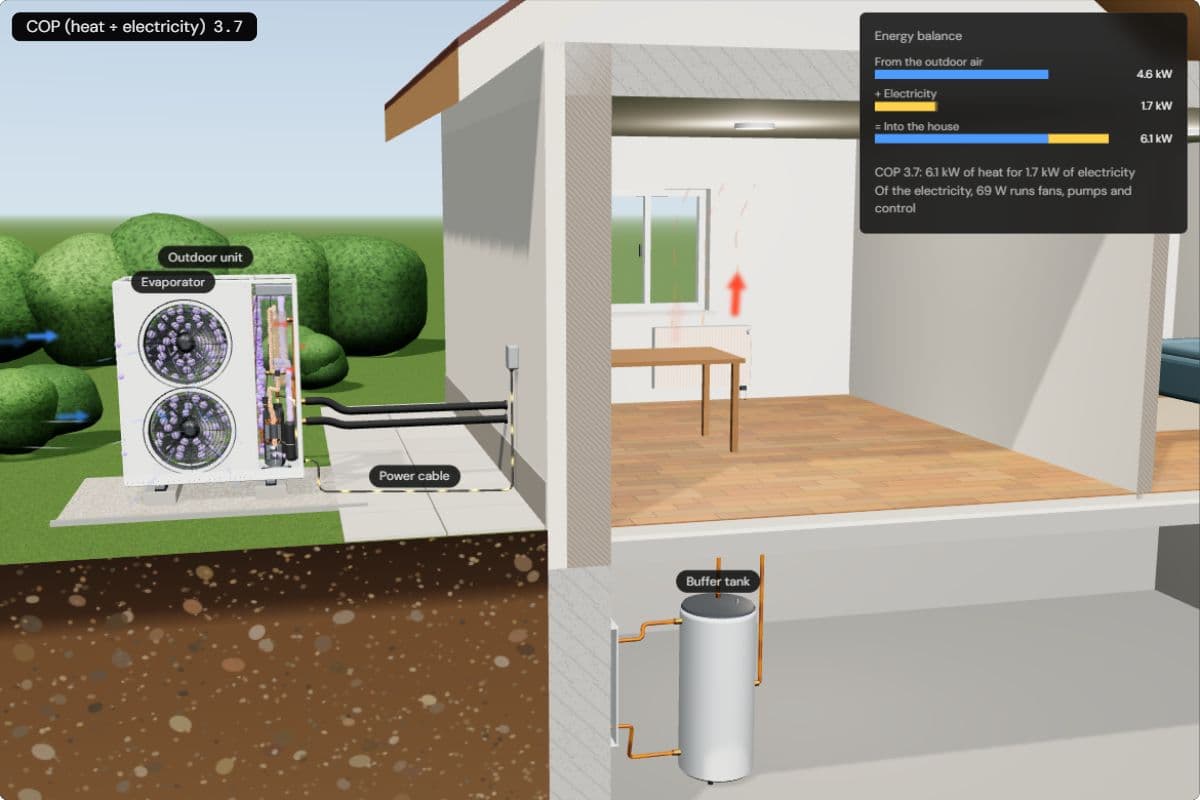
So which number is the efficiency of a heat pump? The COP changes every hour with the weather and the water temperature. On a 2 °C day in an older house with radiators at 45 °C the model's COP is about 3.7, with 6.1 kW of heat for 1.7 kW of electricity.
For a whole year you add up all the heat and all the electricity. On the label that is the SCOP, calculated for an average European climate: 5.01 at 35 °C and 3.87 at 55 °C for the real unit the model follows. Measured in real houses it is called the seasonal performance factor. In Fraunhofer ISE field tests in existing German houses it was about 3.4 for air source heat pumps (between 2.6 and 4.9) and 4.3 for ground source ones.
The year comes out a little lower than a mild day because the coldest days need the hottest water, the outdoor unit has to defrost now and then, and heating domestic hot water to about 55 °C has a lower COP. Most heating hours fall between 0 and 10 °C, though, so the year sits close to a day like this one. That is where the familiar "300 %" comes from.
Typical values: air, ground and groundwater
Air source heat pumps in existing houses: a seasonal performance factor of about 3.1 in the Fraunhofer ISE field test of 2018/19 and about 3.4 in the 2024 test, with single houses between 2.6 and 4.9.
Ground source heat pumps: about 4.1 and 4.3 in the same tests. Their source, the brine from a borehole, stays near 0 °C or warmer all winter, so the lift on cold days is smaller than with air. In the model, at −7 °C outside, the ground source reaches a COP of about 4.5 against 3.8 for air.
Groundwater heat pumps: the water from a well stays at about 7 to 12 °C all year, so the lift is smaller still. In the model, with 35 °C floor heating on a 7 °C day, it reaches a COP of about 5.9.
In the United States, heat pumps are rated with HSPF2 for heating and SEER2 for cooling. Both are seasonal figures like the SCOP, but in British thermal units per watt-hour, so the numbers are larger: divide an HSPF by about 3.4 to compare it with a COP.
How to keep the flow temperature low
The heating curve sets the water temperature from the outdoor temperature: warm water on cold days, cooler water on mild ones. Typical slopes are about 0.3–0.5 for underfloor heating and 1.0–1.6 for radiators (Viessmann). A curve set no higher than the house needs is the cheapest way to a better COP.
Larger or low-temperature radiators give the same heat at a lower water temperature, and better insulation lowers the heat the house needs, so the water can stay cooler too. Hydraulic balancing makes sure every radiator gets its share of water, so one cold room doesn't force the whole house to a higher temperature.
Running slowly also helps. An inverter heat pump that runs its compressor slowly and for long works with smaller temperature differences in its heat exchangers. In the model on a 7 °C day, the COP is about 5.9 at the lowest compressor speed and about 4.8 at a high one.
What this model simplifies
The model shows one real air-to-water unit in steady operation. Its radiators deliver the heat the house needs at any water temperature, so you can't watch a room get cold when radiators run at 35 °C; the radiator figures above come from the EN 442 rating. This tour leaves out defrosting and domestic hot water. Like the EN 14511 test standard, the model's COP counts the electricity for the fans, the water pump and the control, not just the compressor.
FAQ
Frequently asked questions
- What is a good COP for a heat pump?
- At the standard test point, 7 °C air and 35 °C water, a good air source heat pump reaches a COP of about 4 to 5. Over a year, a seasonal figure of 3 or more is good for air: field tests in existing houses measured about 3.4 for air and 4.3 for ground source heat pumps (Fraunhofer ISE).
- How do I calculate the COP of a heat pump?
- Divide the heat delivered by the electricity used over the same time: 7.4 kW of heat for 1.4 kW of electricity gives a COP of about 5.2. For a whole year you need a heat meter on the heating water and a separate electricity meter for the heat pump; the yearly heat divided by the yearly electricity is the seasonal performance factor.
- What is the difference between COP, SCOP and HSPF?
- The COP is the ratio of heat to electricity at one moment and one test point. The SCOP is the same ratio over a whole heating season in a standard European climate. The HSPF, used in the United States, is also a seasonal figure, but in Btu per watt-hour, so it is about 3.4 times larger than the matching COP.
- Can a heat pump work with existing radiators?
- Often yes, at a lower COP. In Fraunhofer ISE field tests in existing houses with radiators, the heat pumps needed about 44–45 °C on the coldest days, on average, and still reached good yearly figures. If single rooms stay cold, larger radiators there help more than turning the whole house up.
- Why are heat pumps more efficient than electric furnaces?
- An electric furnace or heater turns each kilowatt-hour of electricity into one kilowatt-hour of heat, a COP of 1. A heat pump uses the electricity to move heat in from outside, so it adds two to four kilowatt-hours of free heat from the air or the ground to each kilowatt-hour of electricity.
- Is a heat pump's COP higher with a ground source?
- Yes, especially in winter. The ground stays warm while the air gets cold, so the lift is smaller: in the model at −7 °C outside, a ground source gives a COP of about 4.5 against 3.8 for air. Over a year, field tests measured about 4.3 for ground source and 3.4 for air source heat pumps.
Keep exploring
Not the question you had in mind?
More on Heat pump
- Question 1
How does a heat pump work?
Meet the four parts of a heat pump, ride along with the refrigerant and find out why 1.4 kW of electricity brings 7.4 kW of heat into the house.
15 steps · BeginnerStart - Question 2
How does a refrigerator work?
Find out why an open fridge warms the kitchen, follow the refrigerant from the cold plate to the warm grille and watch the thermostat switch the compressor on and off.
12 steps · BeginnerStart - Question 3
How does a heat pump work in winter?
Drag the air down to −15 °C and watch the heat pump keep heating, find out why its output and COP fall, cover a cold house, watch the unit ice up and defrost, and switch to ground heat.
15 steps · BeginnerStart