Physics of flight · Question 7 of 7
What do flaps do on a plane?
Flaps are panels at the back of a plane's wings that slide out and down for takeoff and landing. They make the wing more curved and larger, so it lifts enough at a much lower speed: an A320's stall speed drops by more than a quarter. They add drag too, but they aren't air brakes.
In the 3D tour, extend an A320's flaps, slow it down to landing speed and see what happens without them.
8 steps · Beginner · free, no account
Flaps are not air brakes
Many explanations, including some flight-school pages and search engines' own summaries, describe landing flaps as a kind of air brake. That gets the order wrong. Flaps exist to make the wing lift more at low speed; the extra drag comes with them as a side effect. Pilots do use that drag on the approach, but no airliner extends its flaps just to slow down.
The real air brakes are the spoilers: separate panels on top of the wing that tilt up into the airflow. In flight they cut lift and add drag, so the plane can come down faster or slow down. After touchdown, the ground spoilers pop up fully and dump the remaining lift, so the plane's weight presses on the wheels and the brakes can work (NASA Glenn Research Center, "Flaps and Slats"). Flaps do the opposite of the first part: they add lift.
The tour, retold
Step by step
Step 1 of 8 · Explain
Where the flaps and slats are
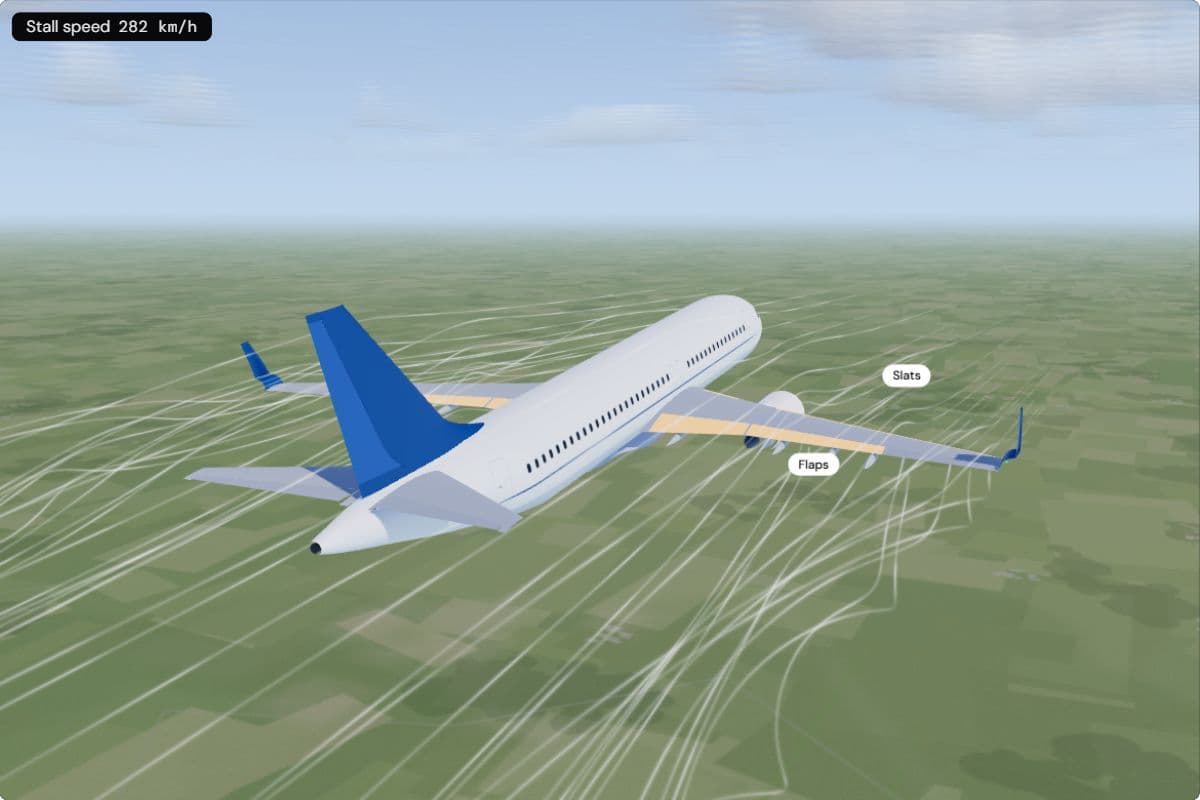
Wing flaps sit along the back edge of each wing, between the fuselage and the ailerons. On an airliner like the Airbus A320 they slide backwards and down on tracks. The slats are their partners at the front edge: they move forward and down. In cruise both are folded into the wing, which is then called clean.
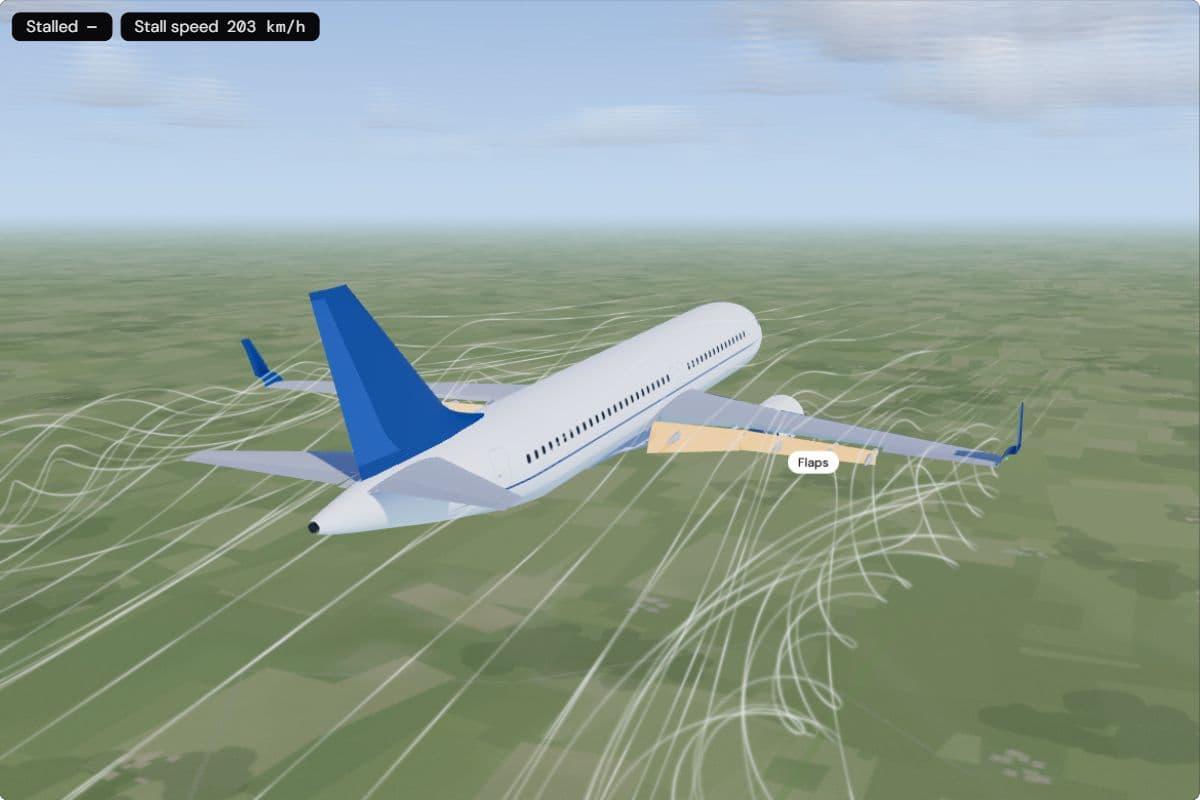
A clean wing is built for speed, not for landing. In the model, a 64 t A320 with its flaps and slats retracted stalls below 282 km/h at 1,000 m: below that speed it can't make enough lift to carry its weight without the airflow breaking away. To land on a normal runway it has to fly much slower than that.
Step 2 of 8 · Predict
Flaps add a lot of lift, and some drag
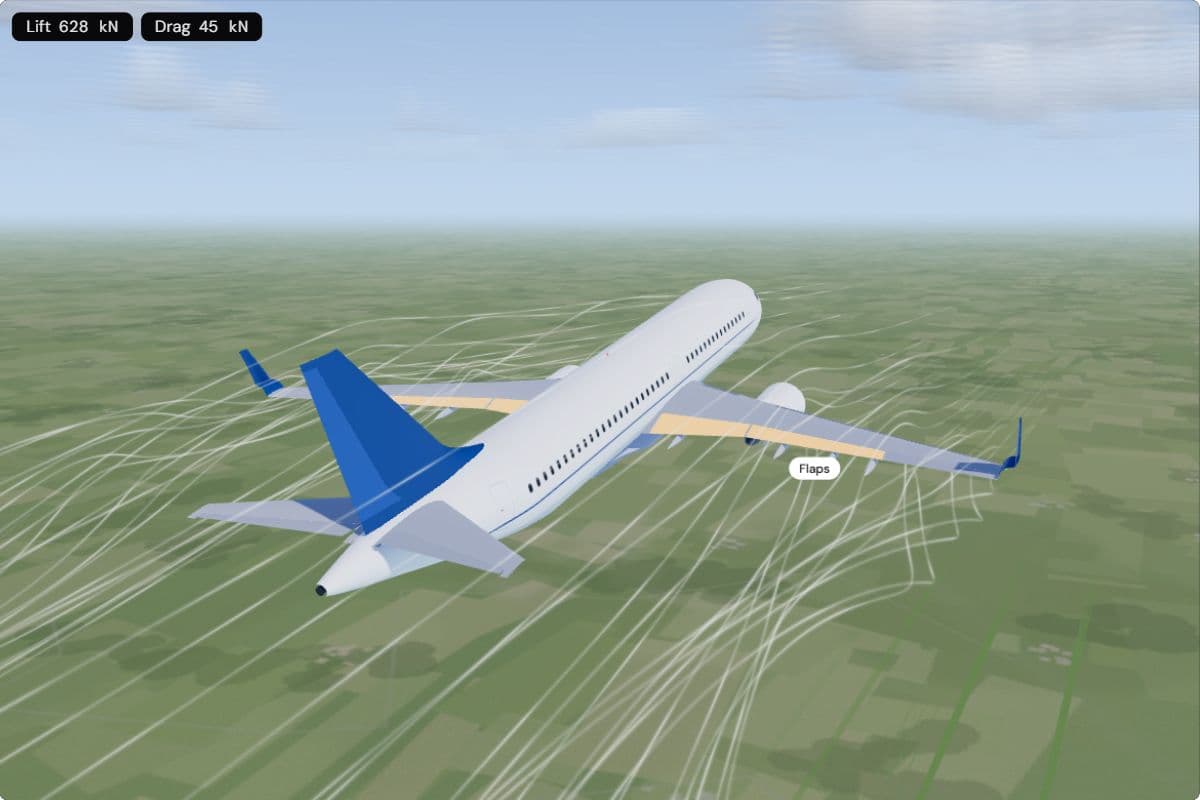
A common explanation is that flaps are air brakes that only add drag. The model shows why that fails. Freeze an A320 at 300 km/h with its clean wing at 11.9°, carrying exactly its 628 kN weight, and extend the flaps fully without changing the speed or the angle: the lift jumps to 1,149 kN, about 520 kN more.
The drag grows too, and in proportion even more: it more than triples, from 45 to 156 kN. But the extra lift is the point. Because the wing now lifts so much more at a given speed, the same plane can fly as slowly as 203 km/h instead of 282 before it stalls. In real flight the pilot lowers the nose as the flaps come out, so the lift stays equal to the weight and the plane slows down instead of climbing.
Step 3 of 8 · Try it
How flaps increase lift: a more curved, larger wing
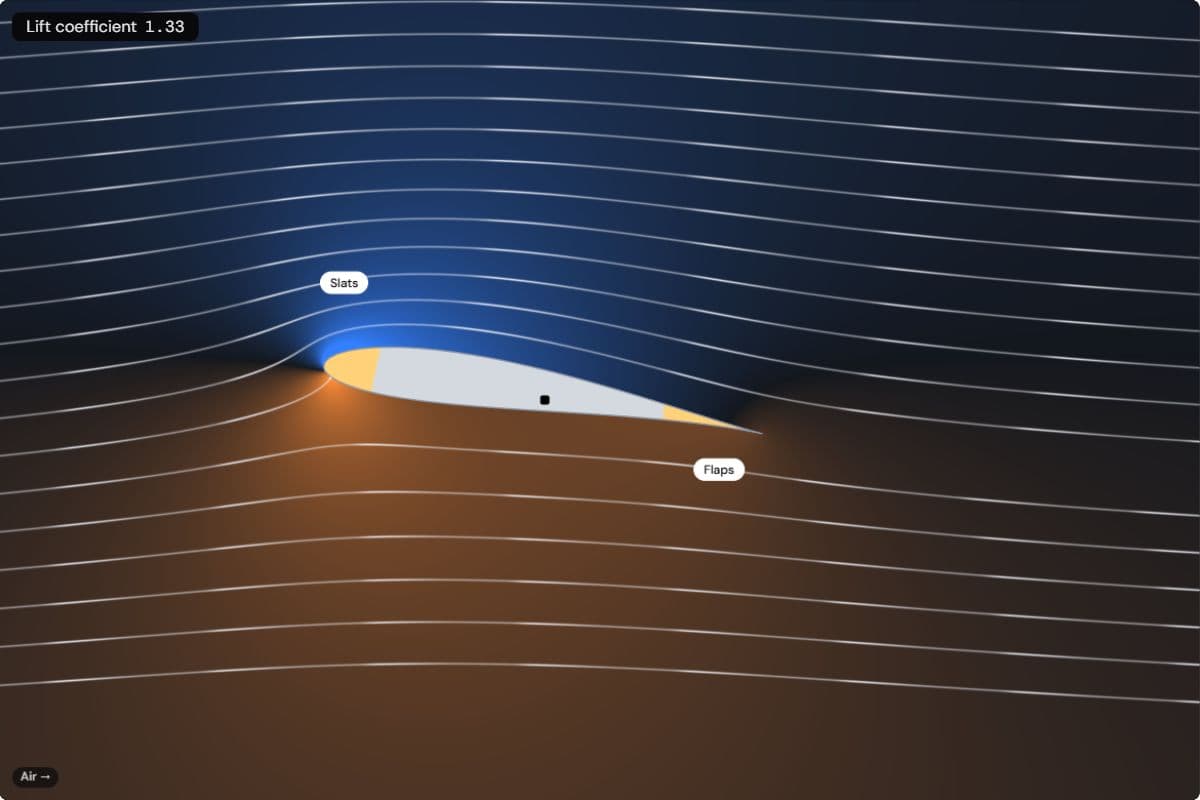
A wing makes lift by turning the passing air downwards. A flap that swings down bends the back of the wing: the profile becomes more curved (aerodynamicists say it has more camber), and the air leaves the trailing edge more steeply. At the same angle the wing turns more air down and gets pushed up harder. In the model the lift coefficient, which measures how much lift a wing makes for its size and speed, rises from 1.33 to 2.43 at 11.9° when the flaps go from retracted to full.
Airliner flaps also slide backwards before they swing down. That makes the wing larger, and a larger wing lifts more at the same speed. The wing section in the 3D view draws only the extra curve, not the gap or the extra area of the real flap. The slats help in a different way: they let the air stay attached to the top of the wing at steeper angles.
Halfway
See it for yourself in 3D
Reading is one thing. In the tour you change it yourself and watch what happens, step by step.
Start the 3D tourStep 4 of 8 · Try it
Flaps and slats lower the stall speed
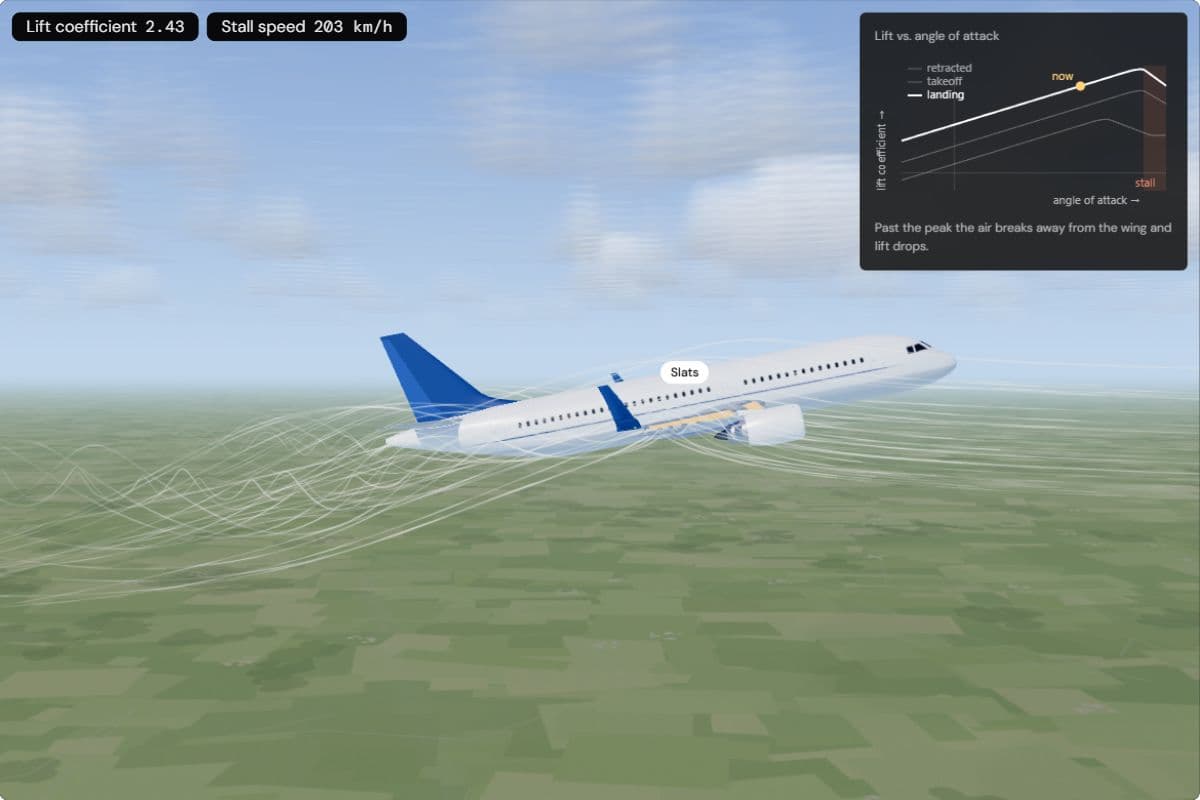
Plot the lift against the angle of attack and you get the wing's lift curve. Each flap setting lifts the whole curve and raises its top. In the model the highest lift coefficient is 1.5 with the flaps and slats retracted, 2.3 in the takeoff setting and 2.9 in the landing setting, in line with the values in aircraft-design textbooks for airliners with slotted flaps. The slats let the curve keep rising to about 18° instead of 14.5° before the flow breaks away.
A higher top of the curve means a lower stall speed: the wing reaches the lift it needs at a lower speed. For a 64 t A320 at 1,000 m the model gives 282 km/h retracted, 228 km/h in the takeoff setting and 203 km/h with full flaps, more than a quarter less.
Step 6 of 8 · Try it
Slowing down to land, and what happens without flaps
Airliners must approach at no less than 1.23 times their stall speed in the landing configuration (FAA, 14 CFR 25.125). With full flaps that is 1.23 × 203 = 250 km/h for the model's A320 at 1,000 m; near the runway, where the air is denser, it is about 240 km/h, the figure on the page "How fast do planes fly?". At 250 km/h the wing needs an angle of only about 6° and still has a margin before it stalls.
Retract the flaps at that speed and the stall speed jumps back to 282 km/h, above the speed the plane is flying. The wing stalls, and the model plane sinks up to about 9 m/s. With only the takeoff setting it would still fly. A plane whose flaps fail must therefore land much faster: about 350 instead of 250 km/h at 1,000 m, about 330 instead of 240 km/h near the runway. Kinetic energy grows with the square of the speed, so the brakes have almost twice as much energy to take away on the runway. Flapless landings do happen, and crews then pick a long runway.
Step 7 of 8 · Explain
Why the drag of the flaps still helps
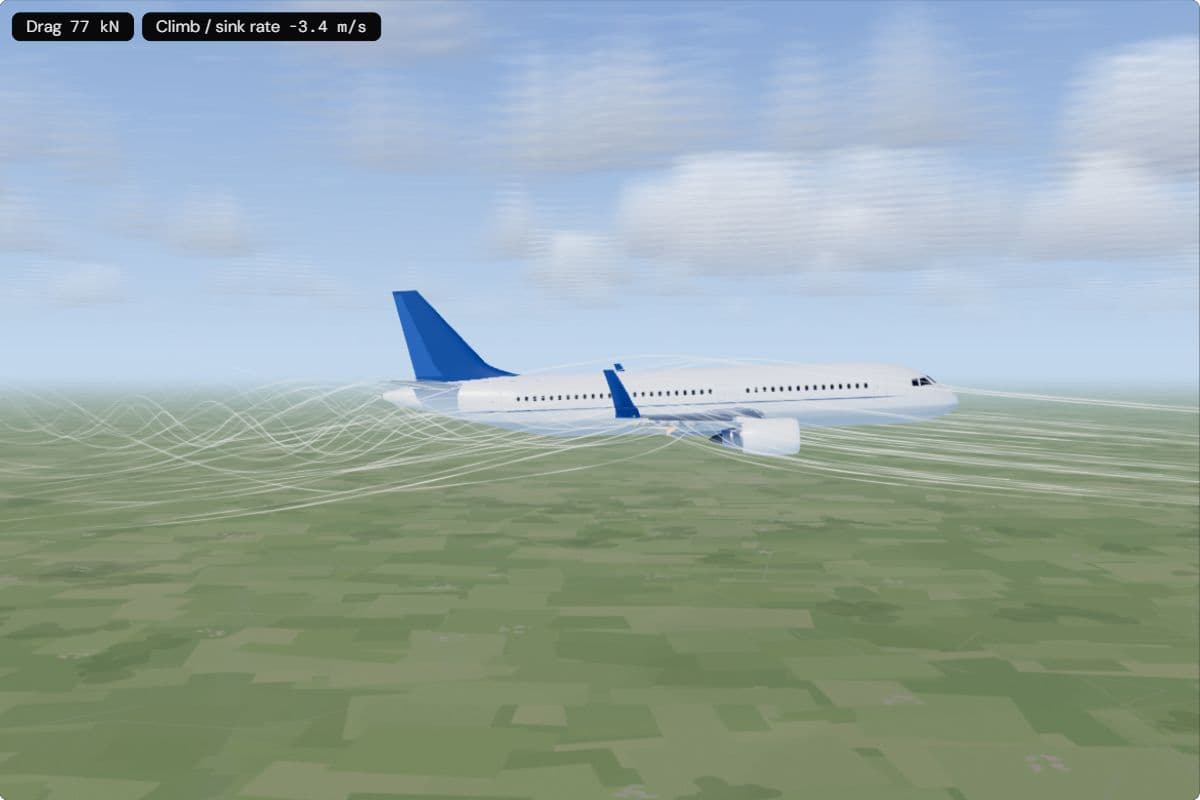
The drag of the flaps is not wasted. With full flaps at 250 km/h and the thrust lever at 25 %, the model's A320 holds its speed and sinks about 3.5 m/s, a shallow descent of about 3°. The flaps' 77 kN of drag lets it come down this slowly while the engines keep running at a useful power.
A clean wing has almost no drag to spare. For the same 3° path at 350 km/h it needs the thrust lever at about 4 %, close to idle, so it can't come down and slow down at the same time. That is how pilots use flap drag on the approach. It always comes together with the extra lift, though; when they only want to lose speed or height, they use the spoilers.
How do planes land? Flaps from approach to touchdown
Flaps don't come out all at once. As the plane slows down on its way to the airport, the crew extends flaps and slats in stages, each at a speed the setting allows; flaps have speed limits, because the air at higher speeds would load them too much. Then the landing gear comes down, the flaps go to the landing setting, and the plane flies a stabilised approach: steady speed, steady descent, lined up with the runway (FAA Airplane Flying Handbook, chapter on approaches and landings).
Just above the runway the pilot raises the nose a little, the flare, so the descent slows and the main wheels touch down first. Then the ground spoilers deploy and dump the lift, the wheel brakes grip, and reverse thrust adds more braking. The approach speed itself, about 240 km/h for a typical A320, is covered on "How fast do planes fly?".
Takeoff or landing: why the settings differ
Flaps aren't only for landing. For takeoff the crew sets a middle position, so the wing lifts enough at a lower speed and the plane leaves the runway sooner. The full landing setting would give even more lift, but its drag would slow the climb after lift-off.
The reason is how flap travel works: the first part of the travel adds mostly lift for little drag, the last part adds little lift but a lot of drag (German Wikipedia, "Auftriebshilfe"). For takeoff, where every bit of thrust should go into climbing, pilots use the first part. For landing, where a slow speed and a steady descent are wanted, they use it all. The model's takeoff numbers are on "How fast do planes fly?".
Types of flaps: plain, split, slotted and Fowler
A plain flap is the simplest: the back of the wing hinges down. A split flap only folds down the lower surface, while the top stays in place. A slotted flap leaves a gap to the wing, through which fast air from below flows over the top of the flap and keeps it from stalling. A Fowler flap first slides backwards on tracks and then down, so it adds wing area as well as camber, and usually has one or more slots (SKYbrary, "Flaps").
Airliners use Fowler flaps because they give the most lift; the A320 has single-slotted Fowler flaps. At the leading edge, most airliners use slats, which open a slot in front of the wing, and some, like the Boeing 747, add Krueger flaps, which fold out from the underside of the leading edge. Small planes like the Cessna 172 manage with simple slotted flaps.
FAQ
Frequently asked questions
- What is the difference between flaps and spoilers?
- Flaps sit at the back of the wing and make it lift more at low speed, adding some drag. Spoilers are panels on top of the wing that tilt up and do the opposite: they cut lift and add drag. In flight they slow the plane or steepen its descent; after touchdown they dump the lift so the wheel brakes work.
- What is the difference between flaps and ailerons?
- Both are hinged surfaces at the back edge of the wing, but they do different jobs. The ailerons, near the wing tips, move in opposite directions on the two wings: one wing gets more lift, the other less, and the plane rolls into a bank. The flaps, closer to the fuselage, move together on both wings and raise the lift of the whole wing.
- Are flaps up or down for landing?
- Down, and fully: landing uses the largest flap setting, with the flaps slid back and angled down as far as they go. That gives the highest lift at low speed, and the extra drag helps the plane hold a slow, steady descent. They are retracted again after landing, while the plane taxis to the gate.
- Can a plane land without flaps?
- Yes, but much faster. Without flaps the stall speed is higher, so the approach speed must be too: for a typical A320, about 330 instead of 240 km/h near the runway in the model. That means almost twice the energy for the brakes, so crews choose a long runway for a flapless landing.
- Why are flaps used for takeoff?
- With flaps in the takeoff setting the wing lifts enough at a lower speed, so the plane leaves the ground sooner and needs less runway. Pilots use only a middle setting, because the full landing setting would add so much drag that the plane would climb slowly. How this plays out for an A320 is shown on "How fast do planes fly?".
- Do flaps increase drag?
- Yes. In the model the drag of an A320 at 300 km/h and the same angle more than triples with full flaps, from 45 to 156 kN, while the lift almost doubles. The first part of the flap travel adds mostly lift, the last part mostly drag, which helps on a steep or slow approach.
Keep exploring
Not the question you had in mind?
More on Physics of flight
- Question 1
How do planes fly?
Find out what really holds a 64-tonne airliner up, why the air over the wing doesn't wait for the air below, and what happens when both engines stop.
8 steps · BeginnerStart - Question 2
Why do planes leave trails, and only on some days?
Find out what the white lines behind planes are made of, and why they vanish in seconds on one day and stay for hours on the next.
8 steps · BeginnerStart - Question 3
What causes a plane to stall?
Push an airliner past the critical angle of attack, see the air break away from the wing, and find out why full power and a fast turn don't protect it.
8 steps · BeginnerStart