Physics of flight · Question 6 of 7
What are wingtip vortices?
Wingtip vortices are two spinning tubes of air that trail behind every plane in flight, one from each wingtip. Under the wing the air pressure is higher than above it, so air flows around each tip and is left behind as a spiral. They are strongest when a plane is heavy and slow, not fast.
In the 3D tour, slow an A320 down, load it up and watch its vortices grow.
7 steps · Beginner · free, no account
Wingtip vortices, wake vortices and wake turbulence
Three terms describe the same thing from different sides. Wingtip vortices are the two swirls of air that roll up behind the tips of a wing that is making lift. Together they form the wake vortex (or wake vortices) a plane leaves behind it. Wake turbulence is what those vortices do to anyone who flies into them: a sudden roll, a drop or a jolt.
Every wing that carries weight makes them, from a glider to an A380. They are not a fault of the design and not exhaust from the engines: the FAA calls them a by-product of wing lift, present from the moment the nose wheel lifts off until touchdown (FAA Aeronautical Information Manual, AIM 7-4-4).
The tour, retold
Step by step
Step 1 of 7 · Explain
Two spirals behind every wing
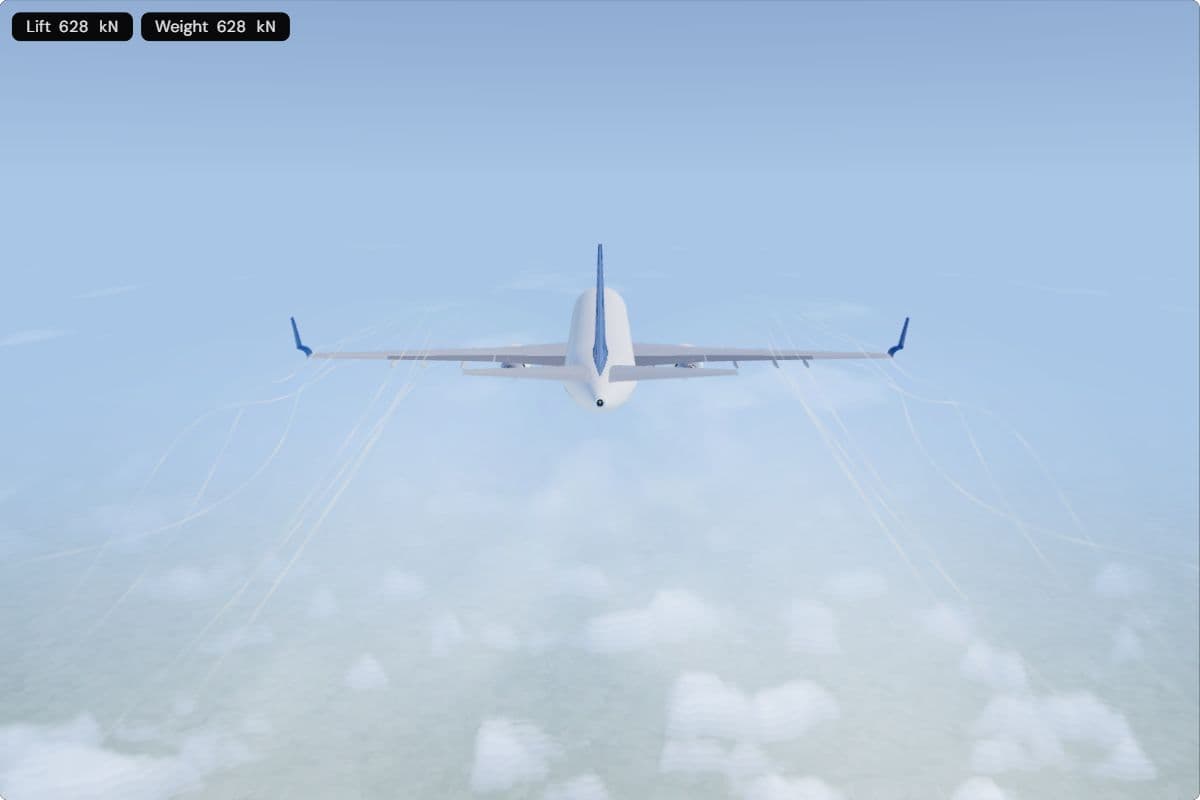
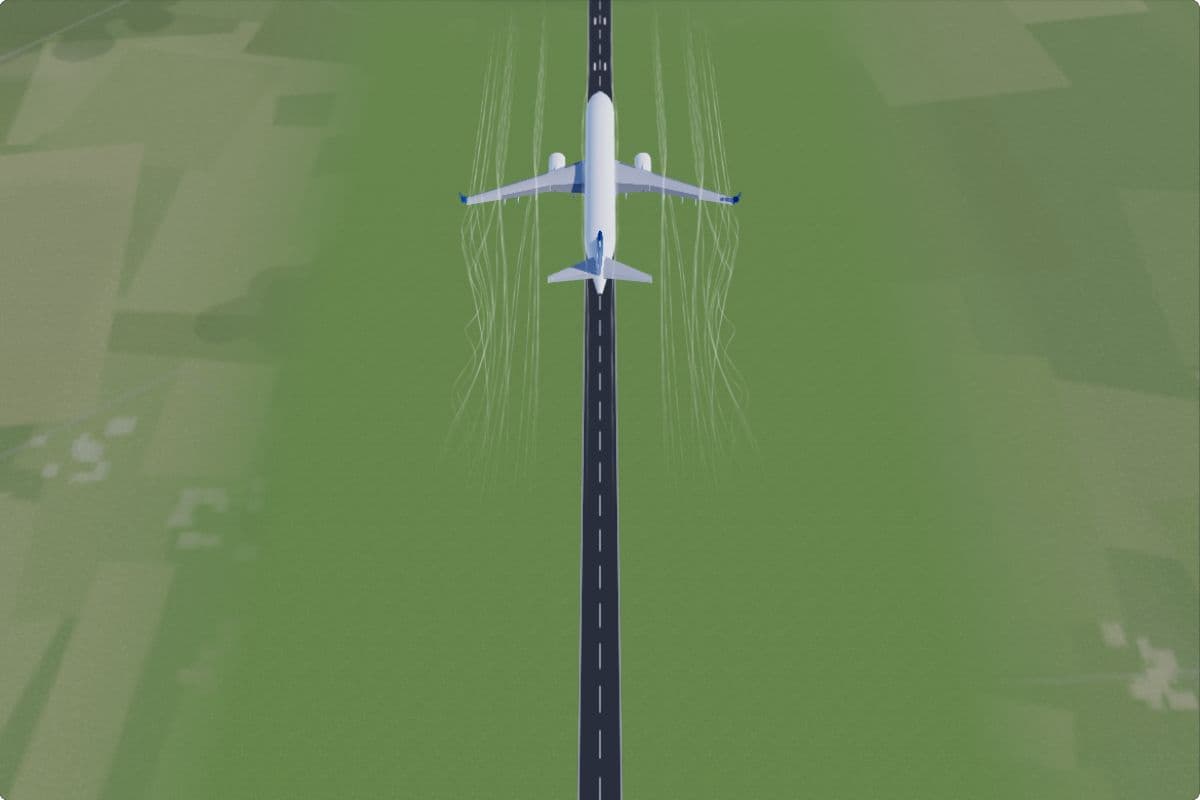
In the model, an Airbus A320 of 64 tonnes cruises at 11,000 m and 829 km/h. Its wings carry its whole weight, 628 kN. Smoke lines traced through the air around it show the flow: at each wingtip they curl outwards and round into a spiral that trails behind the plane, one on the left and one on the right, turning in opposite directions.
The smoke is drawn with twice the swirl of the real flow so it shows up on screen. In reality the vortices are invisible; you only see them when moist air condenses in their cores.
Step 2 of 7 · Explain
What causes wingtip vortices
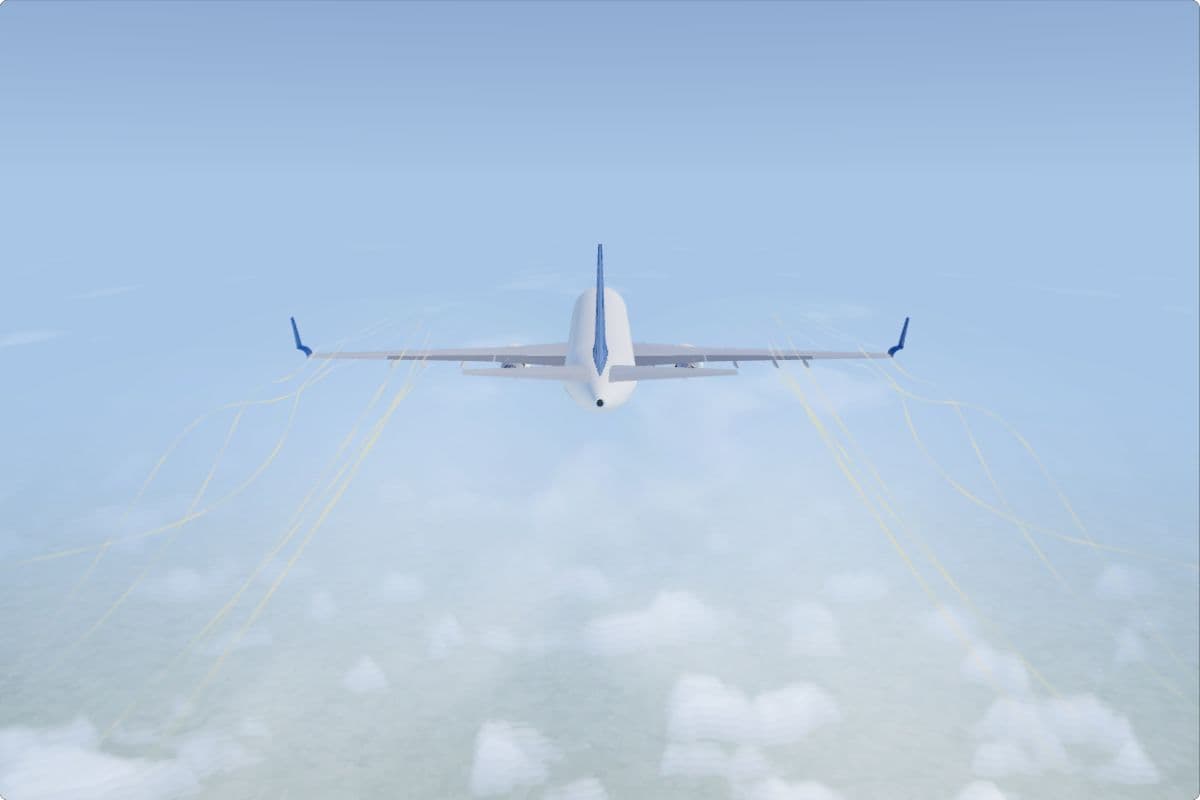
A wing makes lift by pushing air down, which leaves the air pressure under it higher than above it. That pressure difference is the lift. Along most of the wing the wing itself separates the two. At the tip nothing does, so air flows around the tip from below to above. The plane keeps moving, so the circling air is left behind as a tube that rolls up a few metres behind the wing.
Seen from behind, the left vortex turns clockwise and the right one anticlockwise: outwards under the wing, up around the tip, inwards over the top (FAA, AIM 7-4-4). Between the two tubes, the air the wing has pushed down, the downwash, sinks. The vortices are the edges of that sinking air, which is why a wing that lifts always leaves two of them.
Step 3 of 7 · Predict
Faster planes don't leave stronger vortices
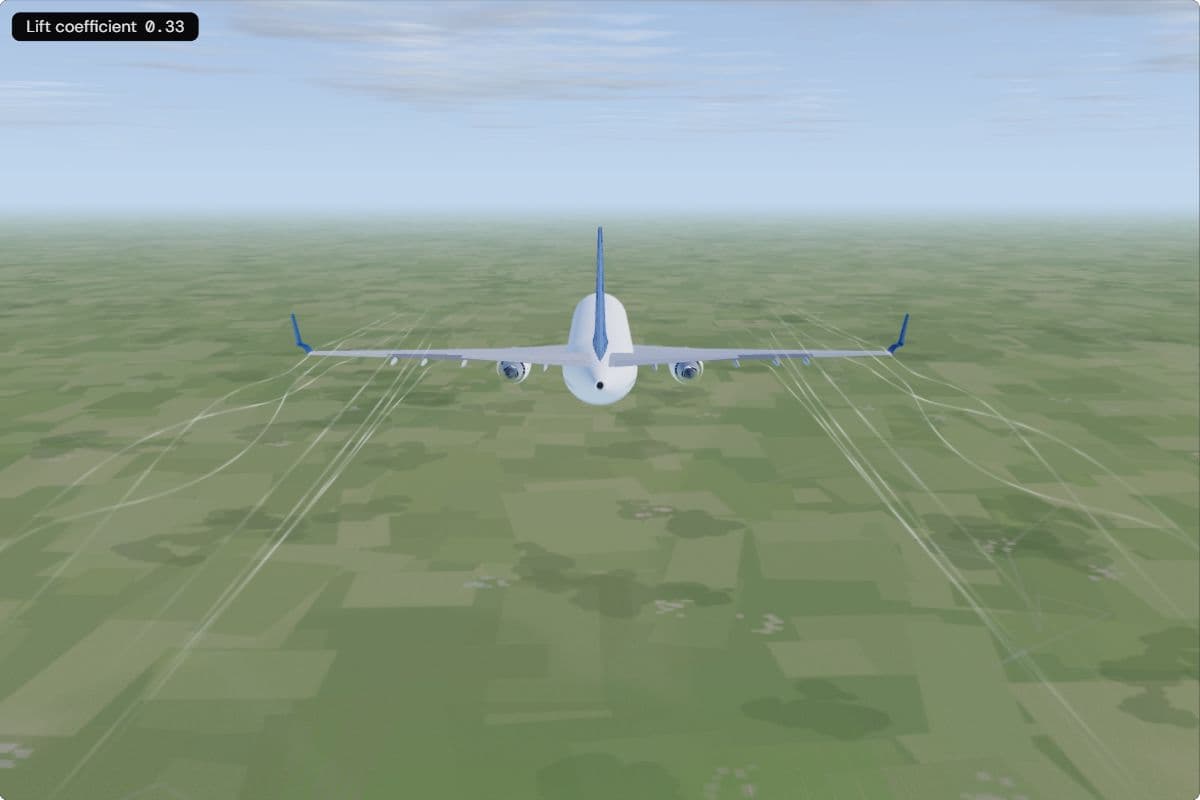
A common assumption is that a fast plane leaves the strongest wake: more speed, more violent air. It fails because the vortices come from lift, and a slow wing has to work harder for the same lift. Take the A320 down to 1,000 m near an airport. At 600 km/h its lift coefficient, how hard each square metre of wing has to turn the air, is 0.33. Slowed to 350 km/h for landing, still at 64 tonnes, it needs 0.97: almost three times as much to carry the same 628 kN.
In the model the spirals grow wider and pull in more of the air from behind the wing, and the air between them sinks more steeply. Speed the plane back up and they shrink again, until the air behind the wing hardly turns. The real vortex strength (the circulation) grows with weight ÷ (air density × speed × wingspan), so at the same height it is about 1.7 times as strong at 350 km/h as at 600 km/h. The drawing exaggerates the change, because it shows how sharply the air turns relative to the flight speed.
Halfway
See it for yourself in 3D
Reading is one thing. In the tour you change it yourself and watch what happens, step by step.
Start the 3D tourStep 5 of 7 · Try it
Heavy, clean and slow: the strongest vortices
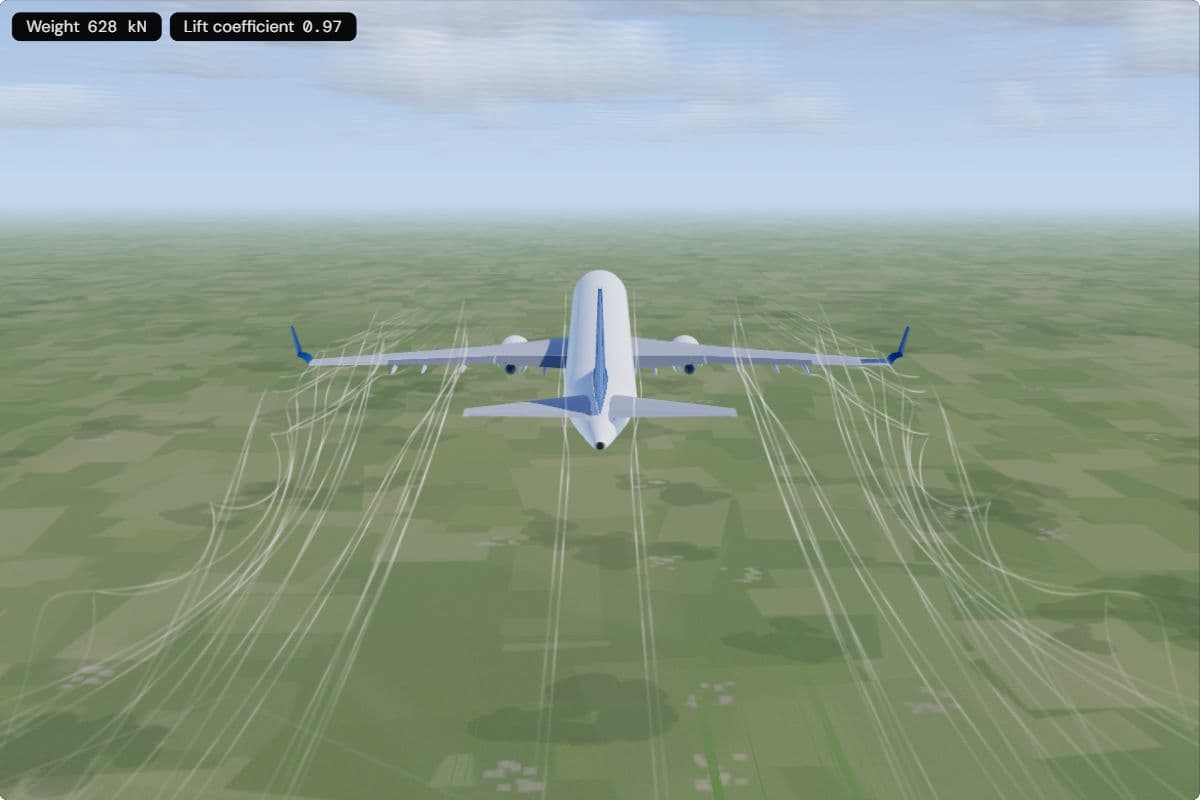
Weight is the other half of the rule. Loaded to its maximum of 78 tonnes at 350 km/h, the A320's wing has to carry 765 kN and turn the air 22 % harder: its lift coefficient rises from 0.97 to 1.19, and the vortices are 22 % stronger. Heavy and slow together, they are about twice as strong as those of the 64 t plane at 600 km/h.
Pilots learn it as one sentence from the FAA: the greatest vortex strength occurs when the generating aircraft is heavy, clean and slow (AIM 7-4-3). Clean means flaps and slats retracted; with them extended, the wake breaks up sooner. The model draws the flow from the lift coefficient alone and leaves that effect out, so the tour keeps the flaps up. The heaviest airliners make the strongest wakes, which is why air traffic control puts the Airbus A380 in a category of its own, Super.
Step 6 of 7 · Explain
What wingtip vortices do behind the plane
Seen from above, the two vortices run side by side behind the plane, about 30 m apart in the model: a bit less than its 34 m wingspan, because the cores sit a little inboard of the tips. The FAA gives the same rule of thumb: a bit less than a wingspan apart (AIM 7-4-4).
The model draws only the first 100 m or so. Behind that, real vortices sink at several hundred feet per minute, slow their descent and weaken with time and distance (AIM 7-4-4); at altitude they settle roughly 150–270 m below the flight path of the plane that made them (Wikipedia, Wake turbulence). Close to the ground they stop sinking and drift sideways at a few knots, and a light crosswind can hold one over the runway. Behind a large aircraft they can last three minutes and more (DLR).
Wake turbulence: why planes keep their distance
A plane that flies into another's vortex is rolled in the direction the air turns. For short-span aircraft the induced roll can be faster than their ailerons can stop (FAA, AIM 7-4-3). In 2001, American Airlines flight 587, an Airbus A300, crashed in New York after flying through a Boeing 747's wake; the copilot's hard rudder inputs broke off the fin. In January 2017 a Challenger 604 business jet passed about 300 m below an Airbus A380 over the Arabian Sea, rolled several times and lost about 3,000 m before the crew recovered; the jet was written off (de.wikipedia, Wirbelschleppe).
That is why air traffic control separates aircraft by wake category. ICAO sorts them by maximum takeoff mass: Light (up to 7 t), Medium (7 to 136 t, where the A320 belongs) and Heavy (136 t or more), with the A380 as Super. Behind a heavier plane the follower gets more distance, roughly 3 to 6 nautical miles on approach, or a waiting time of two to three minutes (de.wikipedia, Wirbelschleppe). For departures the FAA requires 3 minutes behind a Super and 2 minutes behind a Heavy from the same runway, a close parallel one or a crossing path, and 4 and 3 minutes for takeoffs from an intersection or in the opposite direction (AIM 7-4-9).
The danger isn't only near airports. At cruise height the air is about three times thinner than at 1,000 m, and the vortex strength rises as density falls. In the model, the 64 t A320's vortices at 11 km and 829 km/h have a circulation of 280 m²/s, stronger than the 217 m²/s on approach at 350 km/h. Slower means stronger at the same height; the 2017 upset shows the thin air up high counts too.
Winglets and sharklets: do they stop wingtip vortices?
No. The vortices come from the lift itself, so every lifting wing makes them, with or without winglets. What the vortices cost is energy: the swirling air and the downwash tilt the wing's lift slightly backwards, which shows up as extra drag, called induced drag or vortex drag (Smithsonian, How Things Fly). It is largest when the wing works hardest, at take-off and landing.
Winglets, the upturned ends on many airliners, spread the tip flow out and make the wing act as if it were longer. That reduces the flow around the tip and the induced drag, so the plane burns less fuel; the vortex core turns more slowly (de.wikipedia, Wirbelschleppe), but the wake doesn't go away. On the A320 family the winglets are called sharklets. They are drawn on the model's A320, but their effect on the flow isn't calculated.
Can you see wingtip vortices?
Usually not: they are made of clear air. On humid days, though, the low pressure in a vortex core cools the air enough for water to condense, and a thin white thread or a twisting cloud appears at each wingtip, often on approach or at air shows (Wikipedia, Wingtip vortices). Sometimes the vortices also show where they stir up fog, cloud or smoke behind the plane.
That is not the same as a contrail. Contrails at cruise height come mainly from the water in the engines' exhaust freezing in the cold air; our tour on contrails explains them.
FAQ
Frequently asked questions
- How long do wingtip vortices last?
- Usually a few minutes. They weaken with time and distance behind the plane (FAA, AIM 7-4-4); behind a large aircraft they can last three minutes and more (DLR). In calm air they last longest, because no wind or turbulence breaks them up.
- Do wingtip vortices rise or sink?
- They sink, at several hundred feet per minute, then slow their descent (AIM 7-4-4); at altitude they settle roughly 150–270 m below the flight path. Near the ground they stop sinking and drift sideways at 2 to 3 knots, which is why a light crosswind can hold one over a runway.
- Which aircraft make the strongest wingtip vortices?
- Heavy aircraft flying slowly with flaps up: the FAA's rule is heavy, clean and slow. The strength grows in proportion to the weight and falls as speed rises, so the largest airliners, above all the Airbus A380, make the strongest wakes, especially on take-off and approach.
- What happens if you fly into wake turbulence?
- The vortex rolls the plane in the direction its air turns, and it can drop or jolt too. For a small aircraft the roll can be faster than its ailerons can counter (AIM 7-4-3). Airliners usually just feel a sharp bump, but serious accidents have happened, which is why controllers keep planes apart.
- Are wingtip vortices dangerous at cruising altitude?
- Yes, they can be. In thin air the vortices are strong: in the model the A320's vortices at 11 km are stronger than on approach. In 2017 a Challenger 604 that passed about 300 m below an A380 at cruise height rolled several times and lost about 3,000 m before the crew recovered.
- Why are wingtip vortices bad?
- For two reasons. They are a hazard to planes that fly into them, and they cost the plane that makes them energy: induced drag, which raises fuel burn. Winglets reduce the drag, but no wing that makes lift can avoid making the vortices.
Keep exploring
Not the question you had in mind?
More on Physics of flight
- Question 1
How do planes fly?
Find out what really holds a 64-tonne airliner up, why the air over the wing doesn't wait for the air below, and what happens when both engines stop.
8 steps · BeginnerStart - Question 2
Why do planes leave trails, and only on some days?
Find out what the white lines behind planes are made of, and why they vanish in seconds on one day and stay for hours on the next.
8 steps · BeginnerStart - Question 3
What causes a plane to stall?
Push an airliner past the critical angle of attack, see the air break away from the wing, and find out why full power and a fast turn don't protect it.
8 steps · BeginnerStart