Heat pump · Question 4 of 4
Can a heat pump cool?
Yes. A heat pump cools by running its cycle backwards: a four-way valve sends the refrigerant the other way, so the unit takes heat out of the house and gives it to the outdoor air, with no extra machine. Our model moves about 8 kW out of the house for 1.6 kW of electricity on a 32 °C day.
In this tour you flip the unit to cooling in 3D, watch the two heat exchangers swap jobs, find out why the floor water stays at 18 °C and see passive cooling with the ground.
11 steps · Beginner · free, no account
Yes: the same heat pump, running backwards
Many people assume a heat pump is a heater and that cooling the house needs a separate air conditioner. In fact heating and cooling are the same job for a heat pump: it moves heat from a colder place to a warmer one. In winter the cold side is the garden and the warm side is the house. In summer the house becomes the side the heat is taken from, and the garden the side it goes to.
This is called active cooling: the refrigerant cycle runs in reverse, with the compressor doing the work. It is possible with air, ground and water heat pumps. Many air-to-water units can do it from the factory; on others it is a setting the installer switches on or a small kit. The pages that rank for this question say the process "reverses" but rarely show how. The step-by-step guide below does, with the numbers from the model.
The tour, retold
Step by step
Step 3 of 11 · Explain
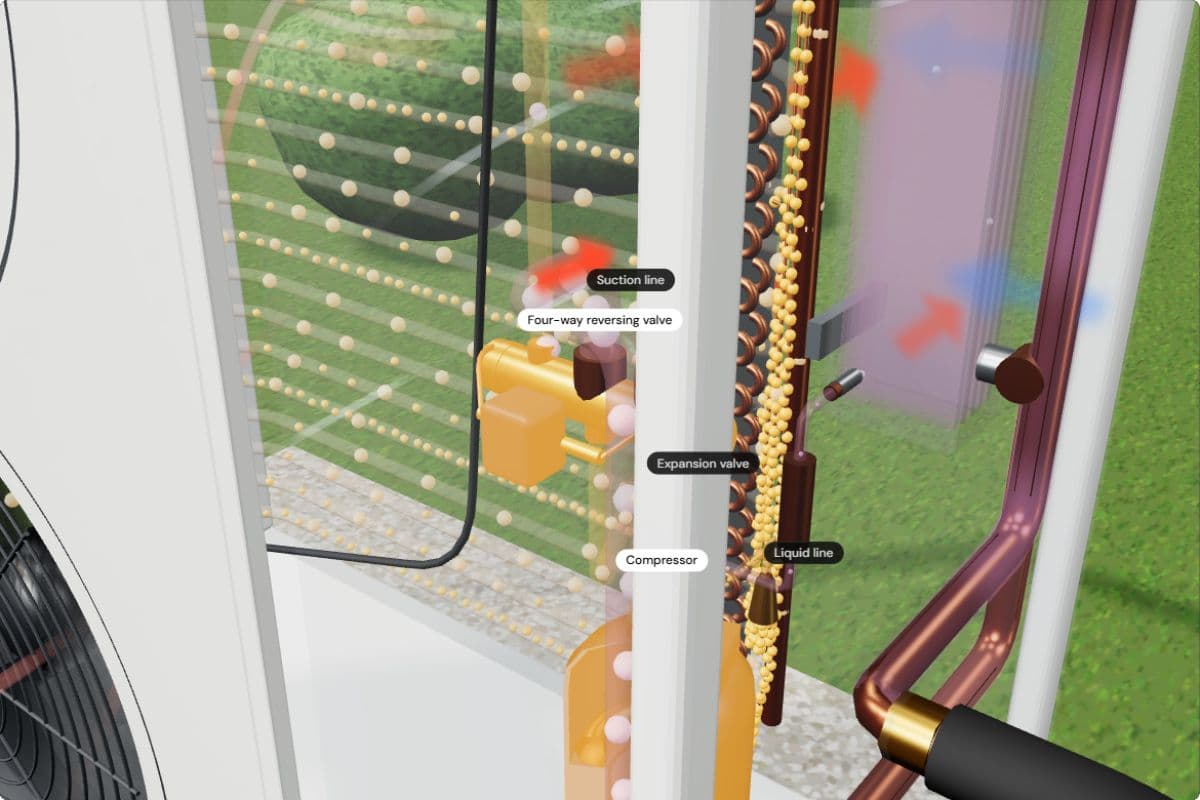
A valve turns the cycle round
In winter the model's air-to-water heat pump works like this: the coil behind the fans, the evaporator, takes about 6 kW of heat from 7 °C outdoor air. The plate heat exchanger beside the compressor, the condenser, gives about 7.4 kW to the water of the floor heating. The compressor adds the rest from about 1.4 kW of electricity.
A common explanation for cooling is that the compressor simply runs backwards. It doesn't: a compressor only pushes one way. Instead a four-way reversing valve sits on the compressor's outlet and decides where the hot gas goes. In heating mode it sends it to the plate exchanger, into the house. In cooling mode it sends it to the coil outside. The pipes stay the same; the refrigerant just flows round the loop the other way. Heat pumps already use the same valve in winter to defrost their coil.
Switched to cooling on a 32 °C day with 18 °C water for the floor, the model takes about 8.3 kW of heat out of the house for about 1.6 kW of electricity.
Step 4 of 11 · Explain
The two heat exchangers swap jobs
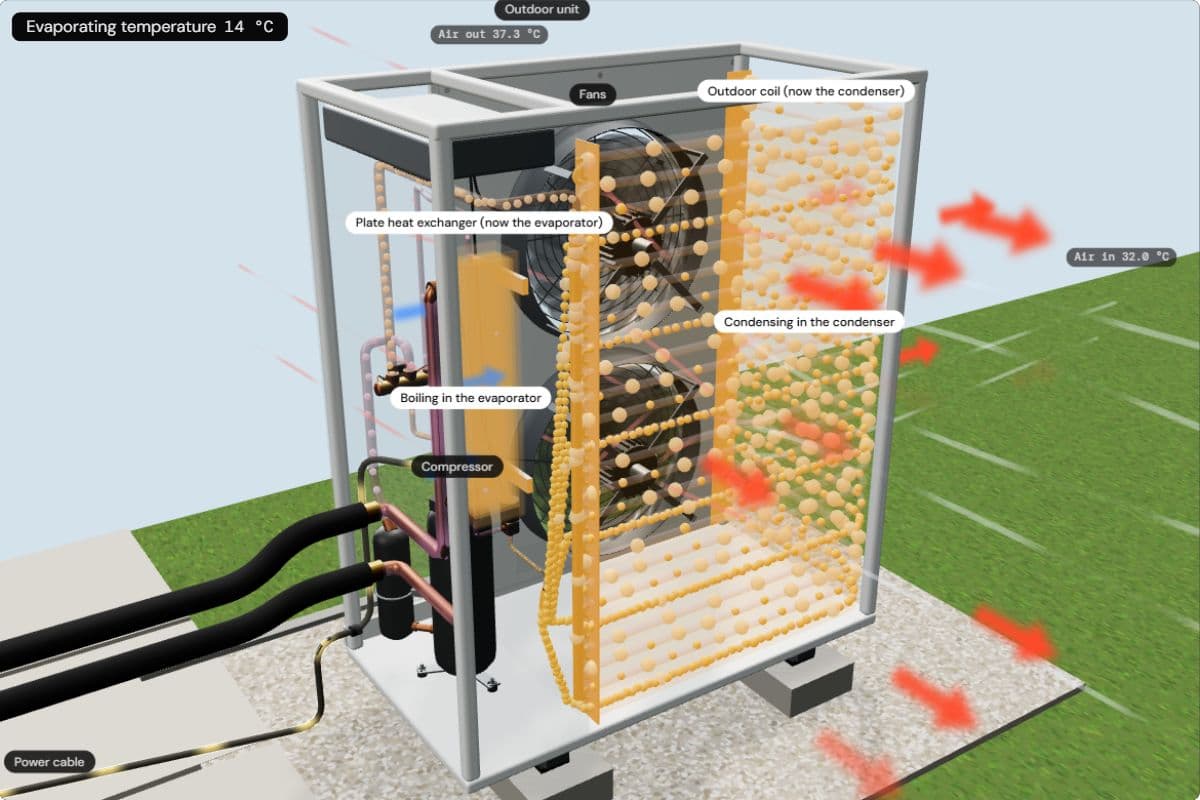
Because the refrigerant flows the other way, each heat exchanger gets the other's job. The plate exchanger, which heated the floor water in winter, is now the evaporator. Its refrigerant boils at about 14 °C. That is colder than the water coming back from the floor at about 24 °C, so heat flows from the water into the refrigerant, and the water leaves at 18 °C, cool enough to chill the floor.
The coil behind the fans, which took heat from the air in winter, is now the condenser. The compressor squeezes the vapour until it condenses at about 42 °C, ten degrees above the 32 °C garden air. Only because the refrigerant is hotter than the air can the heat flow out into it. In the 3D model the labels change with the valve: "Plate heat exchanger (now the evaporator)" and "Outdoor coil (now the condenser)".
Step 6 of 11 · Explain
The heat leaves with the fans' air
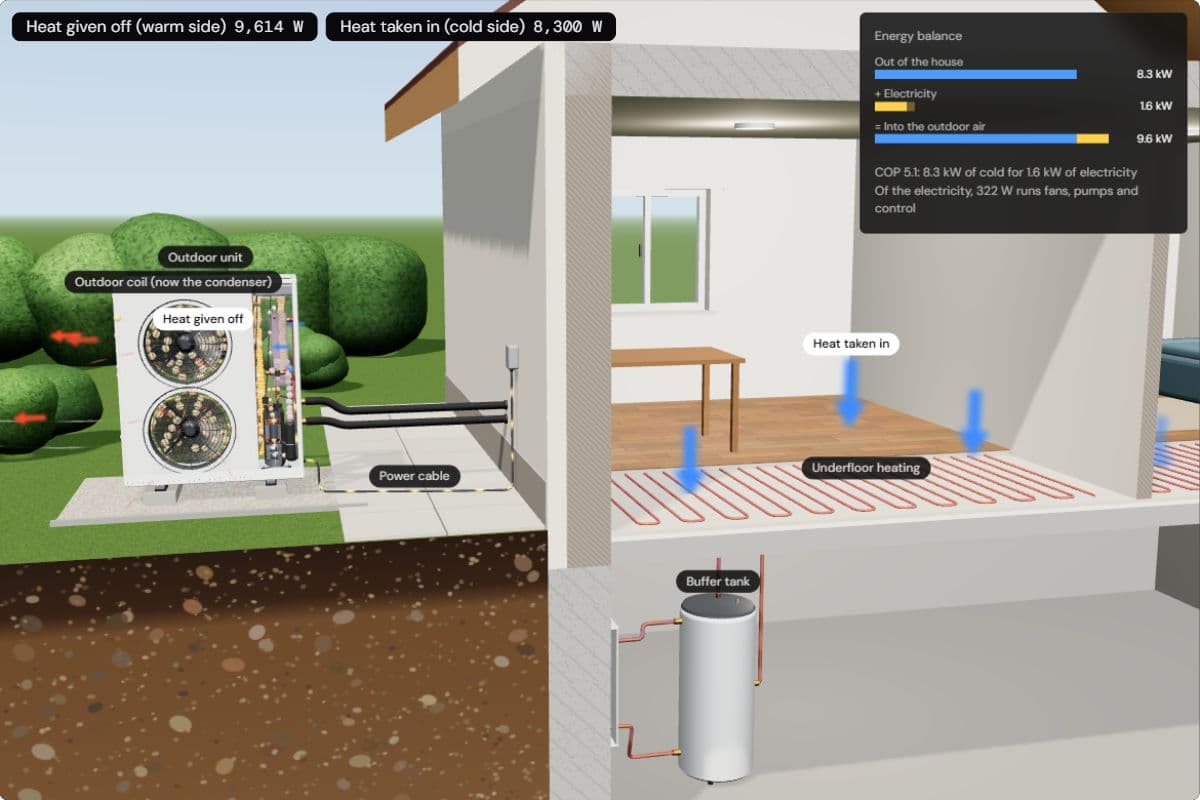
A widespread belief is that the outdoor unit of a cooling heat pump blows cold air into the garden, like the front of an air conditioner. It fails because the cold is not made outside: it goes into the floor water. What leaves the fans is the house's heat. In the model, 32 °C garden air comes out at about 37 °C, five degrees warmer. In winter it is the other way round, and the air leaves colder than it came in.
The energy balance shows where everything goes. About 8.3 kW of heat come out of the house, and the compressor's 1.3 kW of electricity end up as heat as well. Together about 9.6 kW leave through the coil into the outdoor air, and the fans' 0.3 kW warm the air on top. A heat pump cannot destroy heat; it can only move it. A fridge does the same, which is why the back of it warms the kitchen.
Halfway
See it for yourself in 3D
Reading is one thing. In the tour you change it yourself and watch what happens, step by step.
Start the 3D tourStep 8 of 11 · Try it
Hot days and cold water cost efficiency
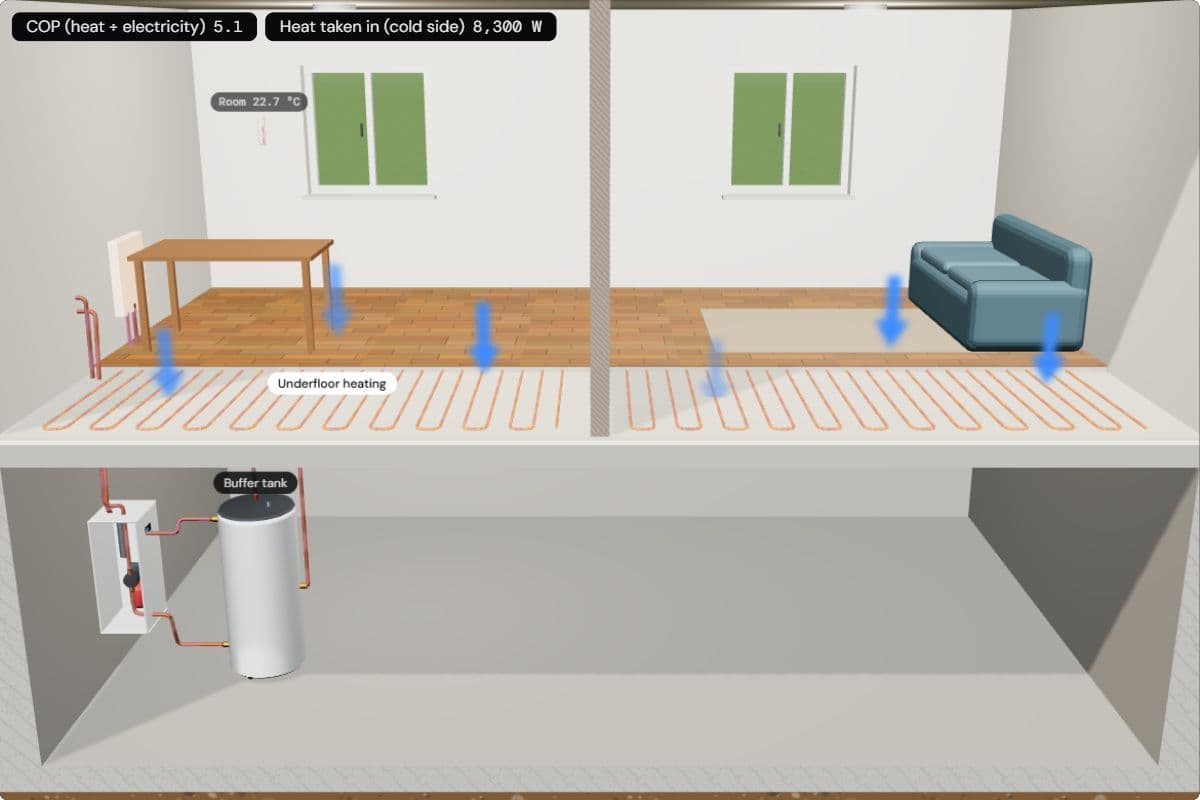
In cooling, the efficiency figure counts the heat taken out of the house per unit of electricity. For cooling it is often called the EER (energy efficiency ratio); the model's chip still says COP. At 32 °C outside and 18 °C water the model reaches about 5.1: five units of cooling for one of electricity. On a mild 24 °C day it is about 7.
Two things lower it. The first is a hotter garden: the refrigerant has to get even hotter to shed its heat, so the compressor lifts the heat further. At 35 °C the model's COP falls to about 4.5 and the cooling from 8.3 to about 8.0 kW. The unit this model follows is rated to cool in air up to 45 °C. The second is colder water. With 10 °C water instead of 18 °C, the refrigerant must boil at about 6 °C instead of 14 °C, and the COP drops to about 3.7 while the cooling falls to about 6.4 kW. The manufacturer's data for the real unit show the same trend: an EER of 5.3 with 18 °C water and 3.3 with 7 °C water, both at 35 °C outside (Viessmann Vitocal 250-A). The model sits about 15 % below the datasheet at 18 °C.
That is why floors cool with water around 18 °C while fan coils, which blow air over a cold coil, work with about 7 °C.
Step 9 of 11 · Explain
Why floor cooling stays above 18 °C: the dew point
Warm summer air carries water vapour. Any surface colder than the air's dew point gets wet, the same way a cold glass of lemonade does on a hot day. Indoors in summer the dew point is often around 17 to 19 °C. The model uses one dew point of about 17 °C for the house.
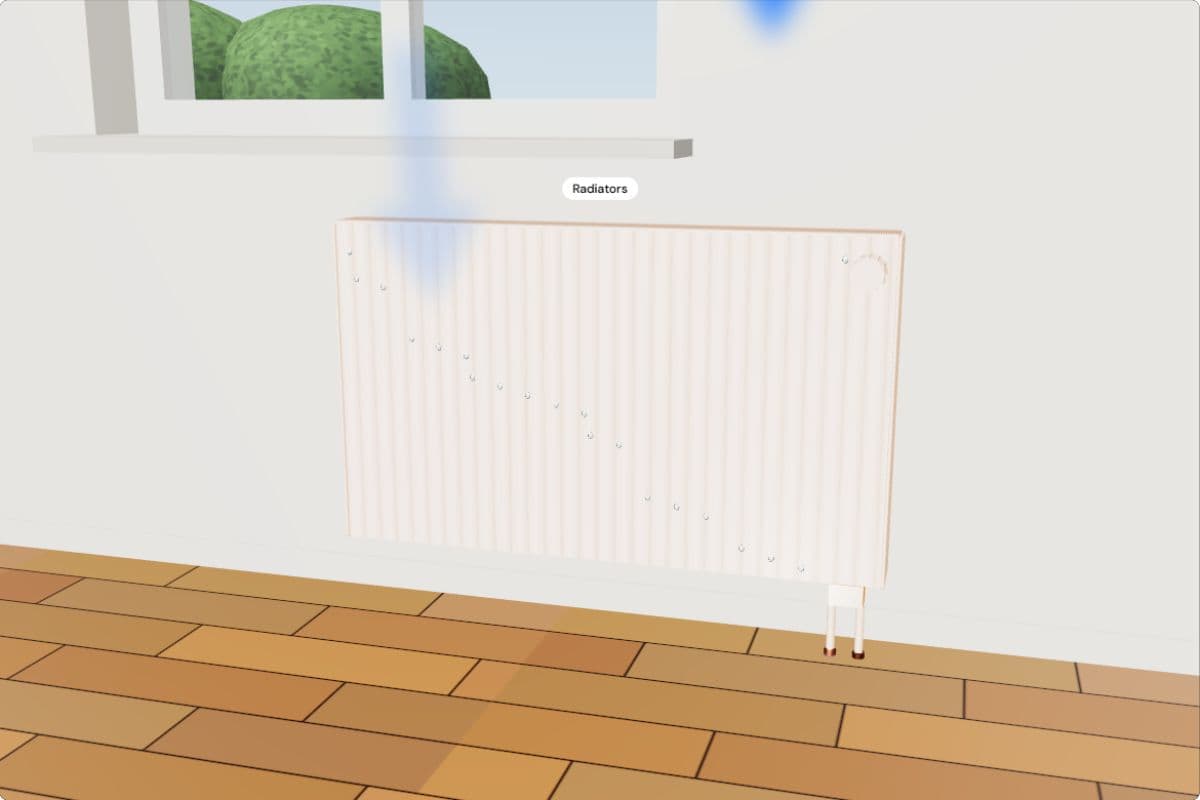
Radiators fed with 12 °C water show what goes wrong: in the model they sweat, with droplets running down the panels. On a real floor that water would soak into the screed and the flooring and could cause mould. So floor cooling runs with water of 18 °C or more, and a dew-point sensor (a humidity sensor in the room or on the pipe) raises the water temperature or stops cooling when the air gets humid. Guides from heating manufacturers recommend about 19 to 21 °C for floors.
Step 10 of 11 · Explain
Passive cooling: the ground does the work
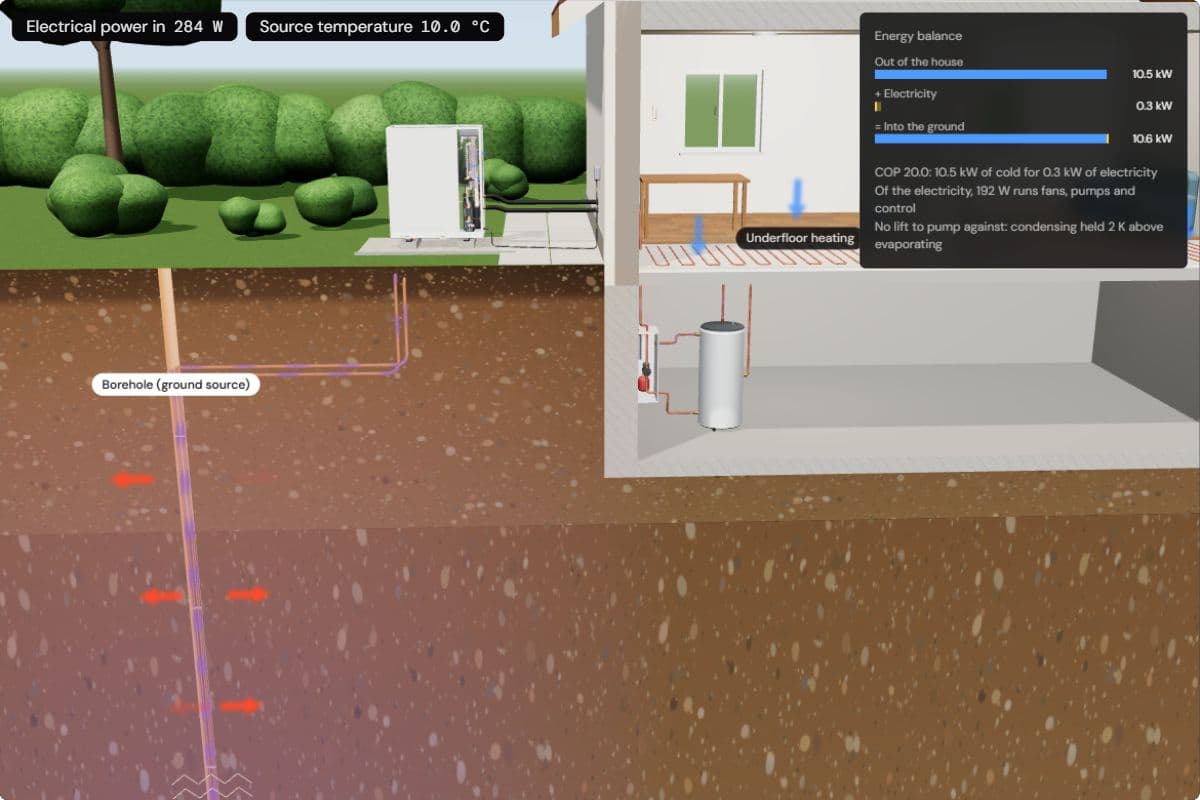
A ground-source heat pump can cool almost without the compressor. A hundred metres down, the ground stays near 10 °C all year, colder than the 18 °C floor water. So heat can flow from the floor water into the ground on its own. Real systems then switch the compressor off and only run the pumps that move the brine and the water. This is called passive cooling or natural cooling.
In the model the compressor keeps running, with almost nothing to lift, and the whole system draws about 0.3 kW instead of the 1.6 kW of active cooling with air. Manufacturers' guides describe passive cooling as gentler than active cooling and very cheap to run. Its bonus: the heat put into the ground over the summer is partly still there in the autumn. Passive cooling only works with a ground or groundwater source, never with an air heat pump, because summer air is warmer than the water you want.
Heat pump vs air conditioner: the difference is one valve
A split air conditioner runs exactly the same refrigerant cycle as a heat pump in cooling mode: an evaporator indoors boils the refrigerant and takes heat from the room, a condenser outdoors gives it to the air. It just runs one way only. A heat pump adds the four-way valve, so it can also run the other way and heat.
So an air-to-air heat pump is an air conditioner that can also heat, and in cooling there is practically no difference between them. In the US, "heat pump" usually means this ducted or ductless air-to-air kind, which replaces central air conditioning. An air-to-water heat pump like the one in this model cools the water of the floor instead of blowing cold air. That feels gentler, is quieter in the room, and does not dry the air the way an air conditioner does. For cooling, air conditioners and heat pumps are compared by their SEER, the seasonal efficiency over a whole summer.
How much cooler does it get?
Cooling through the floor takes the edge off a hot day rather than making the house cold. Manufacturers' guides give about 2 to 4 °C cooler rooms with active cooling, for example 24 to 26 °C instead of 28 °C, and up to about 3 °C with passive cooling. A split air conditioner can cool a room by up to about 12 °C. German manufacturers call floor cooling "temperieren": tempering, not air conditioning.
The reason is the dew point: the floor must stay above about 18 °C, and a floor at 18 to 20 °C can only take up a limited amount of heat. For more cooling, fan coils blow room air over colder water. Shading the windows and airing the house at night help first. The model's room cools much further than a real one, because its floor takes any amount of heat, so the tour never quotes the room temperature.
What you need: surface heating, a dew-point sensor, a unit that can cool
A heat pump that can run its cycle in reverse, or with a ground source, the parts for passive cooling. Underfloor, wall or ceiling heating: large surfaces at mild temperatures. Normal radiators are too small to take up much heat at 18 °C, and they sweat if the water is colder; special fan-assisted radiators or fan coils with a condensate drain are the alternative.
A dew-point sensor that keeps the water above the dew point. And pipes insulated so that water vapour cannot reach them, so that no condensation forms in walls or ceilings. An installer should check all of this before the cooling is switched on.
What this model simplifies
Passive cooling is not modelled: with a ground source the compressor keeps running, with almost nothing to lift, instead of stopping. The floor takes any amount of heat and never sweats, so the model's rooms cool far more than real ones; only the radiators show sweating, and the whole house has one fixed dew point of about 17 °C. The outdoor temperature slider stops at 35 °C, while the real unit cools up to 45 °C. The model's efficiency at 35 °C air and 18 °C water is about 15 % below the datasheet.
FAQ
Frequently asked questions
- Can every heat pump cool?
- Most air-to-water and ground-source heat pumps with a four-way reversing valve can cool actively; on some it is a setting or a kit the installer adds. Passive cooling needs a ground or groundwater source. Check the unit's datasheet for a cooling capacity or EER.
- Does a heat pump cool as well as an air conditioner?
- An air-to-air heat pump is the same machine as an air conditioner and cools just as well. An air-to-water heat pump that cools through the floor is gentler: manufacturers' guides give about 2 to 4 °C cooler rooms, and it does not dry the air.
- Can a heat pump cool a house with radiators?
- Hardly. Normal radiators have little surface, so with water above the dew point they take up little heat, and with colder water they sweat. Fan coils or special fan-assisted radiators with a condensate drain can cool instead.
- Will a heat pump work in 100 degree weather?
- Yes. The unit this model follows is rated to cool in outdoor air up to 45 °C (113 °F). It gets less efficient as the air gets hotter: in the model the COP falls from about 5.1 at 32 °C to about 4.5 at 35 °C.
- How much electricity does a heat pump use for cooling?
- In the model, about 1.6 kW of electricity takes about 8.3 kW of heat out of the house on a 32 °C day: a COP of about 5. Passive cooling with a ground source needs only the pumps, about 0.3 kW in the model.
- What does the reversing valve in a heat pump do?
- The four-way reversing valve decides where the hot gas from the compressor goes: to the indoor heat exchanger for heating, or to the outdoor coil for cooling. The compressor keeps running the same way; the valve makes the refrigerant flow round the loop in the other direction. It also turns the cycle round briefly to defrost the outdoor coil in winter.
Keep exploring
Not the question you had in mind?
More on Heat pump
- Question 1
How does a heat pump work?
Meet the four parts of a heat pump, ride along with the refrigerant and find out why 1.4 kW of electricity brings 7.4 kW of heat into the house.
15 steps · BeginnerStart - Question 2
How does a refrigerator work?
Find out why an open fridge warms the kitchen, follow the refrigerant from the cold plate to the warm grille and watch the thermostat switch the compressor on and off.
12 steps · BeginnerStart - Question 3
How does a heat pump work in winter?
Drag the air down to −15 °C and watch the heat pump keep heating, find out why its output and COP fall, cover a cold house, watch the unit ice up and defrost, and switch to ground heat.
15 steps · BeginnerStart