Physics of flight · Question 4 of 7
How fast do planes fly?
Airliners like the Airbus A320 cruise at about 830 km/h (515 mph), Mach 0.78, some 11 km up: just below the speed of sound, where drag would shoot up. They leave the runway at roughly 250–290 km/h (155–180 mph), but speed alone doesn't lift them off: the pilot raises the nose.
In this tour you push a 3D A320 towards the sound barrier, then rotate it off the runway yourself, at a typical and a full load, with and without flaps.
8 steps · Beginner · free, no account
Takeoff, cruise, landing: how fast a plane flies in each phase
An airliner's speed depends on the phase of the flight. On the runway it accelerates from standstill to its lift-off speed in well under a minute: an Airbus A320 or a Boeing 737 leaves the ground at roughly 240–290 km/h (150–180 mph, 130–155 knots), depending on its weight. Aerospaceweb's table of airliner takeoff speeds gives about 130 kt for a 737 at 45 t, 150 kt for an A320 at 70 t and 155 kt for a 747 at 363 t.
In cruise, some 10–12 km up, an A320 flies at Mach 0.78, 78 % of the speed of sound up there: 829 km/h, 515 mph or 448 knots through the air (Airbus A320 family specifications). Long-haul jets like the Boeing 787 cruise a little faster, at Mach 0.85, about 900 km/h (560 mph).
For landing the plane slows down again, with flaps and slats fully extended. Certification rules set the approach speed at no less than 1.23 times the stall speed in the landing configuration (FAA, 14 CFR 25.125). For a 64 t A320 the model's stall speed with full flaps is 193 km/h, so it comes in at about 240 km/h (150 mph, 130 kt): a little slower than it took off.
The tour, retold
Step by step
Step 1 of 8 · Explain
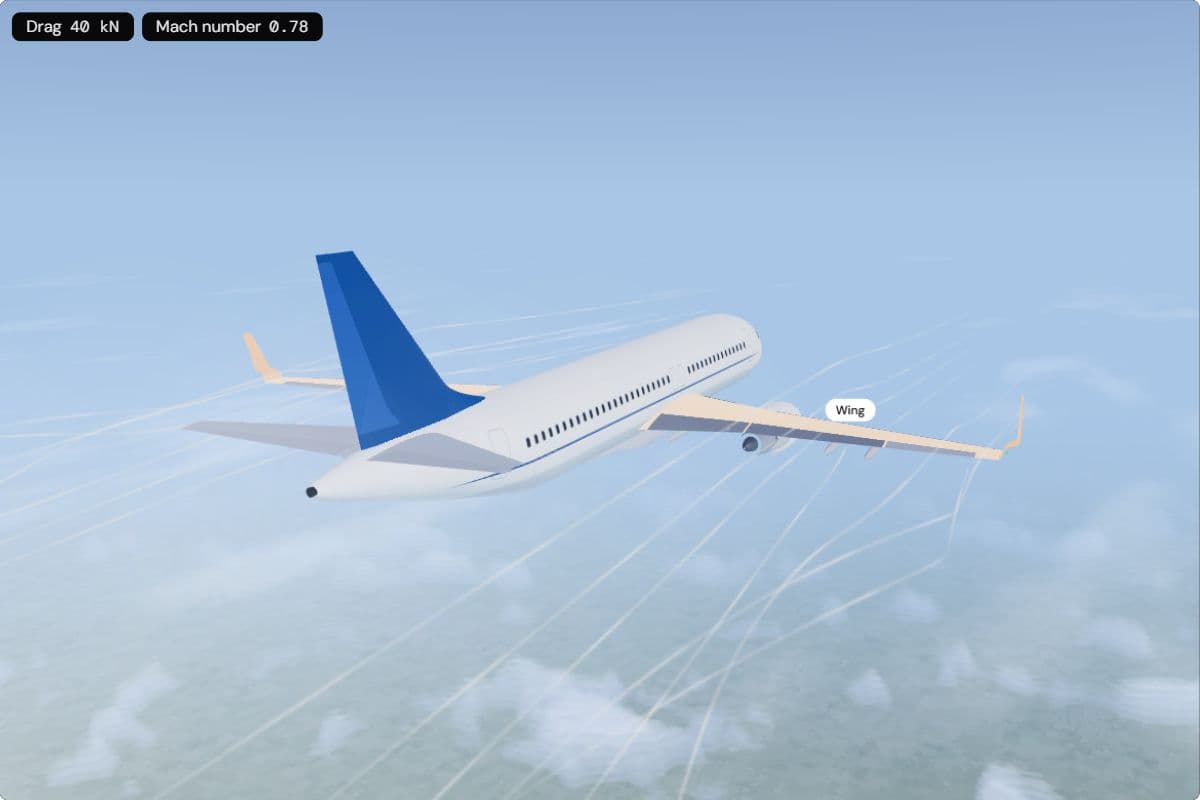
Cruise: about 830 km/h, Mach 0.78
In the model, an A320 of 64 tonnes cruises 11 km up at 829 km/h. At that height the air is −56.5 °C, and in cold air sound travels more slowly: 1,062 km/h instead of 1,225 km/h at sea level. So the same 829 km/h is Mach 0.78 up there. That is why pilots and flight plans state the cruise speed as a Mach number rather than in km/h.
In steady cruise the engines push exactly as hard as the drag holds the plane back, 40 kN in the model, about two thirds of the thrust lever. The speed through the air is what the wing and the engines feel. The number on the cabin's flight map is something else, the speed over the ground (see below).
Step 2 of 8 · Try it
Why airliners don't fly faster
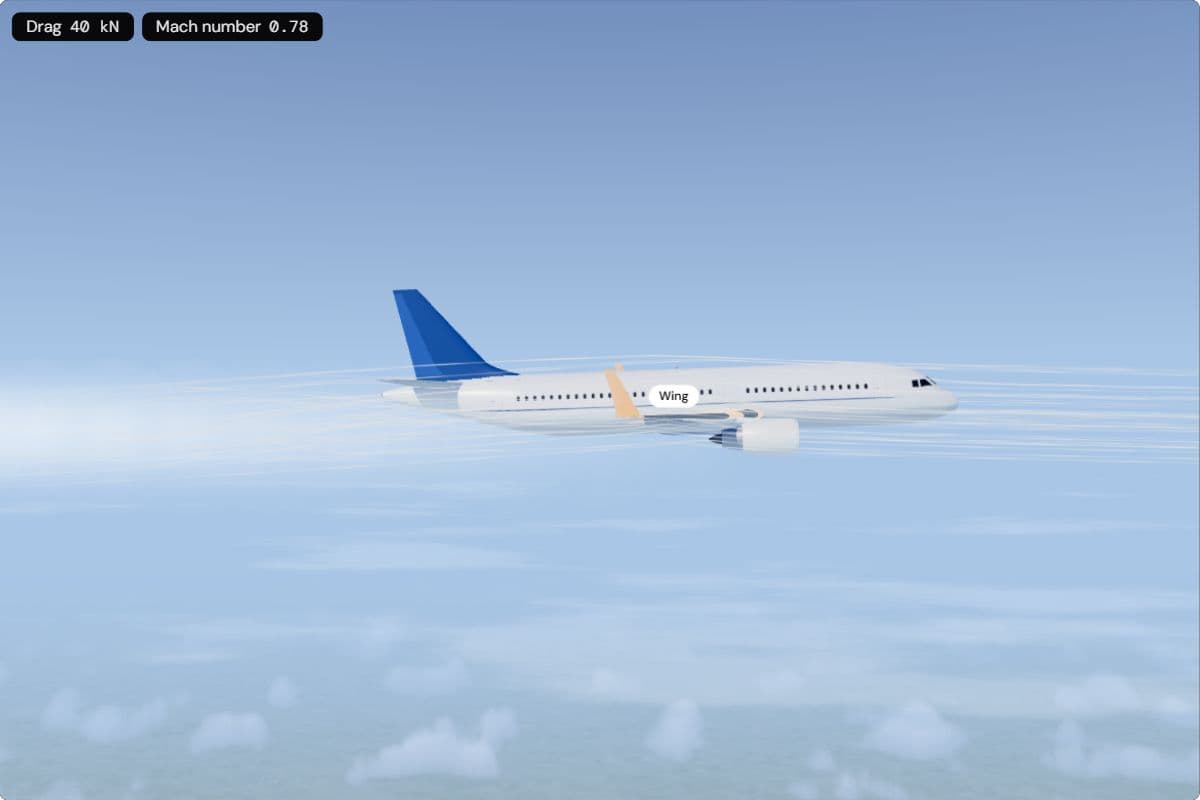
The engines aren't the limit. Over the curved top of the wing the air speeds up, and near Mach 0.8 it goes faster than sound in places. Shock waves form there, and the drag starts to rise steeply; aerodynamicists call this drag divergence. In the model at 11 km the A320 meets 40 kN of drag at 829 km/h, 50 kN at 900 km/h and 73 kN at 950 km/h, almost twice as much as in cruise for 15 % more speed.
Flying faster would therefore cost a lot of fuel for little time saved. To hold its height at 900 km/h the model plane burns 311 kg of fuel per 100 km instead of 273 kg, at 950 km/h 434 kg. At full thrust up there, about 56 kN, it can't hold its height above about 920 km/h. The A320's certified maximum is Mach 0.82, about 870 km/h (Airbus A320 family specifications). Airlines choose a cruise speed just below the drag rise.
Flying lower doesn't help: the air is denser down there, and the same 829 km/h meets 92 kN of drag at sea level, more than twice as much as at 11 km.
Step 3 of 8 · Predict
Speed alone doesn't lift a plane off
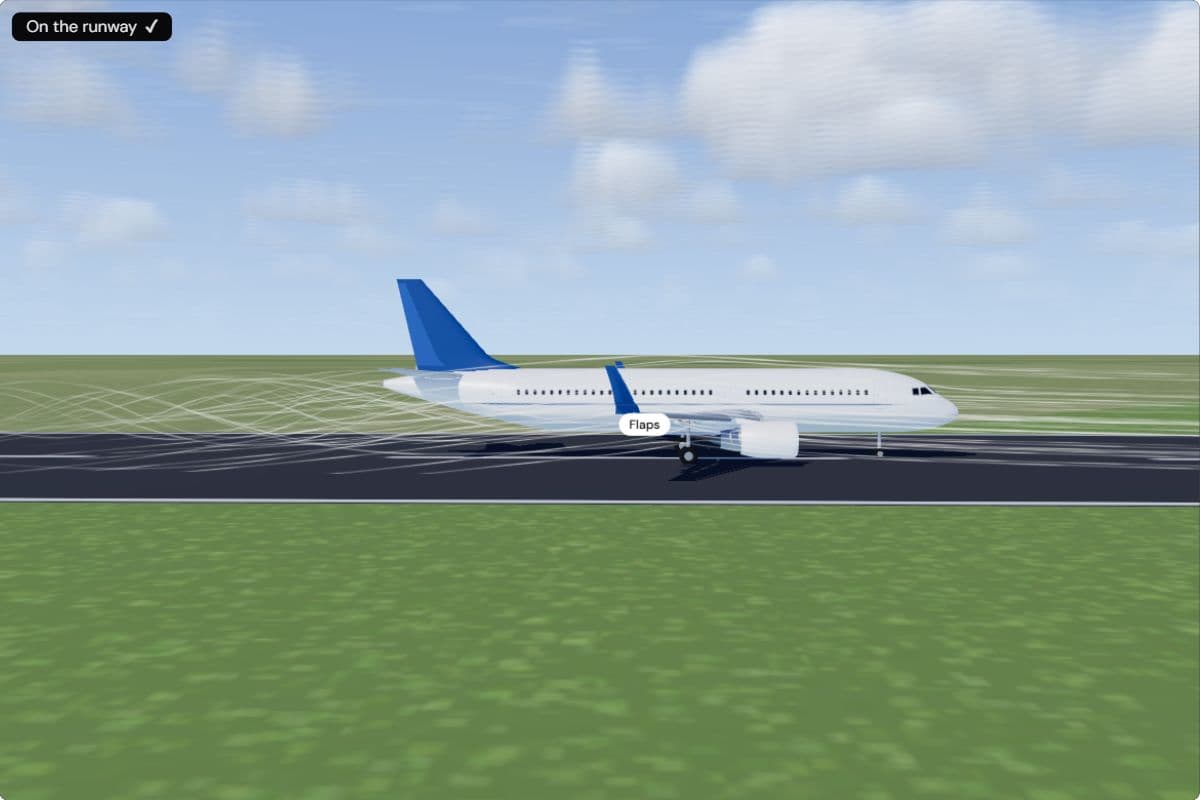
A common idea is that a plane simply lifts off by itself once it is going fast enough, and that the nose only comes up afterwards to climb. Some also picture the engines at full power pushing the plane up. Both miss what happens at the wing.
On the runway an A320's wing meets the air at only about 1°, with all wheels on the ground. In the model, with takeoff flaps and full thrust at 280 km/h, the speed at which it normally lifts off, the wing then makes only 382 kN of lift against 628 kN of weight, about 61 %. Kept like this, the plane would need about 370 km/h to lift off, and more than 2 km of runway instead of about 1.1 km. The engines push forward, along the runway; the wing has to turn that speed into lift.
Halfway
See it for yourself in 3D
Reading is one thing. In the tour you change it yourself and watch what happens, step by step.
Start the 3D tourStep 7 of 8 · Explain
Rotation: the nose comes up and the plane lifts off
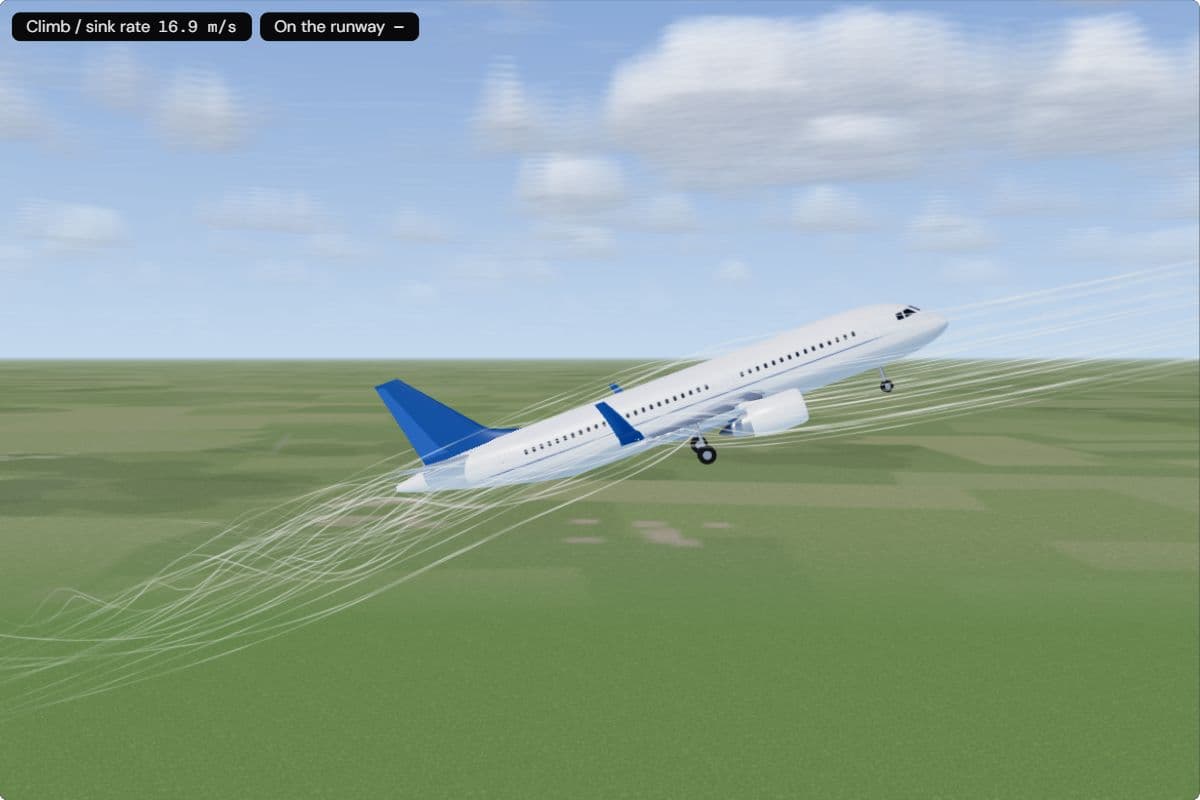
What lifts the plane off is the pilot raising the nose. Pilots call it rotation, and the speed at which they start it VR. The elevator at the tail pushes the tail down and the nose up, and the wing meets the air more steeply: each degree adds about 40 kN of lift at 280 km/h. At about 8° the A320's wing makes 670 kN, more than its 628 kN weight, and the plane leaves the runway. The model lifts off when the lift is 5 % above the weight, at about 278 km/h.
There is a limit: above about 11° the tail would hit the runway, a tail strike. So rotation has to come at the right speed, not too early. After lift-off, with the angle held at 8°, the plane settles at about 270 km/h and climbs about 16 m/s, after about 1.1 km of runway.
Step 6 of 8 · Try it
Weight and flaps decide the takeoff speed
A heavier plane needs more lift, and at the same angle that means more speed. In the model, with takeoff flaps and rotated to 8°, the A320 lifts off at 246 km/h at 50 t, 278 km/h at 64 t and 307 km/h at its maximum of 78 t. The full plane also needs more runway: about 1.8 km instead of 0.7 km for the light one. That's why pilots work out the takeoff speeds before every flight from the actual weight.
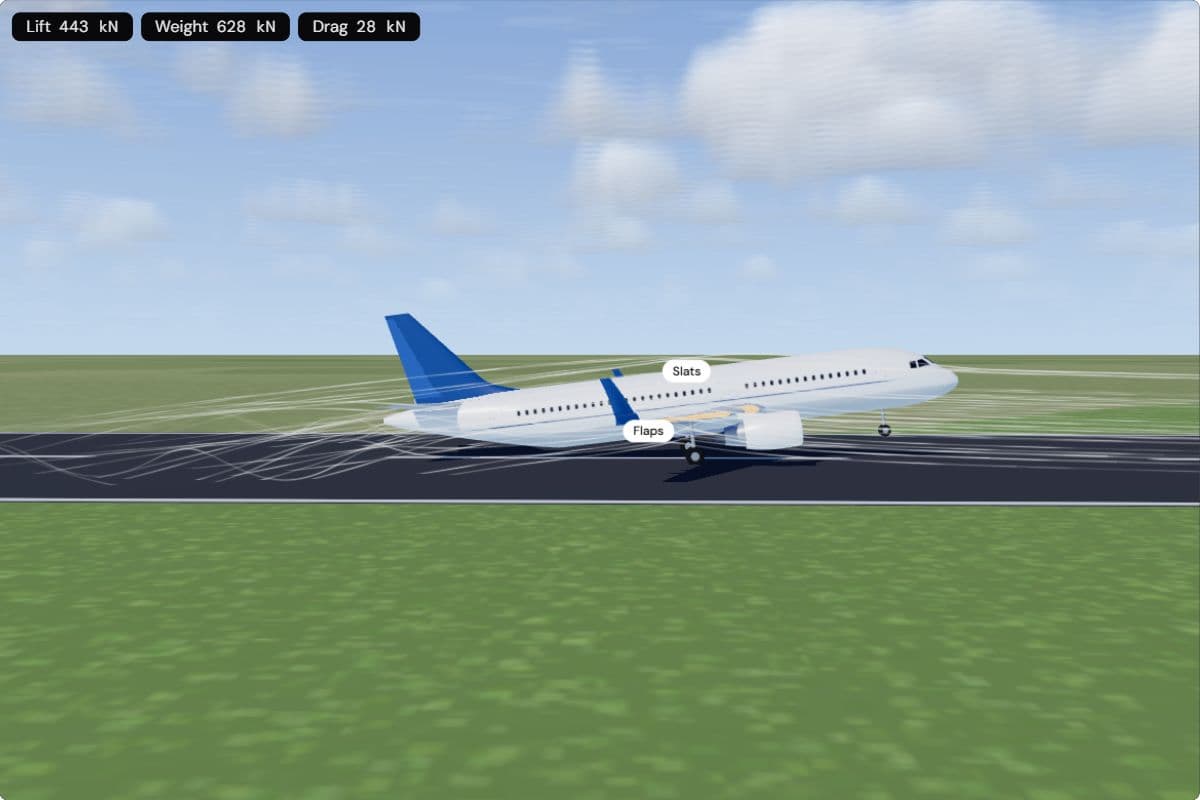
Flaps and slats make the wing more curved and larger, so it lifts enough at a lower speed. Without them, the same plane at 280 km/h and 8° makes only 443 kN of lift; it would need about 340 km/h and 1.7 km of runway. With takeoff flaps it lifts 670 kN. The landing setting lifts even more, 942 kN, but doubles the drag: once it has settled after lift-off, the plane climbs only about 10 m/s instead of 15–16. So airliners take off with a middle setting and save the full flaps for landing.
Airspeed vs ground speed: why the flight map can show 1,000 km/h
Everything above is airspeed, the speed through the air. The flight map in the cabin shows the speed over the ground. The two differ by the wind. At cruising height that wind can be strong: in the core of a jet stream it generally blows at 100–150 knots (185–280 km/h) and can reach 250 knots (about 460 km/h), according to the US National Weather Service.
A plane flying 830 km/h through the air with a 280 km/h tailwind covers the ground at about 1,100 km/h. That's how passenger planes show more than 1,000 km/h on the map while the same plane flying west against the jet stream crawls along at around 550 km/h over the ground. The wing doesn't notice: for lift and drag only the speed through the air counts.
How fast other planes fly
Most jet airliners cruise within a narrow band just below the speed of sound, because they all meet the same drag rise. The A320 family cruises at Mach 0.78 (829 km/h), the Boeing 787 at Mach 0.85 (903 km/h) and the Boeing 747-8 at Mach 0.855 (908 km/h).
Small propeller planes are much slower: a Cessna 172 cruises at 122 knots, about 226 km/h, slower than an airliner takes off. The fastest passenger plane in service history was Concorde, which cruised at Mach 2.02, about 2,150 km/h, and crossed the Atlantic in just under 3.5 hours. It was retired in 2003 (figures from the Wikipedia articles on each aircraft).
What else changes the takeoff speed: wind and hot, high airports
Planes take off into the wind whenever they can. The wing only feels the speed through the air: with a 30 km/h headwind, a plane that needs 280 km/h of airspeed lifts off at only 250 km/h over the ground, and its takeoff run gets shorter. A tailwind does the opposite.
Heat and height make the air thinner. Lift grows with the air density and with the square of the speed, so in thin air the plane must move faster through it to make the same lift. At a hot or high airport the true takeoff speed is higher and the takeoff run longer, while the engines also make less thrust. The speed the pilots read on their airspeed indicator, which measures the air pressure, stays about the same. The simulation's runway is at sea level without wind, so these effects aren't in the tour.
FAQ
Frequently asked questions
- How fast does a plane go when landing?
- Slower than at takeoff. With full flaps the approach speed must be at least 1.23 times the stall speed in the landing configuration (FAA, 14 CFR 25.125). For a 64 t A320 in the model that is about 240 km/h (150 mph, 130 kt). On the ground the brakes and the engines' reverse thrust slow it to taxi speed.
- Can a passenger plane fly 1,000 km/h?
- Not through the air. Most airliners cruise at 830–910 km/h, and their certified maximum is only a little higher: Mach 0.82, about 870 km/h at cruising height, for the A320. Over the ground, though, a strong jet-stream tailwind can push them past 1,000 km/h. 1,000 mph (1,600 km/h) is supersonic territory: Concorde cruised at about 2,150 km/h (1,330 mph).
- Will planes ever fly faster?
- Supersonic passenger flight existed: Concorde cruised at Mach 2.02 until it was retired in 2003. Faster than about Mach 0.8, though, drag rises steeply, and above Mach 1 a plane makes a sonic boom on the ground, so it costs much more fuel per passenger. That's why today's airliners stay just below the speed of sound.
- How long is the takeoff run?
- In the model, an A320 at 64 t with takeoff flaps and full thrust lifts off after about 1.1 km and 28 seconds; at its maximum of 78 t it needs about 1.8 km. The runway length the A320's specifications list at maximum weight, 2,100 m, is longer, because the certification rules add margins, for example for an engine failure during takeoff.
- What are V1, VR and V2?
- Three speeds the pilots work out before every takeoff (FAA, 14 CFR 25.107). V1 is the decision speed: below it they can still stop on the runway, above it they take off even if an engine fails. VR is the rotation speed, where they raise the nose. V2 is the takeoff safety speed the plane must reach by 35 ft (about 11 m) above the runway, even with one engine out.
Keep exploring
Not the question you had in mind?
More on Physics of flight
- Question 1
How do planes fly?
Find out what really holds a 64-tonne airliner up, why the air over the wing doesn't wait for the air below, and what happens when both engines stop.
8 steps · BeginnerStart - Question 2
Why do planes leave trails, and only on some days?
Find out what the white lines behind planes are made of, and why they vanish in seconds on one day and stay for hours on the next.
8 steps · BeginnerStart - Question 3
What causes a plane to stall?
Push an airliner past the critical angle of attack, see the air break away from the wing, and find out why full power and a fast turn don't protect it.
8 steps · BeginnerStart