Physics of flight · Question 5 of 7
How high do planes fly?
Airliners typically cruise at 31,000–38,000 ft (9.4–11.6 km); an Airbus A320 often near 11 km. Thin air isn't worse: the wing needs more speed for the same lift, gets it for about the same drag, and so flies further on each kilogram of fuel. Higher up, the wing's safety margin runs out, and every type has a certified ceiling.
In this tour you take a 3D A320 down low and back up, then find its ceiling yourself: by height, in a turn and fully loaded.
8 steps · Beginner · free, no account
How high different planes fly
Jet airliners typically cruise at 31,000–38,000 ft, that is 9.4–11.6 km or about 6–7 miles above sea level (Wikipedia, Cruise). Each type also has a certified maximum altitude it may never exceed. For the Airbus A320 it is 39,100 ft (11.9 km), or 39,800 ft (12.1 km) with a later modification, according to its EASA type-certificate data sheet. Large long-haul jets are certified higher: 43,100 ft (13.1 km) for the Boeing 787-9 and the Airbus A380.
Smaller planes fly much lower. The ATR 72, a turboprop on regional routes, has a ceiling of 25,000 ft (7.6 km); a Cessna 172, the classic single-engine trainer, 13,500 ft (4.1 km). Business jets climb above the airliners: a Gulfstream G650 is certified to 51,000 ft (15.5 km) (figures from the Wikipedia articles on each aircraft).
For comparison: Mount Everest is 8,849 m high. An airliner in cruise flies up to about 3 km above its summit.
The tour, retold
Step by step
Step 2 of 8 · Try it
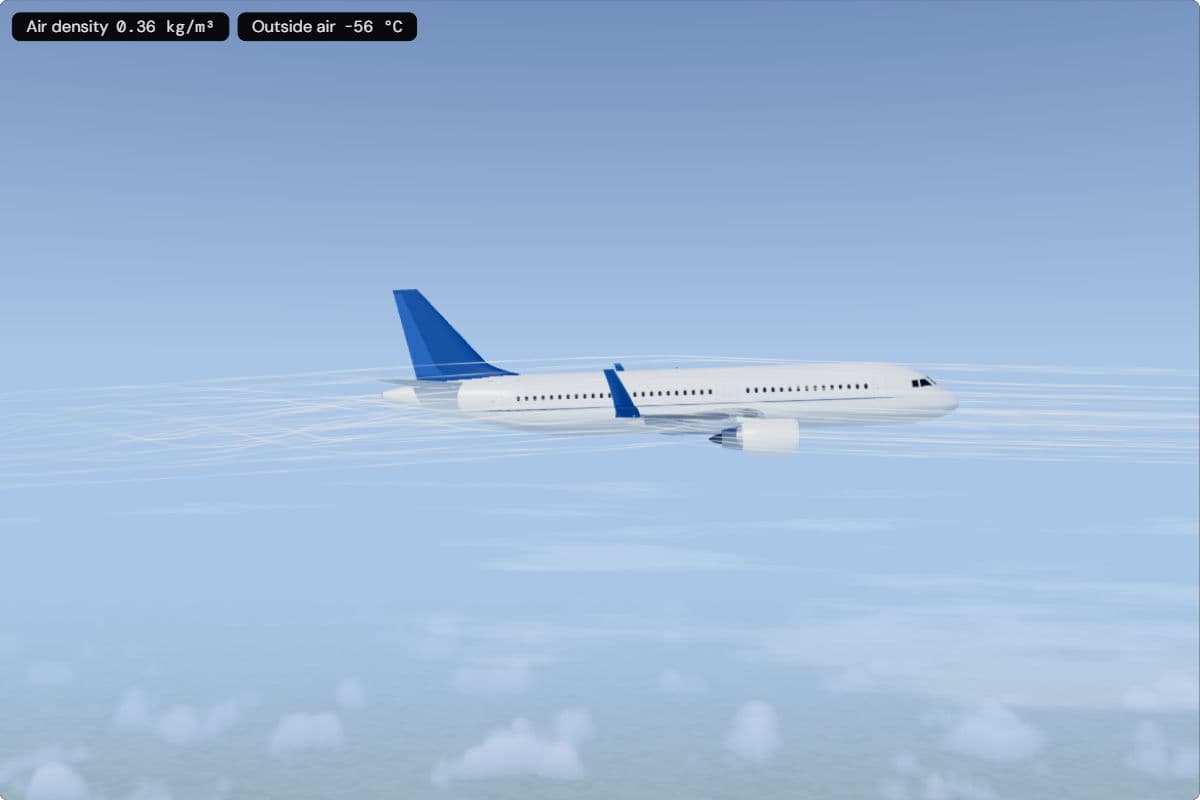
Cruising altitude: about 11 km, in thin, icy air
In the model, an Airbus A320 of 64 tonnes cruises at 11,000 m (36,100 ft) at 829 km/h (515 mph). Up there a cubic metre of air has a mass of only 0.36 kg, less than a third of the 1.225 kg at sea level, and its temperature is −56.5 °C. These are the values of the standard atmosphere that pilots and engineers calculate with (NASA Glenn, Earth atmosphere model); on a real day they differ by a few degrees.
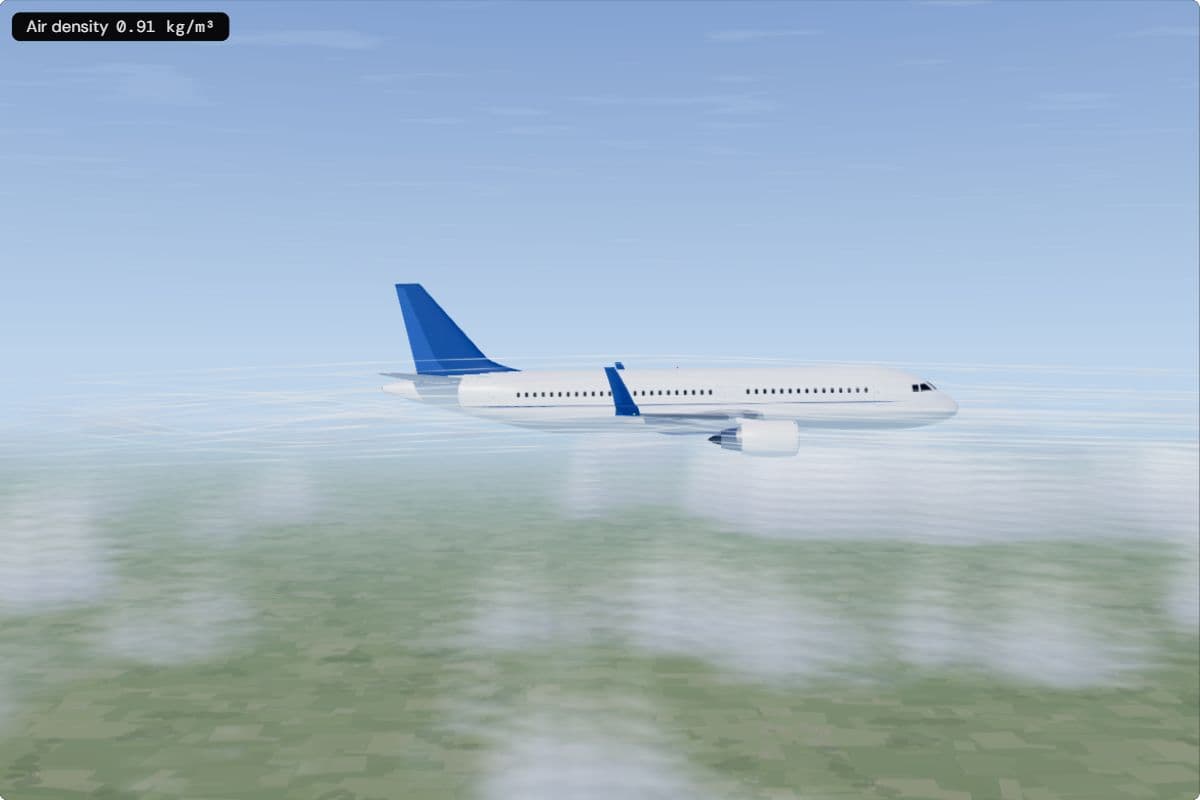
Lower down, the air gets denser and warmer: at 2,000 m about 1.0 kg/m³ and +2 °C, at sea level 1.225 kg/m³ and 15 °C. Near the ground the air is almost three and a half times as dense as at 11 km. In cruise the A320 burns about 270 kg of fuel per 100 km.
Step 3 of 8 · Predict
Is thin air worse for flying?
A common view is that thin air carries a plane worse: the wing finds less air to push down and the engines less oxygen, so flying up there should be harder. Another, often given as the reason for flying high, says the thin air simply has less drag. Both miss what actually happens.
Take the A320 down to 3,000 m, where the air is two and a half times as dense as at 11 km, and fly it at the most economical speed for that height: 591 km/h. The drag there is 44 kN, close to the 40 kN at cruise. So the engines push about as hard and burn only about 10 % more fuel per hour. But down low that hour carries the plane only 591 km, up high 829 km. Per 100 km it needs about 420 kg instead of 273 kg, half as much again. At sea level, at its best speed there, it would be 486 kg.
Step 4 of 8 · Try it
Why planes fly so high: the same drag, 40 % faster
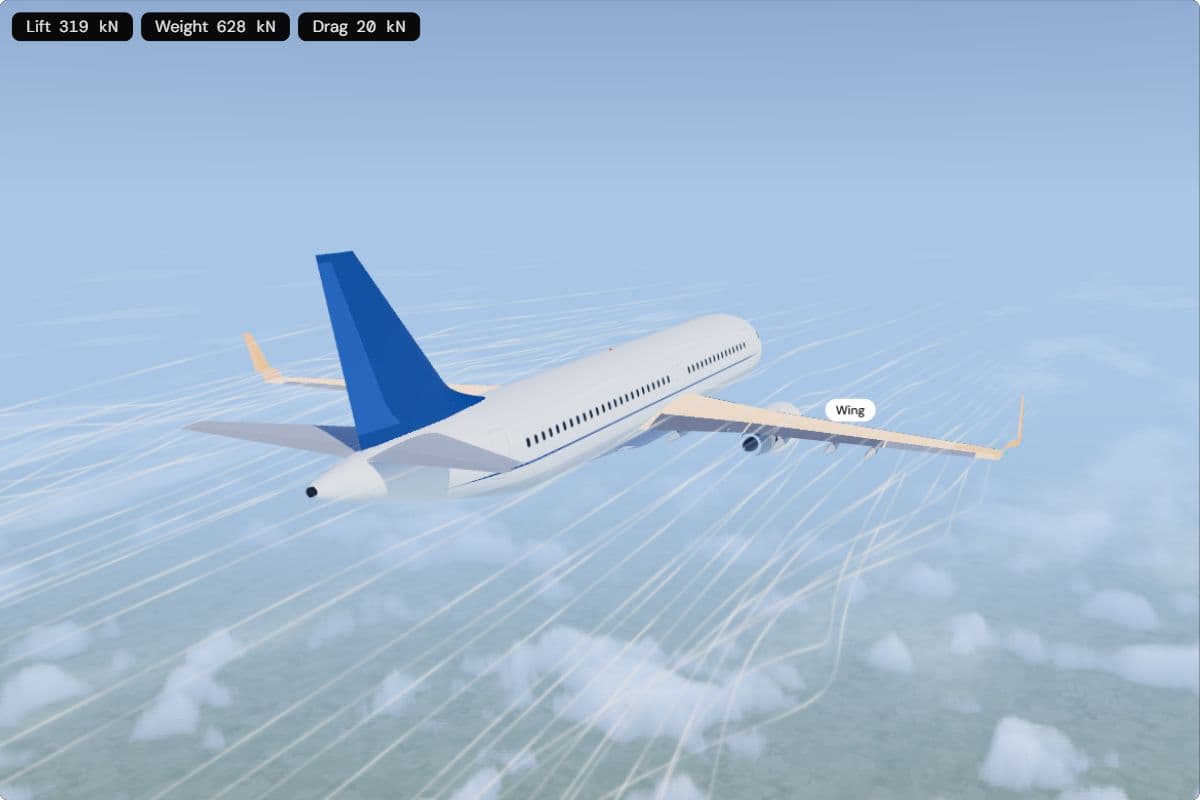
Lift grows with the density of the air and with the square of the speed (NASA Glenn, the lift equation). In air with a third of the density, a wing at the same angle needs more speed to carry the same weight. At 11 km and 591 km/h the A320's wing lifts only 319 kN, half its 628 kN weight. At about 830 km/h the lift carries it again.
The point is the drag at that speed: 40 kN, about what the plane met low down at 591 km/h. In the thin air the same push moves it 40 % faster, so each kilogram of fuel takes it further. The drag isn't lower because the air is thin; at the same speed, 829 km/h at 3,000 m would mean 71 kN of drag. It is lower because the plane flies the speed the thin air asks for, and gets it for the same force.
The cold helps as well: jet engines work more efficiently in the cold air up there (BBC Science Focus). Our model leaves that out, so the gain it shows comes from the wing alone.
Halfway
See it for yourself in 3D
Reading is one thing. In the tour you change it yourself and watch what happens, step by step.
Start the 3D tourStep 6 of 8 · Try it
Why planes don't fly higher: the wing runs out of margin
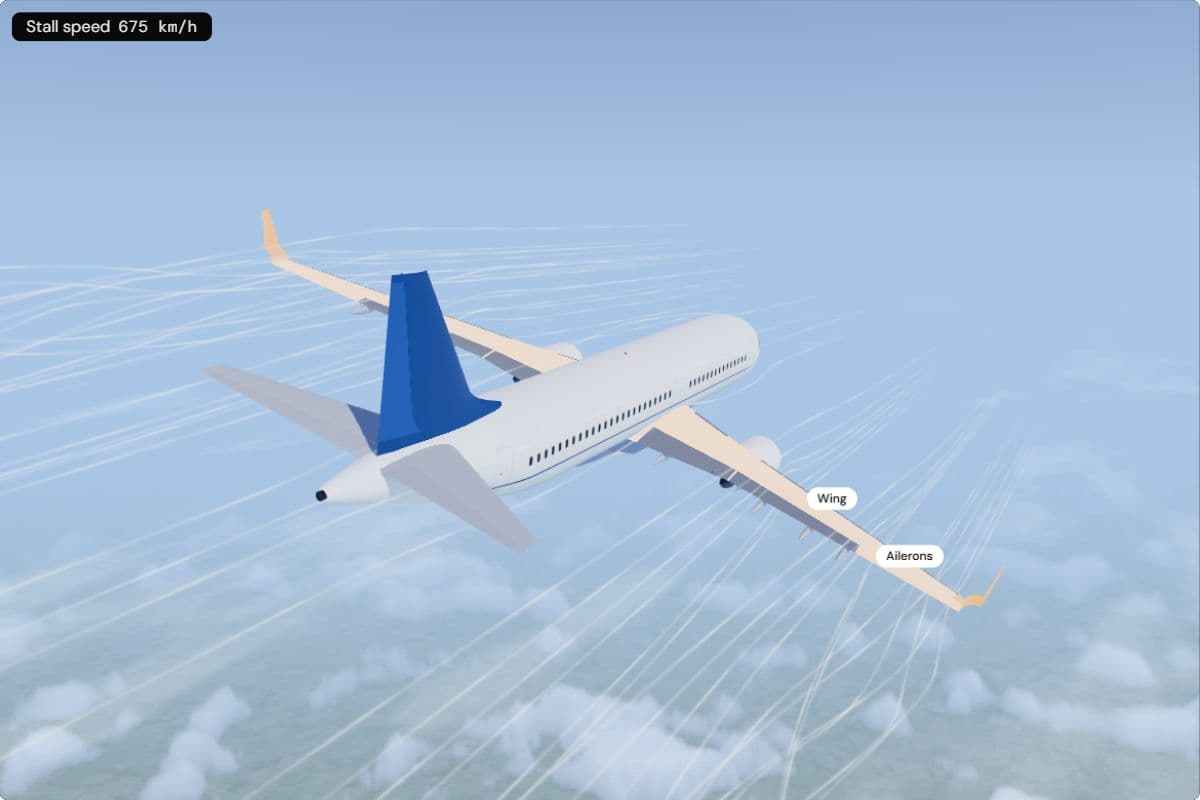
If thin air is so good, why not fly at 15 km? Because the higher the plane flies, the harder its wing must work to carry it, while near Mach 0.78 the wing can give less before the air over it starts to shake and break away, called buffet. The stall speed, the lowest speed at which the wing can still carry the plane (explained in our tour on stalls), creeps up towards the speed it flies: 550 km/h at 11 km, 704 km/h at 13 km, only 125 km/h below its 829 km/h. Flying faster isn't possible either, because drag shoots up near the speed of sound. Pilots call this narrowing gap between too slow and too fast the coffin corner.
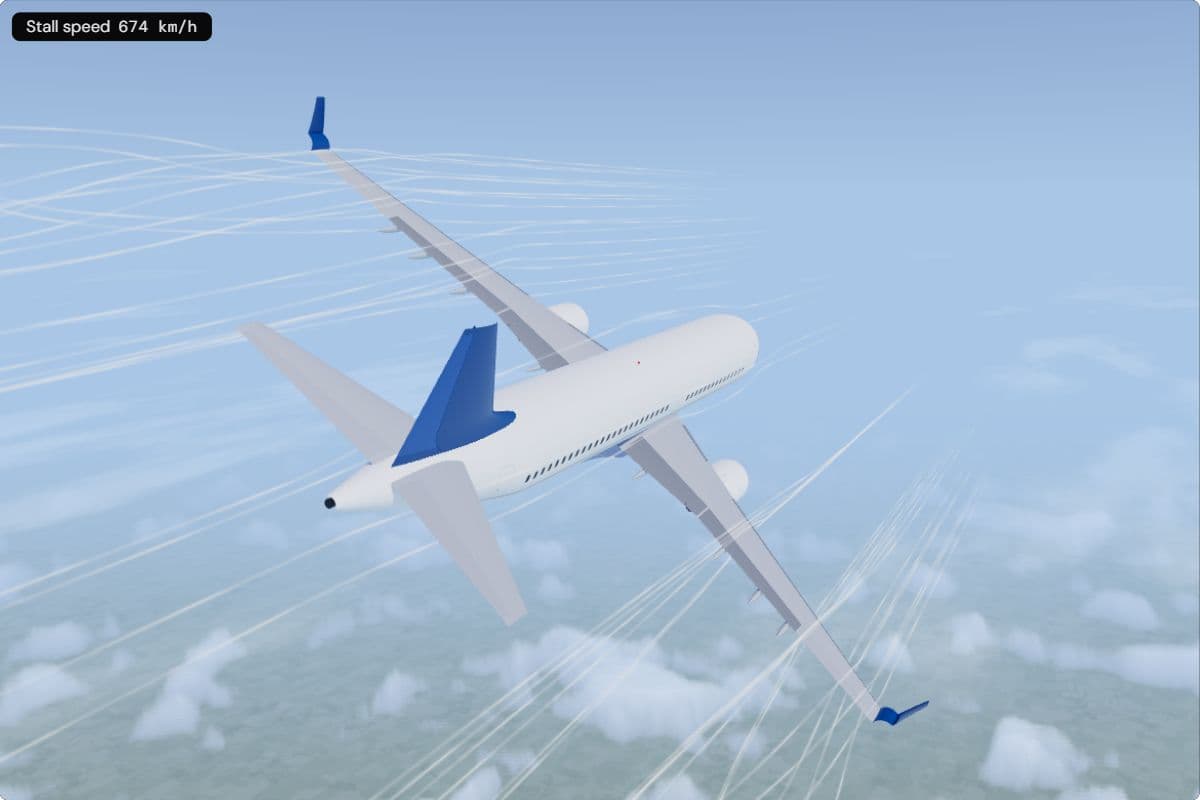
The margin that counts is for turns and gusts. In a turn the wing must carry more than the weight: in a 40° bank 1.3 times as much. In practice, crews aim to keep at least 1.3 g available before buffet in calm air, and up to 2 g when turbulence is expected (Aviation Week, Learning From Test Pilots). In the model, a 64 t A320 at 12,300 m and 829 km/h has used up exactly that margin: in a 40° bank the stall speed reaches 831 km/h. At 11 km the same turn leaves 155 km/h to spare.
And the gain from climbing further is small: from 11 to 13 km the fuel per 100 km falls by only about 5 %, from 273 to 260 kg in the model. The engines do lose thrust in the thin air (from 58 to 47 kN at full power), but for a 64 t A320 the wing's margin runs out first, not the oxygen. On top of all this, every type has its certified maximum altitude, 39,100–39,800 ft (11.9–12.1 km) for the A320, which it never exceeds whatever the wing could do.
Step 7 of 8 · Try it
Heavy planes fly lower and climb in steps
A heavier plane needs more lift, so its wing reaches its limit lower down. In the model at 11 km, 829 km/h and a 40° bank, the stall speed is 558 km/h for a light A320 of 50 t, 674 km/h at 64 t and 822 km/h at its maximum of 78 t: just below the speed it flies. A full A320 has used up its 1.3 g margin at about 11.1 km already.
That's why long-haul flights, which take off heavy with fuel, start lower and climb in steps as the fuel burns off and the most economical height rises; pilots call it a step climb (Wikipedia, Cruise). A light plane's wing would allow much more height, about 13.9 km for 50 t in the model, but no A320 flies above its certified ceiling of about 12 km. That certified limit is different from the service ceiling, the height where a plane can still climb at a small set rate, typically 100 ft/min, or about 500 ft/min for jets (Wikipedia, Ceiling).
Other reasons: weather, glide distance and flight levels
Cruising heights lie near the top of the troposphere, which in the standard atmosphere reaches up to about 11 km (36,152 ft, NASA Glenn), with much of the cloud below. That makes for a smoother ride, but it is a bonus: as the tour shows, fuel and the wing's margin set the height.
Height is also a safety buffer. An airliner's lift is about 16 times its drag, so a plane with no engine power covers about 16 km for every kilometre of height it loses: from 11 km, about 170 km (our tour on how planes fly has the glide step).
Planes don't choose any height they like. Air traffic control assigns flight levels, heights in hundreds of feet (FL 350 is 35,000 ft). Between FL 290 and FL 410, where most airliners cruise, flights on an eastward magnetic track (000–179°) take odd thousands of feet (FL 290, 310, 330, …) and westward flights (180–359°) even thousands (FL 300, 320, 340, …), so planes heading towards each other are separated in height (Wikipedia, Flight level, semicircular rule).
Up high, the cabin stays at about 2,400 m
Passengers don't breathe the thin air outside. The cabin is pressurized: the certification rules require a cabin pressure altitude of no more than 8,000 ft, about 2,400 m, under normal conditions at the plane's maximum operating altitude (FAA, 14 CFR 25.841). At 11 km the cabin therefore feels like a mountain town, not like the summit of Everest.
FAQ
Frequently asked questions
- Do planes fly higher than Mount Everest?
- Yes. Mount Everest is 8,849 m high, and airliners typically cruise at 9.4–11.6 km (31,000–38,000 ft), so an A320 at 11 km flies about 2 km above the summit. Up there the air is −56.5 °C and has less than a third of its density at sea level.
- How high do planes fly in miles?
- About 6 to 7 miles. The typical cruising range of 31,000–38,000 ft is 5.9–7.2 miles (9.4–11.6 km). An A320 at 11 km flies 6.8 miles up; its certified maximum, 39,800 ft, is about 7.5 miles.
- How cold is it at 35,000 feet?
- About −54 °C (−66 °F) in the standard atmosphere that pilots and engineers calculate with. The temperature falls by about 6.5 °C per kilometre up to 11 km and then stays at −56.5 °C. On a real day it can differ by several degrees.
- What is the coffin corner?
- The height where the speed band an aircraft can fly in closes: the stall speed rises towards the cruise speed, while flying faster runs into the steep drag rise near the speed of sound. In the model, a 64 t A320 at 13 km has a stall speed of 704 km/h at a cruise speed of 829 km/h. Airlines stay well below it, keeping enough margin for turns and gusts.
- What is the highest a plane has ever flown?
- The highest sustained level flight is 25,929 m (85,069 ft), by an SR-71 Blackbird in 1976. In a zoom climb, coasting up after a dash, a MiG-25 reached 37,650 m (123,520 ft) in 1977 (Wikipedia, Flight altitude record). Both are military jets. Today's airliners are certified to at most about 13 km (43,100 ft); Concorde, retired in 2003, cruised up to 18.3 km (60,000 ft) (Wikipedia, Concorde).
- Why don't passengers notice the thin air?
- Because the cabin is pressurized. The rules require a cabin pressure altitude of no more than 8,000 ft (about 2,400 m) in normal operation (FAA, 14 CFR 25.841), so at 11 km the air inside is like that of a high mountain town.
Keep exploring
Not the question you had in mind?
More on Physics of flight
- Question 1
How do planes fly?
Find out what really holds a 64-tonne airliner up, why the air over the wing doesn't wait for the air below, and what happens when both engines stop.
8 steps · BeginnerStart - Question 2
Why do planes leave trails, and only on some days?
Find out what the white lines behind planes are made of, and why they vanish in seconds on one day and stay for hours on the next.
8 steps · BeginnerStart - Question 3
What causes a plane to stall?
Push an airliner past the critical angle of attack, see the air break away from the wing, and find out why full power and a fast turn don't protect it.
8 steps · BeginnerStart