Heat pump · Question 1 of 4
How does a heat pump work?
A heat pump moves heat instead of making it. Outside, a cold fluid takes heat from the air, even in winter; a compressor squeezes it until it is hot, and that heat goes into the heating water. At 7 °C, 1.4 kW of electricity brings about 7.4 kW of heat into the house; the rest comes from the air.
In this tour you meet the four parts, find out how a liquid can boil at 4 °C, follow it once around the loop, switch the compressor off and take the unit below zero.
15 steps · Beginner · free, no account
A heat pump moves heat, it doesn't make it
Many people picture a heat pump as a better kind of electric heater: it plugs into the mains, the house gets warm, so the electricity must be turning into heat. That is how a fan heater works, and a fan heater gives exactly as much heat as it draws: 1 kW of electricity, 1 kW of heat.
A heat pump gives several times more. On the datasheet of a real 10 kW air-to-water unit (Viessmann Vitocal 250-A), 1.38 kW of electricity brings 7.3 kW of heat into the heating water at 7 °C outside and 35 °C flow temperature, a coefficient of performance (COP) of 5.3. Even at −7 °C it delivers 9.7 kW for 3.07 kW: 6.6 kW of that heat came out of air at −7 °C.
The balance is simple: the heat that reaches the house is the heat taken from outside plus the electricity the compressor uses. (A small share, the fans' power, warms the outdoor air instead.) The electricity doesn't become the heat, it drives a machine that carries heat from the cold garden into the warm house. A fridge does the same thing the other way round: it pumps heat out of its inside and gives it off at the back, into your kitchen.
The tour, retold
Step by step
Step 2 of 15 · Explain
Four parts in one closed loop
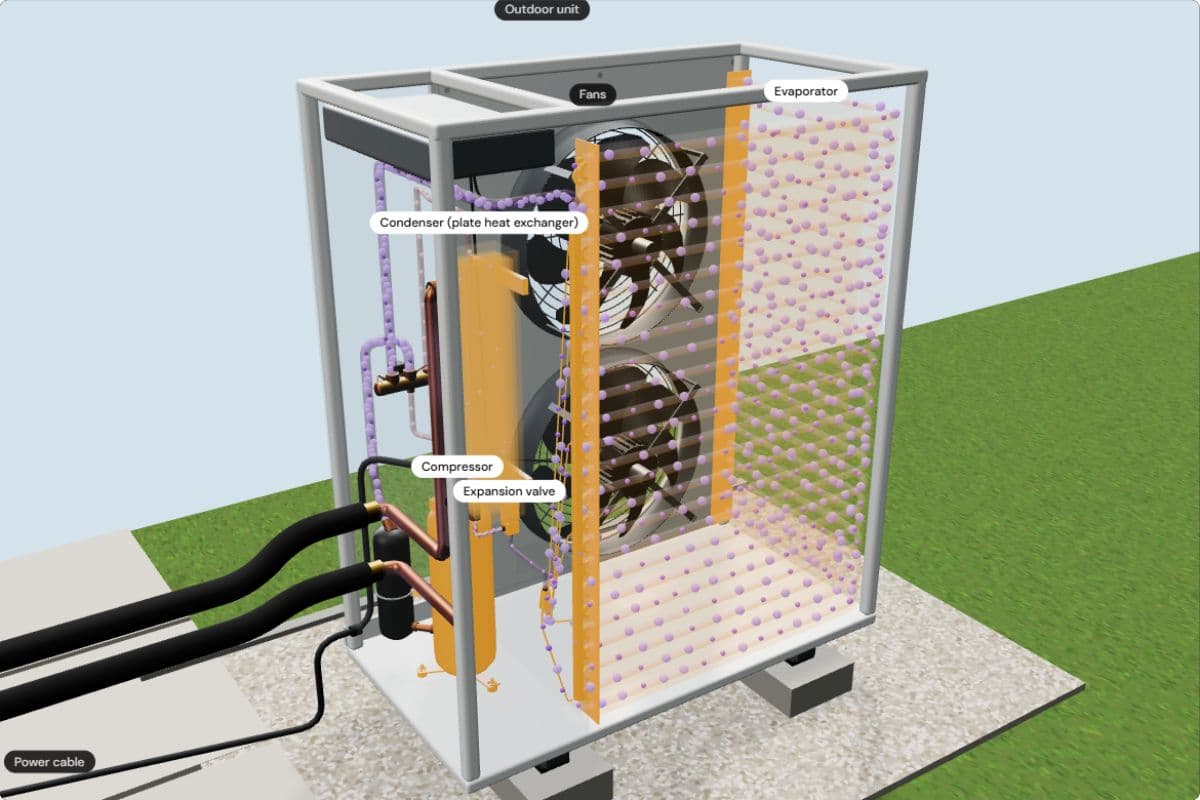
The outdoor unit in the garden holds the whole refrigerant circuit. Only water pipes run into the house, to the circulation pump in the cellar and on to the underfloor heating. One cable brings electricity into the box; most of it drives the compressor, a little the fans and the control.
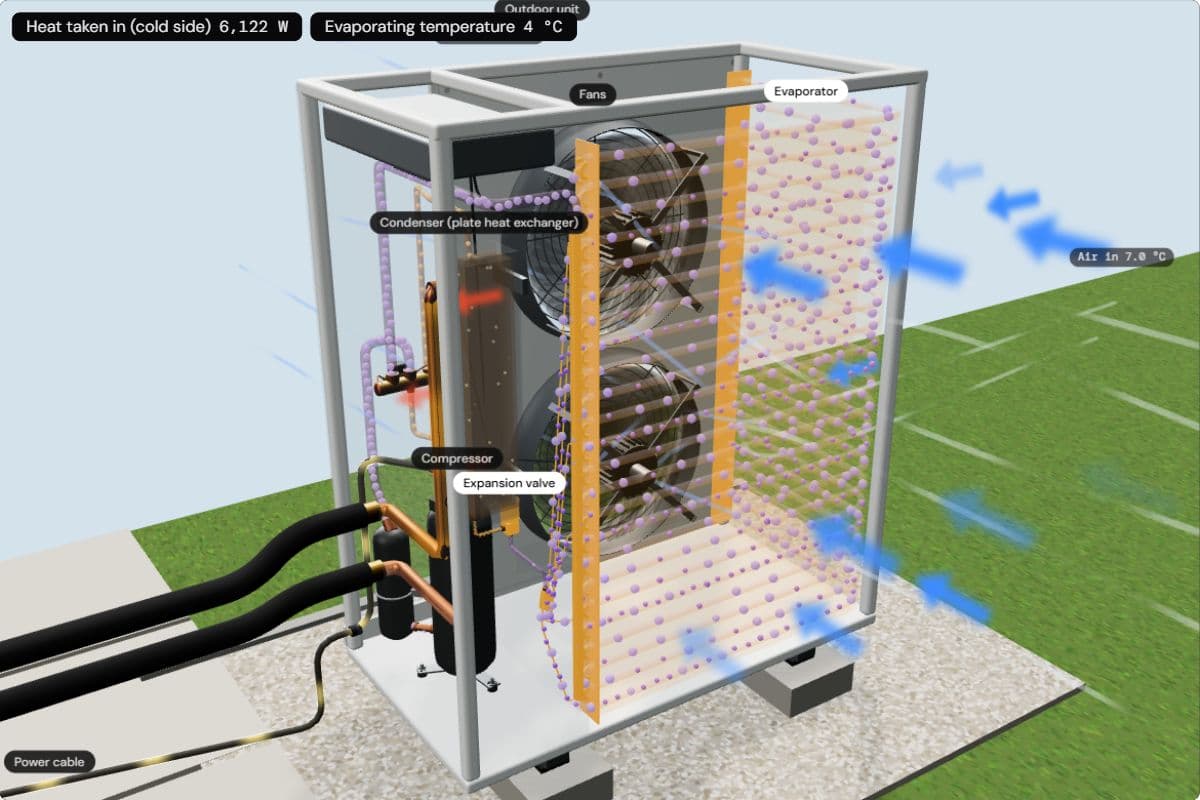
Inside, a refrigerant runs round a closed loop and passes four parts. In the evaporator, the finned coil behind the fans, the cold refrigerant takes heat from the air. The compressor squeezes it, which makes it hot. In the condenser, a stack of steel plates, it gives that heat to the heating water. The expansion valve lets the pressure drop, and the refrigerant is cold again.
Step 3 of 15 · Predict
Electricity drives the compressor, the air supplies most of the heat
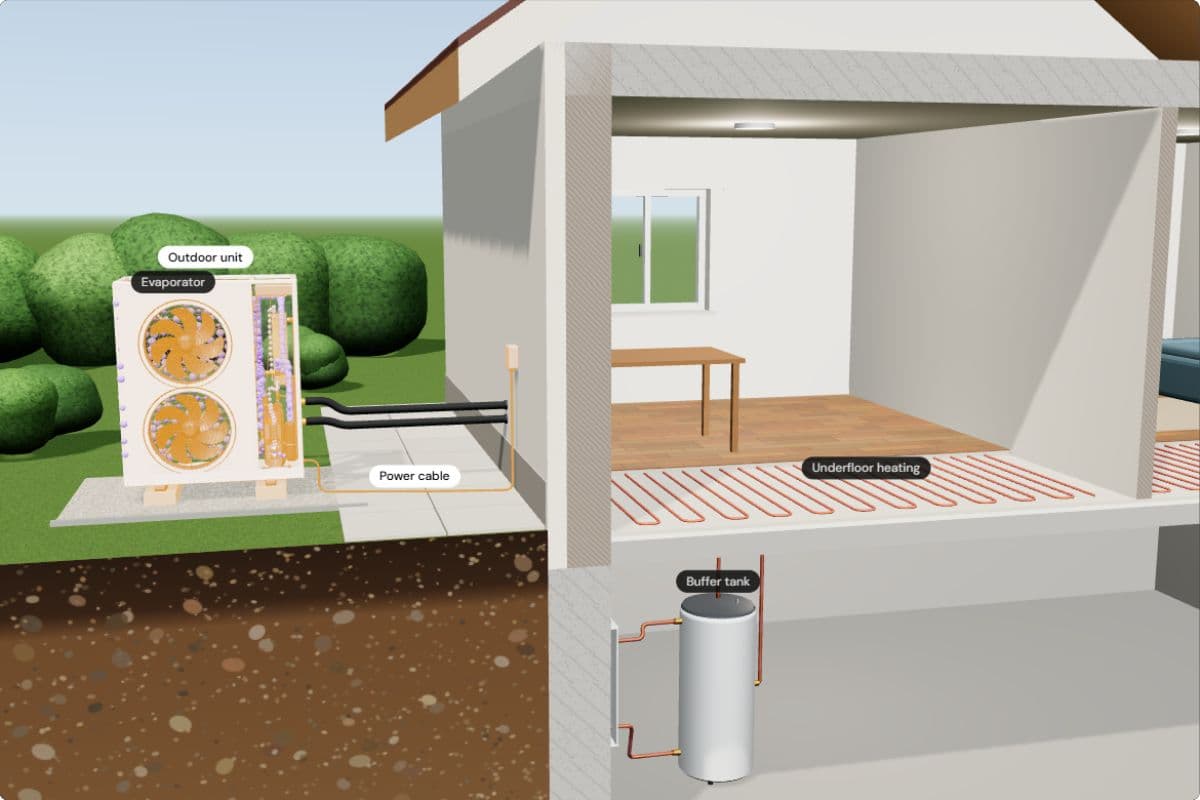
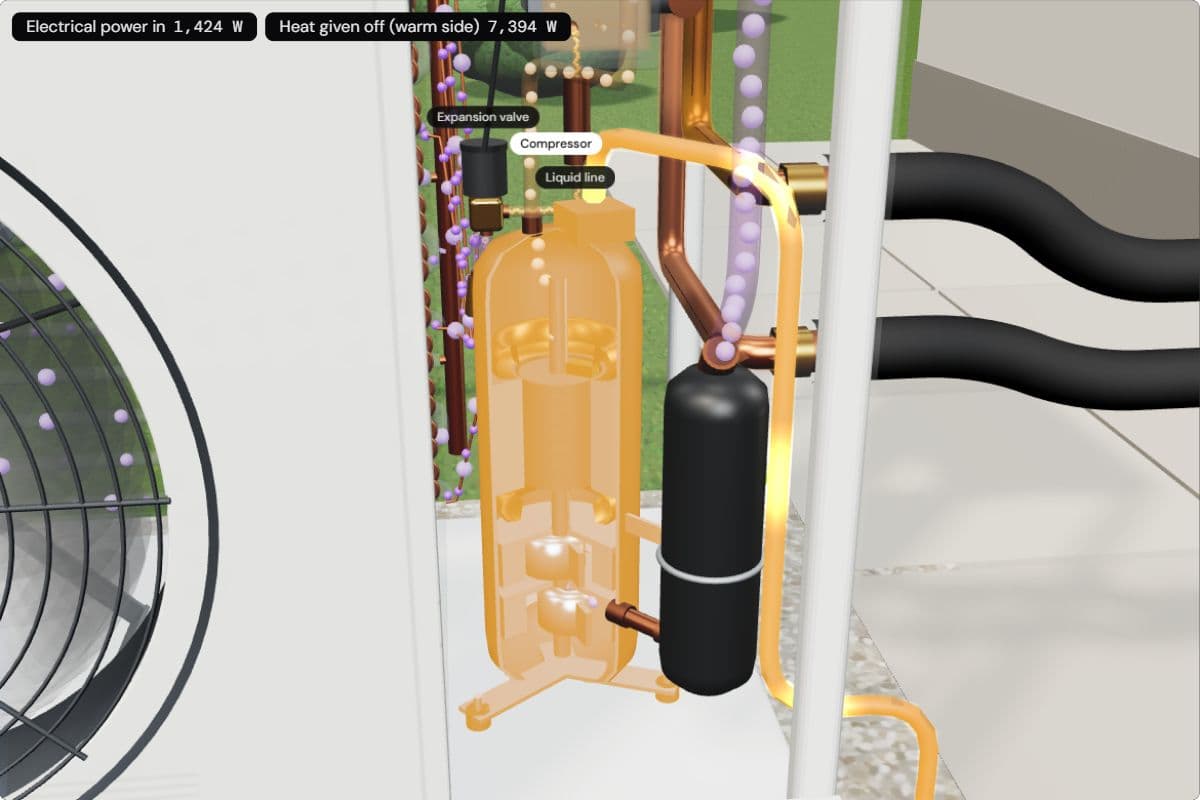
In the model at 7 °C outside, the unit draws about 1,400 W and gives about 7,400 W of heat to the water: a COP of 5.2, close to the datasheet's 5.3. About 6,100 W of it come from the outdoor air, and about 1,300 W are the work of the compressor and the water pump, which also ends up in the water. The fans' roughly 150 W leave with the air that blows out of the unit.
Step 4 of 15 · Predict
Cold air still heats a colder refrigerant
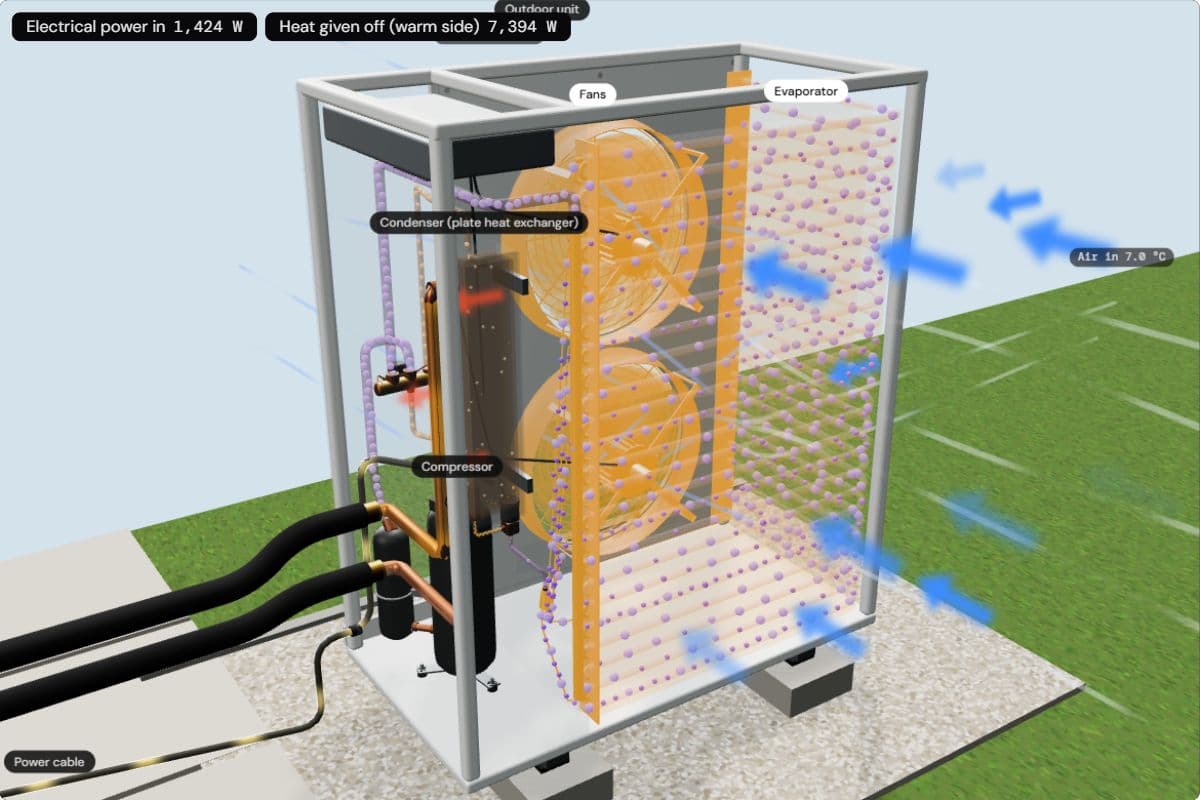
A common objection is that air at 7 °C, or at −7 °C, has no heat left to give. But cold only means less heat, not none. Heat flows from warmer to colder, so all the heat pump needs is something colder than the air.
That something is the refrigerant, here propane. In the evaporator, the finned coil behind the fans, it boils at about 3.5 °C. The 7 °C air blown through the fins warms it and leaves the unit about 4 degrees colder; the boiling propane takes up about 6,100 W.
Step 5 of 15 · Explain
Boiling doesn't mean hot
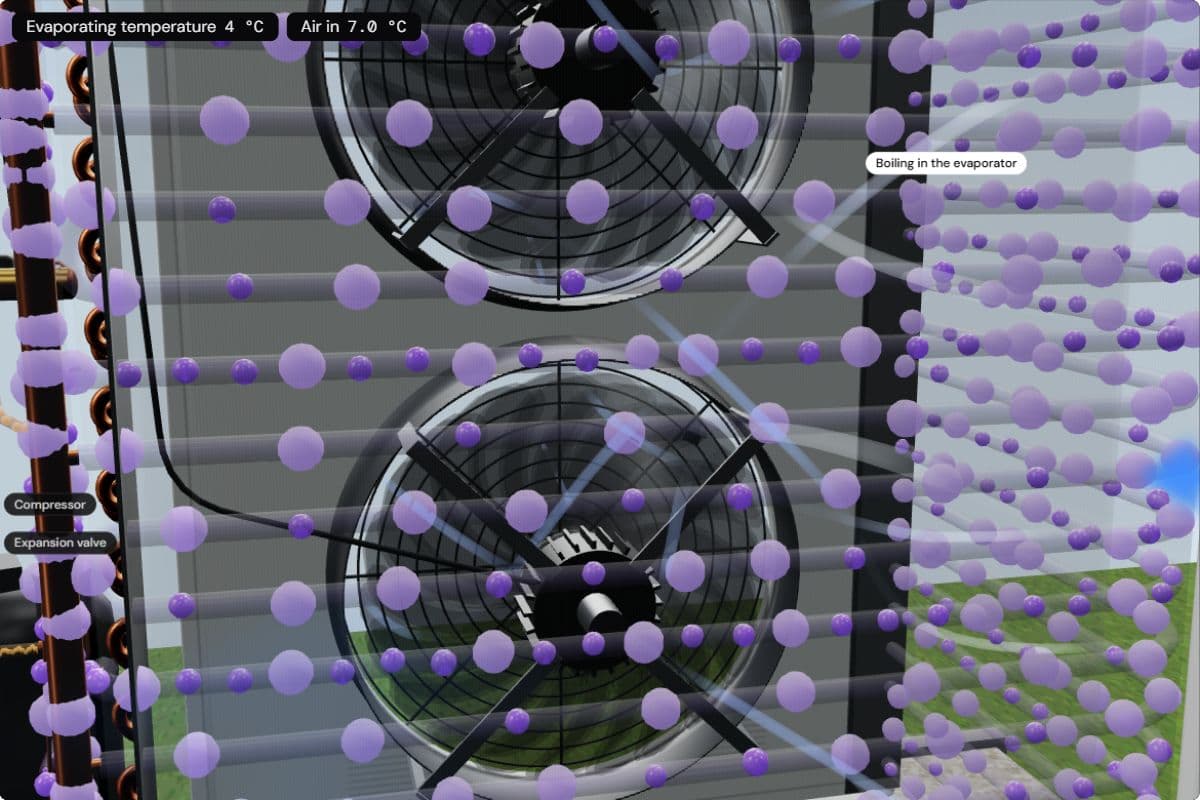
Boiling only means that a liquid turns into gas, and the temperature at which that happens depends on the pressure. Water boils at 100 °C at normal air pressure, at about 70 °C on top of Mount Everest and at about 120 °C in a pressure cooker. Propane, sold as camping gas, boils at −42 °C at normal air pressure; it stays liquid only inside its pressurised canister.
In the evaporator the pressure is set so that the propane boils at about 3.5 °C. Boiling swallows a lot of heat, which is why sweat cools your skin and a spray can gets cold when you use it. The boiling propane takes that heat from the air blowing through the fins.
Halfway
See it for yourself in 3D
Reading is one thing. In the tour you change it yourself and watch what happens, step by step.
Start the 3D tourStep 8 of 15 · Try it
Without low pressure there is no cold side
The expansion valve keeps the pressure in the evaporator low. In the model you can open it fully: within about 15 seconds the boiling temperature climbs to 7 °C, as warm as the air, and the heat taken from the air drops to almost nothing. Low pressure is what makes the refrigerant boil cold; without it, a heat pump can't take any heat from the air.
Step 10 of 15 · Explain
One lap: evaporate, compress, condense, expand
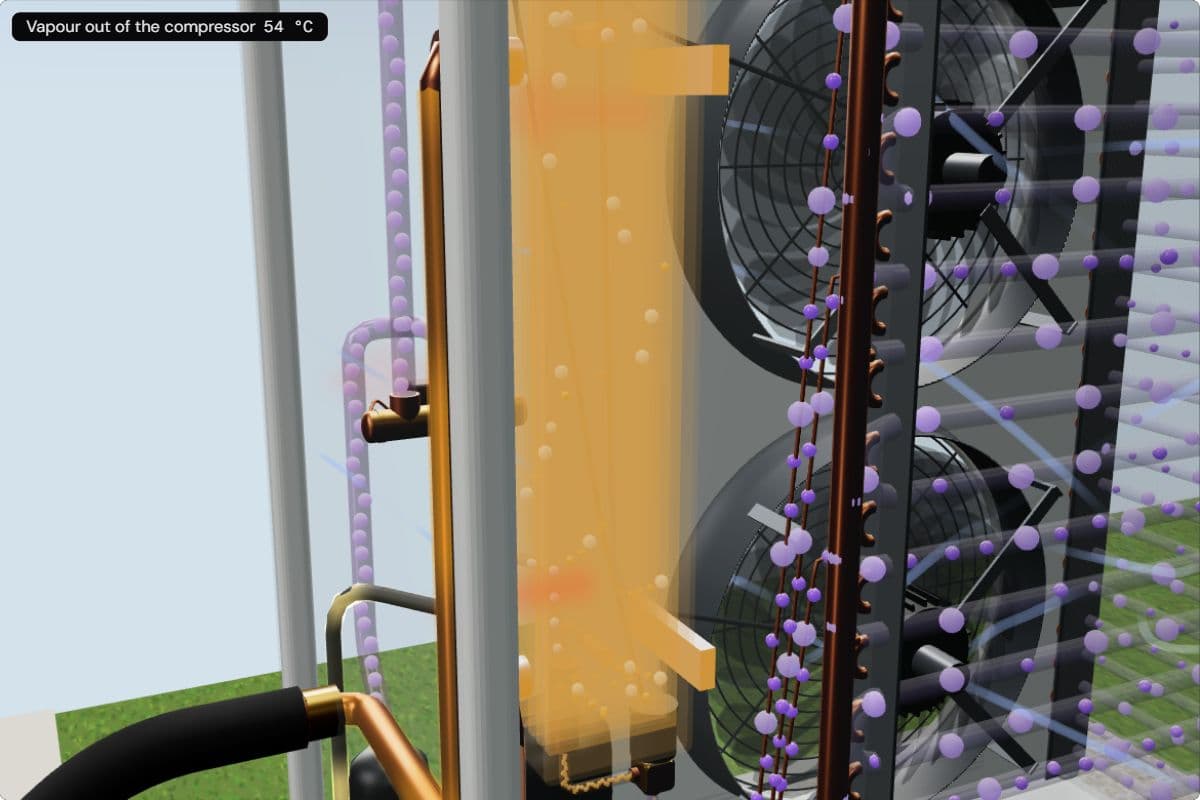
The refrigerant leaves the evaporator as cold vapour, below 10 °C. The compressor squeezes it, and squeezing a gas heats it, like the air in a bicycle pump: it comes out at about 54 °C, hotter than the 35 °C heating water.
In the condenser, a stack of steel plates, the hot vapour gives its heat to the water and turns liquid; it leaves at about 34 °C. That is still warmer than the water coming back from the floor at about 30 °C, which it warms first.
Then the expansion valve, a narrow opening, lets the pressure drop. At the low pressure about a fifth of the liquid boils off at once and takes the heat for that from the rest, which cools to a few degrees above zero. So the compressor makes the refrigerant hot, and the valve makes it cold. The cold mixture enters the evaporator, and the lap starts again.
Step 13 of 15 · Predict
Without the compressor no heat flows
If the compressor stops while the fans and the water pump keep running, you might expect the fans to blow at least some heat into the house. They don't: the heat output drops to 0 W at once. Only about 180 W of electricity is left for the fans, the pump and the control.
Without the compressor the refrigerant is never squeezed, so it never gets hotter than the water, and the propane in the outdoor unit simply takes on the temperature of the air. Heat never flows from cold to warm on its own. The compressor is what lifts it from the 7 °C garden to the 35 °C water: it is the pump in heat pump.
Step 15 of 15 · Quiz
Below zero it keeps working
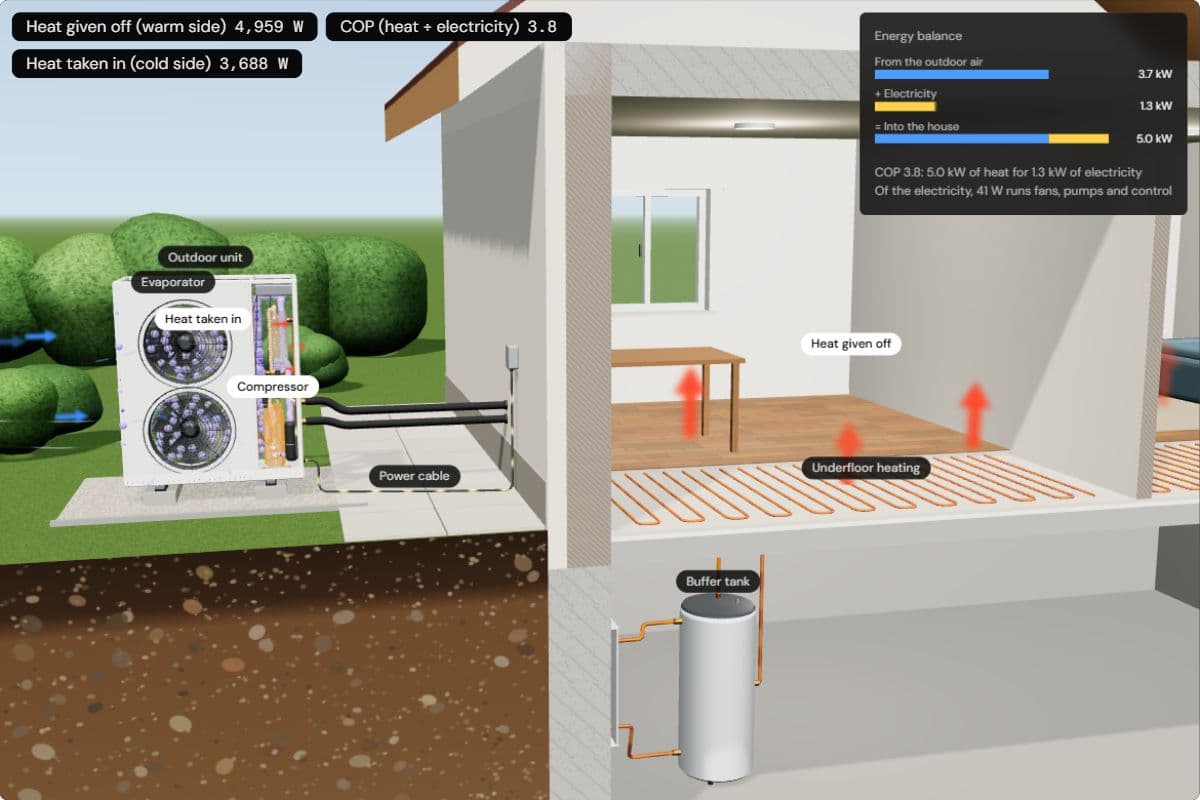
At −7 °C outside, the pressure in the evaporator drops further, so the propane boils at about −10 °C, still colder than the air. Heat still flows in: about 3,700 W from the −7 °C air. At the model's moderate compressor speed that makes about 5,000 W of heat for 1,300 W of electricity, a COP of 3.8.
On a cold day the house needs more than that, so the compressor runs faster. The propane then boils colder still, at about −13 °C, and the COP falls: to about 3.3 in the model, and to 3.16 on the datasheet (9.7 kW of heat for 3.07 kW). That is still more than three times what a fan heater gives. The datasheet unit keeps heating down to −20 °C outside.
Air, ground or water: where the heat comes from
This model takes its heat from the outdoor air, the most common kind. Air is free and needs only a place for the box, but it is coldest exactly when the house needs the most heat: over a year it ranges from about −15 to +35 °C in Germany.
Below about 10 m, the ground stays at about 10 °C all year. A ground-source heat pump circulates brine through a borehole about 100 m deep and gets it back at roughly 0 to 10 °C; a groundwater heat pump draws water at 7 to 12 °C even on the coldest day. A smaller lift means a better COP: in Fraunhofer ISE field tests in existing houses, air-source heat pumps reached an annual performance factor of 3.1 to 3.4, ground-source ones 4.1 to 4.3. Drilling or wells cost more and need permits.
Why the flow temperature matters
The colder the source and the hotter the water, the higher the compressor has to lift the heat, and the more electricity each kilowatt of heat costs. On the datasheet at −7 °C outside, the COP is 3.16 for 35 °C water but only 2.13 for 55 °C water.
That is why heat pumps suit underfloor heating, which warms a house with water at 30 to 35 °C. Radiators need hotter water because their surface is smaller, but often less than expected: in the Fraunhofer field tests, radiators in existing houses got by with a maximum flow temperature of about 44 to 45 °C.
The same cycle can cool
Many air-to-water heat pumps can also cool. A four-way reversing valve swaps the roles of the two heat exchangers: the plate heat exchanger, which warms the heating water in winter, becomes the evaporator and takes heat out of the water, and the finned coil becomes the condenser and gives that heat off to the air. Both sit in the outdoor unit, so the refrigerant never leaves it; only the cooled water runs into the house. The datasheet unit cools with 7 °C water at 35 °C outside, 3.9 kW of cooling for 1.18 kW of electricity.
A fridge and an air conditioner are the same machine with a different job: the cold side is the one you want.
What this model simplifies
The model is built on one real unit and its datasheet, with one refrigerant, propane (R290), and real propane data. It runs in a steady state and moves to each new state with simple time lags, without start-up effects, oil or the refrigerant charge shifting around. Pipes and heat exchangers have no pressure losses, so the lines in the p-h diagram are flat. Superheat and subcooling are fixed. Defrosting is a simple four-minute reversal, which this tour doesn't reach. The refrigerant moves about ten times slower than in a real unit, so you can follow one lap.
FAQ
Frequently asked questions
- Do heat pumps create heat?
- No, they move it. The heat that reaches the house is the heat taken from the air, the ground or water plus the electricity the compressor uses. At 7 °C outside, a typical unit takes about 6 kW from the air and adds about 1.3 kW of work.
- How much electricity does a heat pump use?
- Over a year, about 1 kWh of electricity for every 3 to 4 kWh of heat: Fraunhofer field tests measured annual performance factors of 3.1 to 3.4 for air-source and 4.1 to 4.3 for ground-source heat pumps in existing houses. At its rating point, the datasheet unit uses 1.38 kW for 7.3 kW of heat.
- Do heat pumps work in very hot weather?
- Yes. In summer they mainly make hot water or, with a reversing valve, cool the house. The datasheet unit cools with outdoor air up to 45 °C and heats with outdoor air from −20 to +40 °C.
- How loud is a heat pump?
- The noise comes from the fans and the compressor of the outdoor unit. The datasheet unit is rated at a sound power level of 49 to 58 dB(A); what you hear depends on the distance and on walls nearby.
- How much does a heat pump cost?
- The purchase price depends on the house, the heat source and the grants available, so there is no single number. The running cost is easy to estimate: the heat the house needs per year, divided by the annual performance factor (3 to 4), times the electricity price.
- Are heat pumps difficult to install?
- An air-to-water monoblock is the simplest: the refrigerant stays sealed in the outdoor unit, and only water pipes go into the house, so no refrigerant work is needed on site. Ground-source heat pumps need a borehole or a collector and usually a permit.
Keep exploring
Not the question you had in mind?
More on Heat pump
- Question 1
How does a refrigerator work?
Find out why an open fridge warms the kitchen, follow the refrigerant from the cold plate to the warm grille and watch the thermostat switch the compressor on and off.
12 steps · BeginnerStart - Question 2
How does a heat pump work in winter?
Drag the air down to −15 °C and watch the heat pump keep heating, find out why its output and COP fall, cover a cold house, watch the unit ice up and defrost, and switch to ground heat.
15 steps · BeginnerStart - Question 3
Can a heat pump cool?
Flip the heat pump to cooling, find the four-way valve that turns its cycle round, watch the two heat exchangers swap jobs, feel the warm air leave the outdoor unit and see why floor cooling stays above the dew point.
11 steps · BeginnerStart