Heat pump · Question 3 of 4
How does a heat pump work in winter?
A heat pump keeps heating in winter because even −15 °C air still holds heat: its refrigerant boils at an even lower temperature, so heat flows in. What the cold changes is the cost. In our model the heat pump gets about 5 kWh of heat per kWh of electricity at 7 °C and about 3 at −15 °C.
In this tour you drag the air down to −15 °C in 3D, speed up the compressor for a cold house, watch the outdoor unit ice up and defrost, and switch to heat from the ground.
15 steps · Beginner · free, no account
Cold air still holds heat
Many people expect an air source heat pump to give up once the air drops below freezing: cold air, the idea goes, has no heat left to take. That isn't how heat works. Cold only means less heat, not none. Heat only runs out completely at absolute zero, −273 °C. Air at −15 °C is still almost 260 degrees above that and holds plenty of heat.
Heat flows on its own from anything warmer to anything colder. So a heat pump doesn't need warm air. It needs something in the outdoor unit that is colder than the air, and that is its refrigerant, which boils a few degrees below the air temperature even on a freezing night.
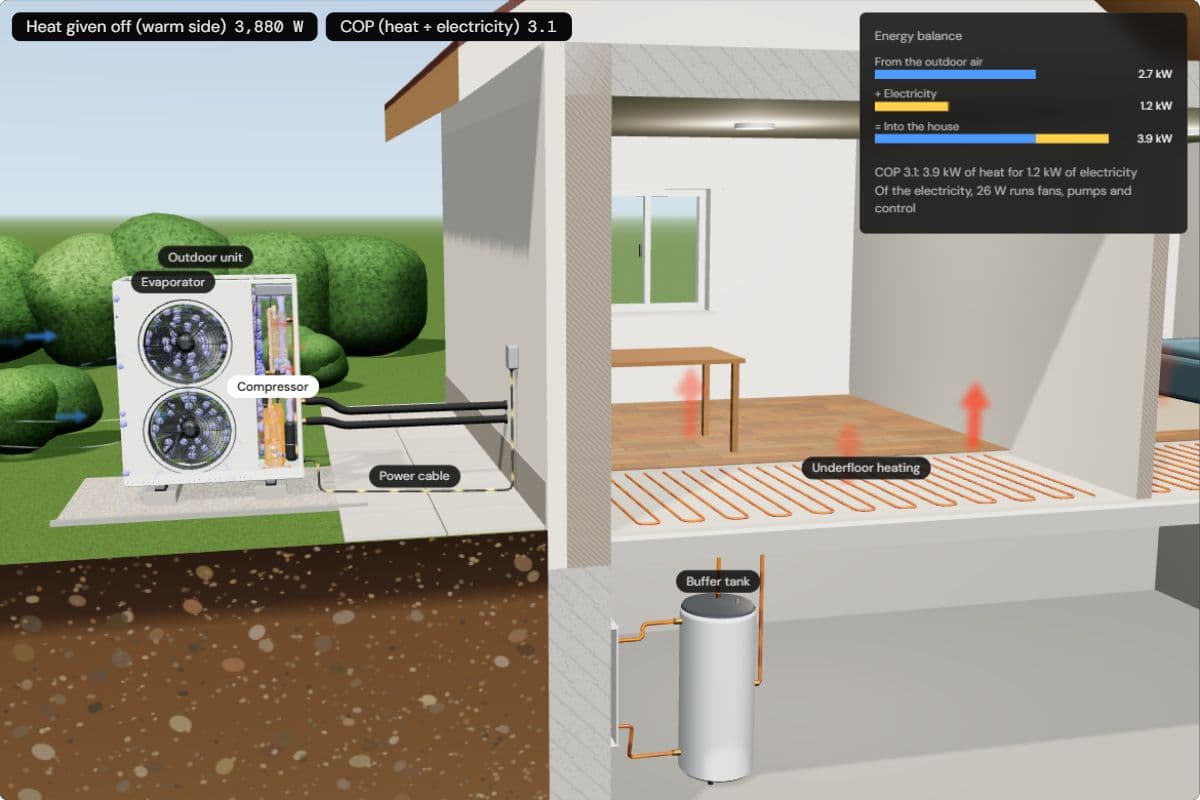
Some pages claim that in deep cold a heat pump runs on electricity alone. The model shows otherwise: at −15 °C it delivers about 3.9 kW of heat, and about 2.7 kW of that still comes out of the outdoor air. The air even leaves the unit colder than it came in.
The tour, retold
Step by step
Step 2 of 15 · Predict
At −15 °C it still heats
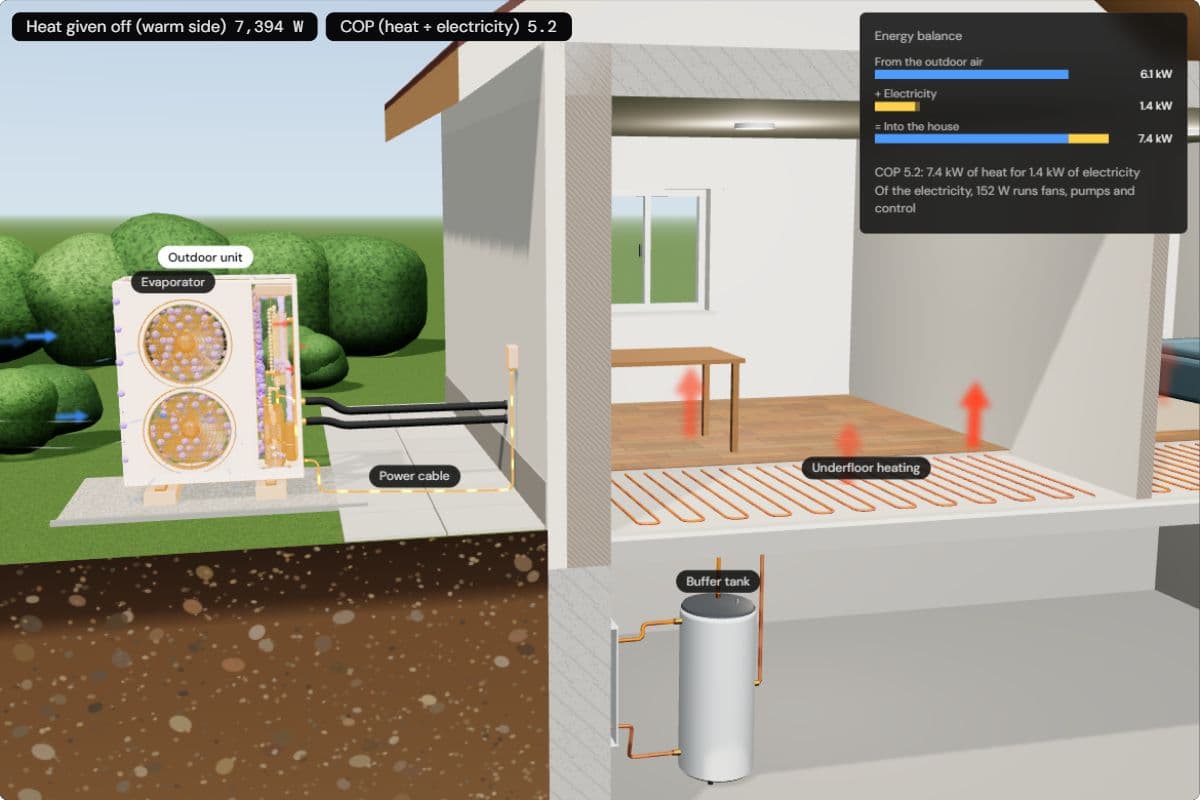
On a mild 7 °C day the model's heat pump, at a medium compressor speed, gives about 7.4 kW of heat for about 1.4 kW of electricity. That ratio, the coefficient of performance or COP, is about 5.2: five units of heat for each unit of electricity.
A common guess is that in a cold snap it stops, or quietly switches to plain electric heating. Neither happens. Drop the air to −15 °C and the same unit still gives about 3.9 kW for about 1.2 kW of electricity: a COP of about 3.1. That is still three times what an electric heater gets from the same electricity. The air blowing out of the unit leaves at about −19 °C, because the heat pump has taken heat even from −15 °C air.
Step 4 of 15 · Explain
Low pressure lets the refrigerant boil below −15 °C
The key is boiling. Boiling doesn't mean hot; it means a liquid turns into gas, and the temperature at which that happens depends on the pressure. Water boils at 100 °C at normal air pressure, but at only about 70 °C on top of Mount Everest, where the pressure is lower.
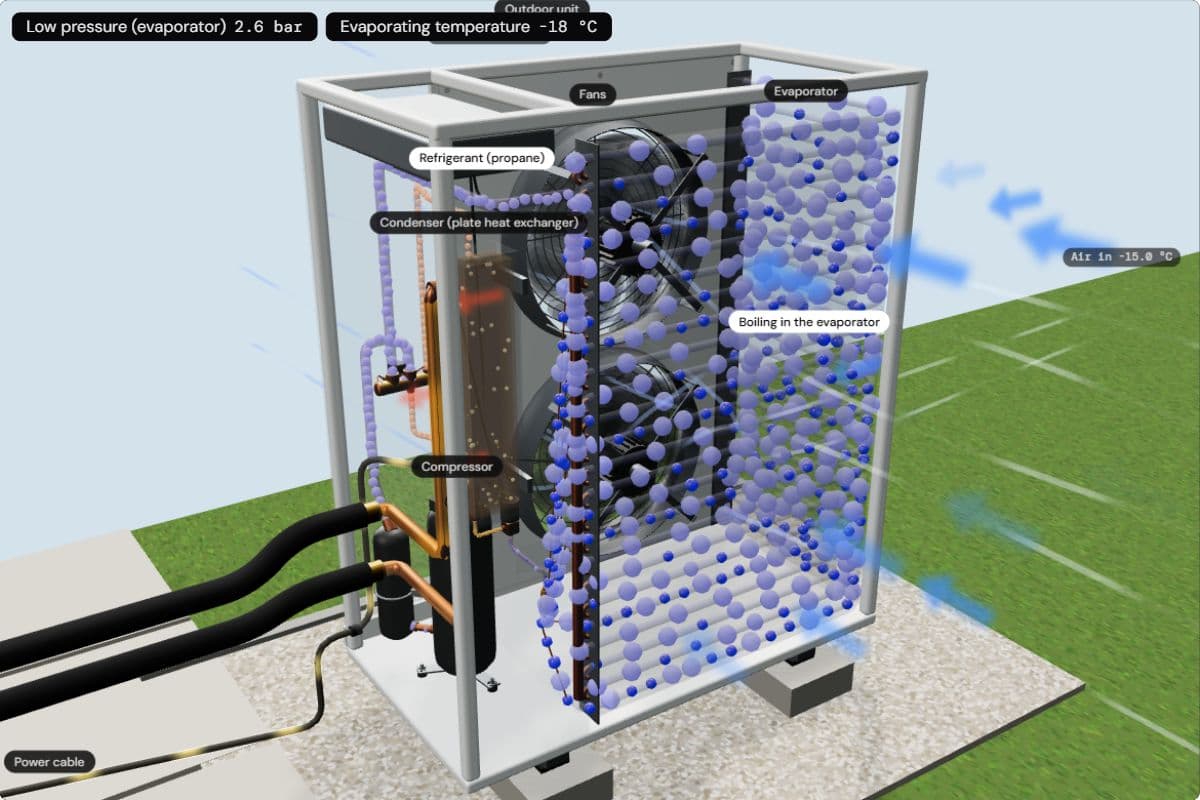
The model's refrigerant is propane, which boils at −42 °C at normal air pressure (NIST). The compressor keeps sucking the evaporator coil down to a low pressure. At −15 °C outside, that pressure is only about 2.6 bar, about two and a half times normal air pressure, and there the propane boils at about −18 °C: a few degrees colder than the air. Heat flows from the air into the boiling refrigerant, and boiling swallows that heat, the same way a spray can gets cold while you spray.
On the mild 7 °C day the pressure in the coil is about 5.3 bar and the refrigerant boils at about 3.5 °C. The heat pump simply runs its cold side at a lower pressure when the air is colder.
Step 5 of 15 · Try it
The colder the air, the lower the COP
What the cold does change is the cost. The compressor has to lift the heat from the temperature at which the refrigerant boils to the temperature at which it gives the heat to the heating water, about 38 °C for floor heating at 35 °C. The colder the air, the bigger that lift, and the more electricity each kilowatt of heat takes.
In the model, at the same compressor speed, the COP is about 5.2 at 7 °C, 4.7 at 2 °C, 3.8 at −7 °C and 3.1 at −15 °C. It falls steadily but never reaches zero. A real air-to-water heat pump's datasheet shows the same curve: 5.31 at 7 °C, 4.46 at 2 °C and 3.16 at −7 °C air, all with water at 35 °C (Viessmann Vitocal 250-A), and a test lab measured about 2.9 at −10 °C on a sister model (WPZ Buchs).
Step 7 of 15 · Explain
Less heat just when the house needs more
Not only the COP falls; the heat output does too. At the same compressor speed the model gives about 7.4 kW at 7 °C but only about 3.9 kW at −15 °C. The reason is the vapour the compressor sucks in: cold vapour at low pressure is thin, about half as dense at −15 °C as at 7 °C. Each turn of the compressor moves only about half as much refrigerant, like a pump working in thin mountain air.
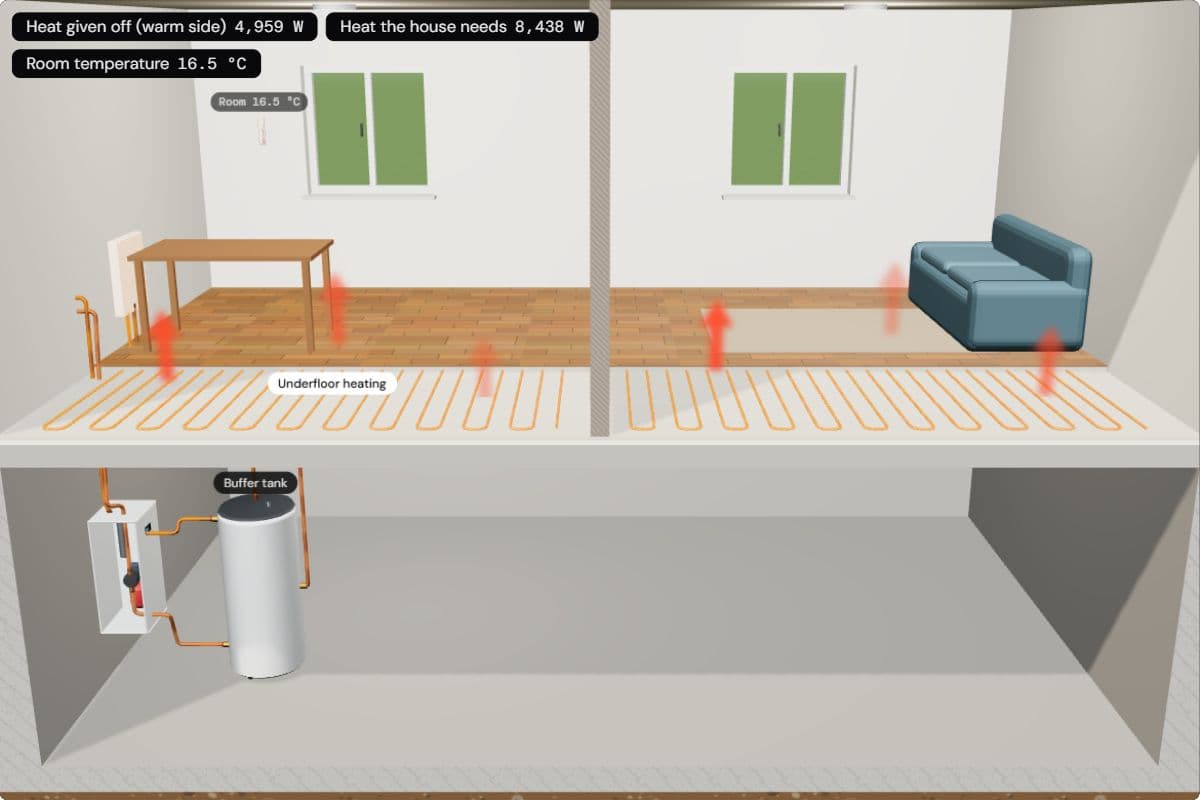
Meanwhile the house loses heat faster the colder it gets. The model house needs about 8.4 kW at −7 °C and 10 kW on the coldest days, −12 °C and below. At medium speed the heat pump gives only about 5 kW at −7 °C, and the rooms would only reach about 16 to 17 °C.
Modern heat pumps solve this with an inverter that changes the compressor's speed. Turned up to about 95 Hz, the model's compressor delivers about 8.7 kW and the rooms reach 20 °C again. The price: the electricity doubles to about 2.6 kW and the COP drops from about 3.8 to 3.4. Working harder costs efficiency.
Halfway
See it for yourself in 3D
Reading is one thing. In the tour you change it yourself and watch what happens, step by step.
Start the 3D tourStep 9 of 15 · Explain
On the coldest nights a back-up heater helps
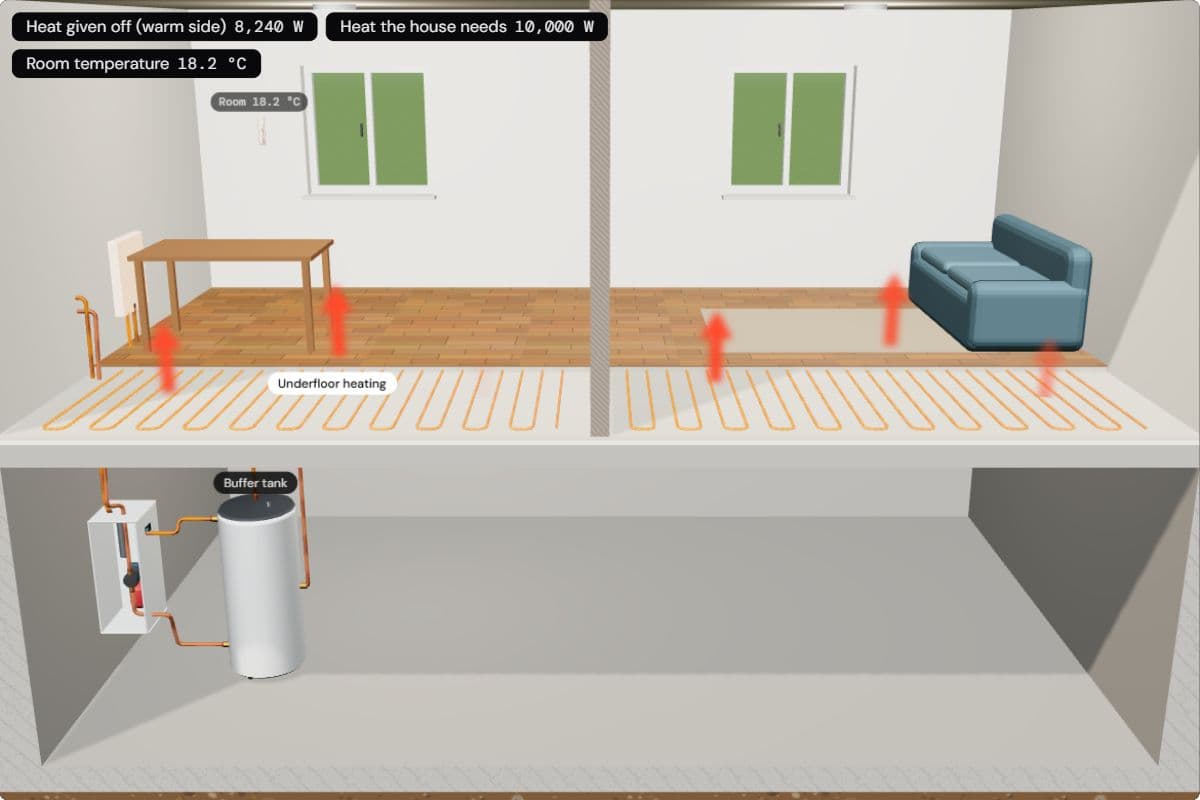
At −15 °C even full speed isn't enough in the model: the heat pump gives about 8.2 kW, the house needs 10 kW, and the rooms settle around 18 °C. The outdoor temperature below which the heat pump alone no longer covers the house is called the balance point; for this model house at full speed it is about −10 °C.
Below it, a real system switches on an electric back-up heater, which turns 1 kWh of electricity into just 1 kWh of heat. The model doesn't show it. It matters less than it sounds, because such nights are rare: in Fraunhofer ISE field tests in existing houses, the back-up heater used only 1.3 to 1.9 % of the heat pumps' electricity.
Step 13 of 15 · Try it
Frost forms on damp days around freezing
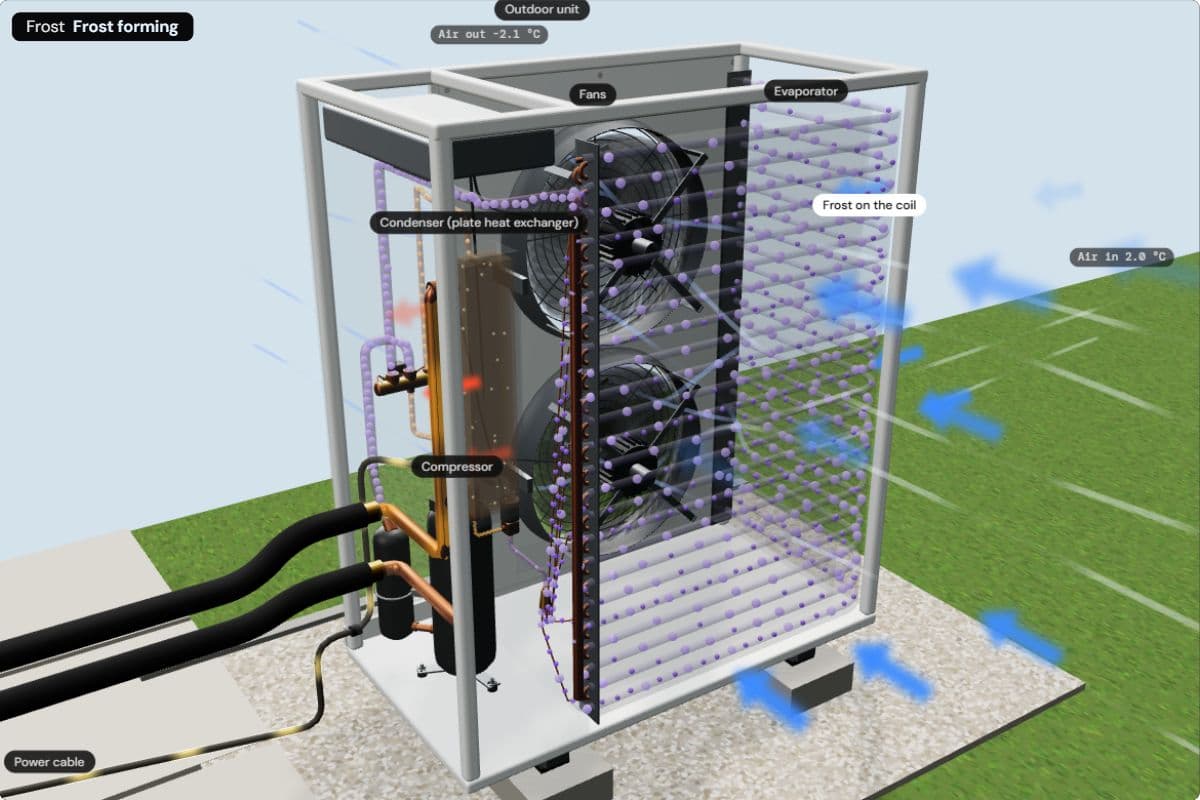
The fins of the outdoor unit are colder than the air, because the refrigerant inside boils below the air temperature. When they are below 0 °C and the air is damp, the water in the air freezes onto them as frost. A layer of ice blocks the air and makes the heat pump work harder.
A common belief is that icing is worst on the coldest days. It isn't. Frost is heaviest around 0 to +5 °C in humid air, above about 70 % relative humidity, and rare below −10 °C, because very cold air holds very little water (Zhu et al. 2015; Bosch). In the model, at 2 °C and 90 % humidity, frost forms; drop the humidity to about 70 % and it stops. At −15 °C the model forms no frost at all.
Step 14 of 15 · Try it
Defrosting: the cycle runs backwards for a few minutes
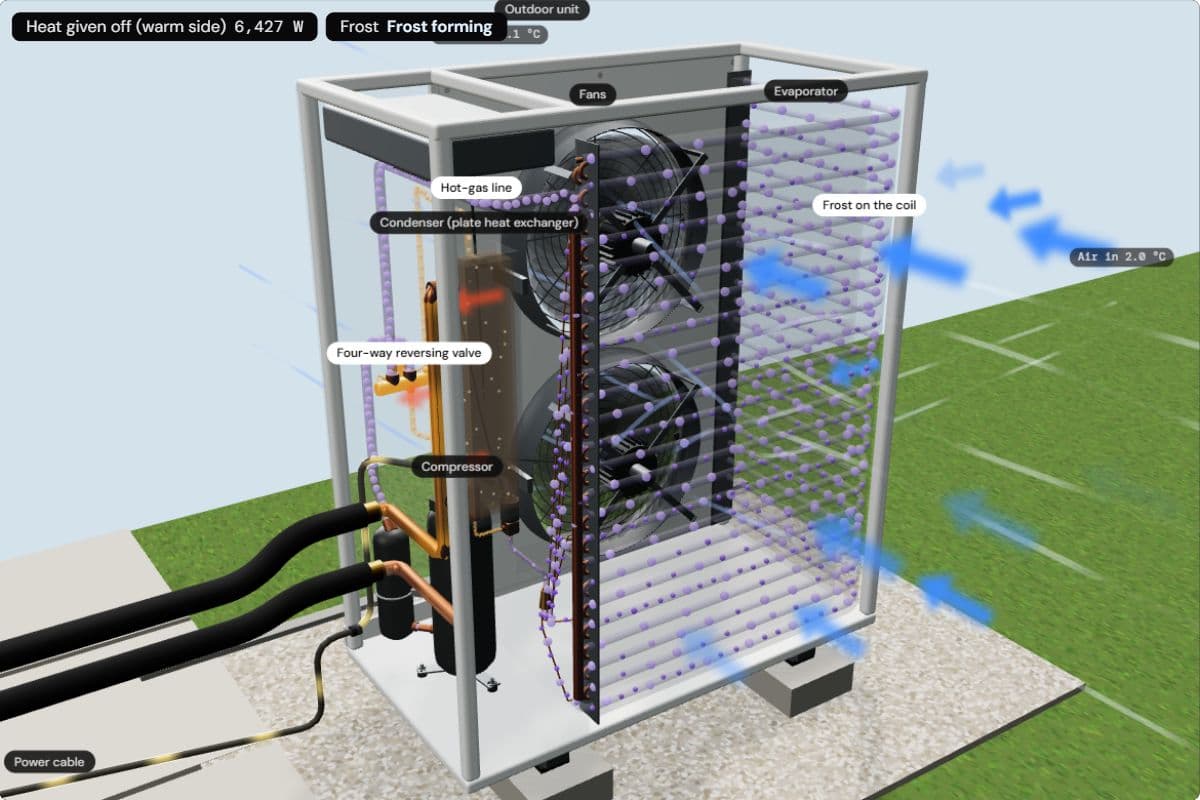
Every air source heat pump defrosts itself. A four-way valve turns the refrigerant loop round for a few minutes: the fans stop, hot gas from the compressor flows into the outdoor coil and melts the ice, and the water runs off. The heat for that comes from the house's heating water. In the model the heat to the house goes negative, about −6 kW, for the four minutes the defrost lasts; then the valve flips back.
Real units defrost for about 3 to 8 minutes every 30 to 90 minutes in damp weather around freezing. Over a whole winter that costs about 5 % of the energy in simulations, more in some measurements, and on frosty days the daily COP can drop by 15 to 20 % (Università di Bologna; E3S 2019).
Step 11 of 15 · Explain
Ground and groundwater stay warm in winter
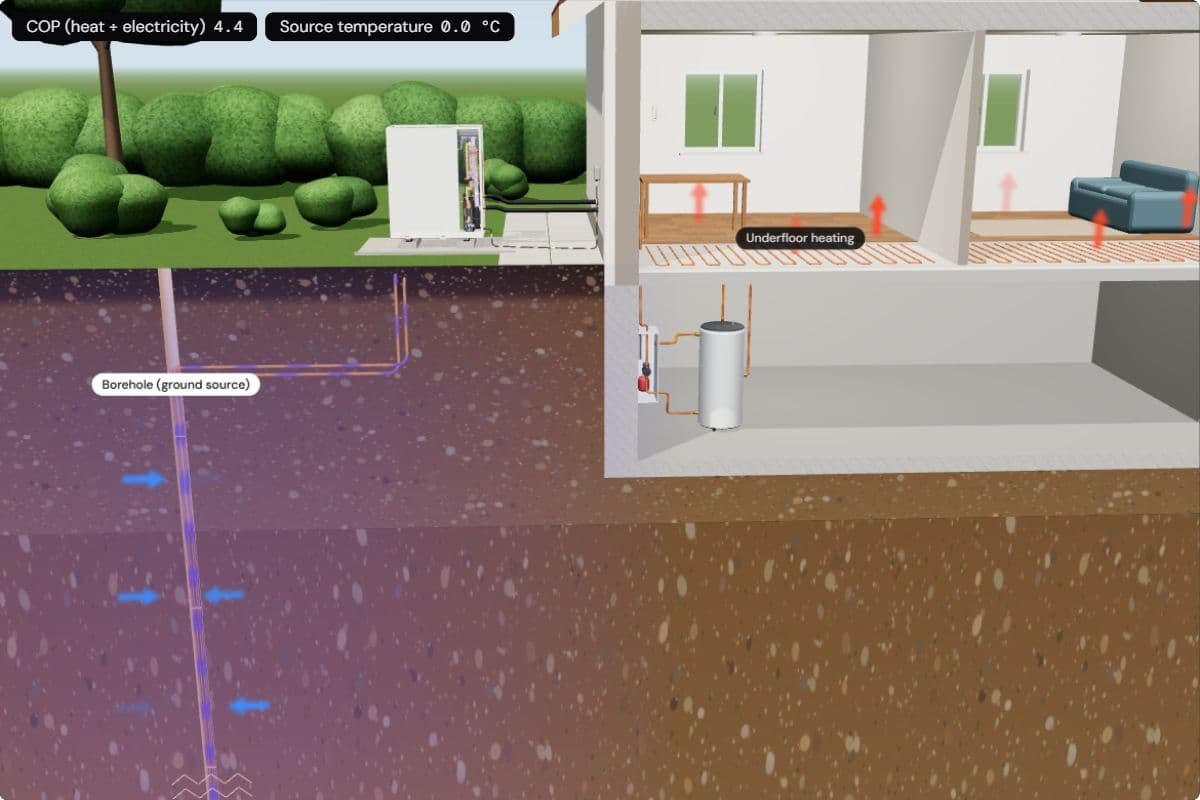
Outdoor air is coldest exactly when the house needs the most heat. The ground isn't: below about 10 m it stays near 10 °C all year (C.A.R.M.E.N.). A ground source heat pump pumps a fluid, brine, through a borehole often around 100 m deep. In the model the brine comes back at about 0 °C even when the air is −15 °C, and the COP is about 4.4 instead of 3.1. Groundwater from a well is about 7 to 12 °C all winter; in the model it gives a COP of about 5.5 at −15 °C (Bundesverband Wärmepumpe).
Field tests show the same over a whole year: air source heat pumps in existing houses reached a seasonal performance factor of 3.1 to 3.4, ground source ones 4.1 to 4.3 (Fraunhofer ISE). The trade-off is the cost: a borehole or wells cost much more to build and need a permit.
Back-up heater and balance point
Most air-to-water heat pumps have an electric heating element built into the indoor unit or the buffer tank; the datasheet unit used here has an 8 kW back-up heater (Viessmann). It turns electricity into heat one to one, so it is about three times as expensive per kWh of heat as the heat pump on a cold day.
The heater switches on below the balance point, when the heat pump alone can no longer keep up. Because most heating hours fall between 0 and 10 °C and only a few nights get colder than the balance point, the heater does little over a year: 1.3 to 1.9 % of the electricity in German field tests (Fraunhofer ISE). A heat pump sized for the house, and a low flow temperature, push the balance point further down.
In North America, many heat pumps are paired with a gas or oil furnace instead (dual fuel): the furnace takes over below a set outdoor temperature.
What this model simplifies
The air temperature slider stops at −15 °C; the real unit the model follows runs down to −20 °C, and cold-climate units go lower. The back-up heater isn't modelled. The house is one 10 kW load with no thermal mass worth mentioning, so the rooms warm and cool within minutes. Frost is one lumped layer that forms only above −10 °C, and every defrost takes four minutes. The heating is floor heating at 35 °C throughout; with radiators at 55 °C the COP would be about a third lower (Viessmann datasheet: 3.16 against 2.13 at −7 °C).
FAQ
Frequently asked questions
- How cold is too cold for a heat pump?
- The real unit this model follows is rated to keep running down to −20 °C (Viessmann), and cold-climate models go lower. In the model the COP is still about 3 at −15 °C. Below the balance point, around −10 °C for the model house, an electric back-up heater helps.
- Do heat pumps work below freezing?
- Yes. Air below 0 °C still holds heat, and the refrigerant in the outdoor coil boils even colder than the air because its pressure is kept low. So heat keeps flowing in; the cold only lowers the output and the COP.
- Can a heat pump freeze up in winter?
- The outdoor coil can ice up, mostly on damp days between about 0 and +5 °C. The unit then defrosts itself by running the cycle backwards for a few minutes, which melts the ice.
- Why is my electric bill higher with a heat pump in winter?
- The house needs more heat, the COP is lower and the compressor runs faster. For a house that needs 10 kW on the coldest day, the model needs about 200 kWh of heat on a −7 °C day and about 60 kWh of electricity for it. Defrosting and the back-up heater add a little.
- What is a cold-climate heat pump?
- An air source heat pump built and rated to keep a useful output and COP in deep cold, usually with an inverter-driven compressor and a refrigerant circuit designed for low outdoor temperatures. It works on the same principle shown here.
- Is a ground source heat pump better in winter?
- Yes, its source stays warm: in the model the brine comes back at about 0 °C at −15 °C air, for a COP of about 4.4 instead of 3.1. Over a year, ground source heat pumps reach about 4.1 to 4.3 against 3.1 to 3.4 for air (Fraunhofer ISE), but they cost more to install.
Keep exploring
Not the question you had in mind?
More on Heat pump
- Question 1
How does a heat pump work?
Meet the four parts of a heat pump, ride along with the refrigerant and find out why 1.4 kW of electricity brings 7.4 kW of heat into the house.
15 steps · BeginnerStart - Question 2
How does a refrigerator work?
Find out why an open fridge warms the kitchen, follow the refrigerant from the cold plate to the warm grille and watch the thermostat switch the compressor on and off.
12 steps · BeginnerStart - Question 3
Can a heat pump cool?
Flip the heat pump to cooling, find the four-way valve that turns its cycle round, watch the two heat exchangers swap jobs, feel the warm air leave the outdoor unit and see why floor cooling stays above the dew point.
11 steps · BeginnerStart