What causes the midnight sun and polar night?
The midnight sun and polar night come from the 23.4° tilt of Earth's axis. In June the Arctic leans towards the Sun and stays on the day side as Earth turns; in December it stays on the night side. The further north, the longer the midnight sun: about a month at the Arctic Circle, half a year at the pole.
In this tour you stand in Tromsø at midnight, move Earth through the year and travel to the North Pole to watch how the six-month day really ends.
8 steps · Beginner · free, no account
 Start the 3D tour here
Midnight sun, polar day and polar night: what the words mean
The midnight sun means the Sun stays above the horizon for at least one full day, so it is still visible at midnight. The whole period when that happens is called the polar day. The polar night is the opposite: the Sun stays below the horizon for at least 24 hours and doesn't rise at all.
Both only happen near the poles, roughly beyond the Arctic and Antarctic Circles at 66.6° north and south. And they belong together: a place that gets the midnight sun in summer gets short days or the polar night in winter, half a year later.
Step by step
The Sun at midnight
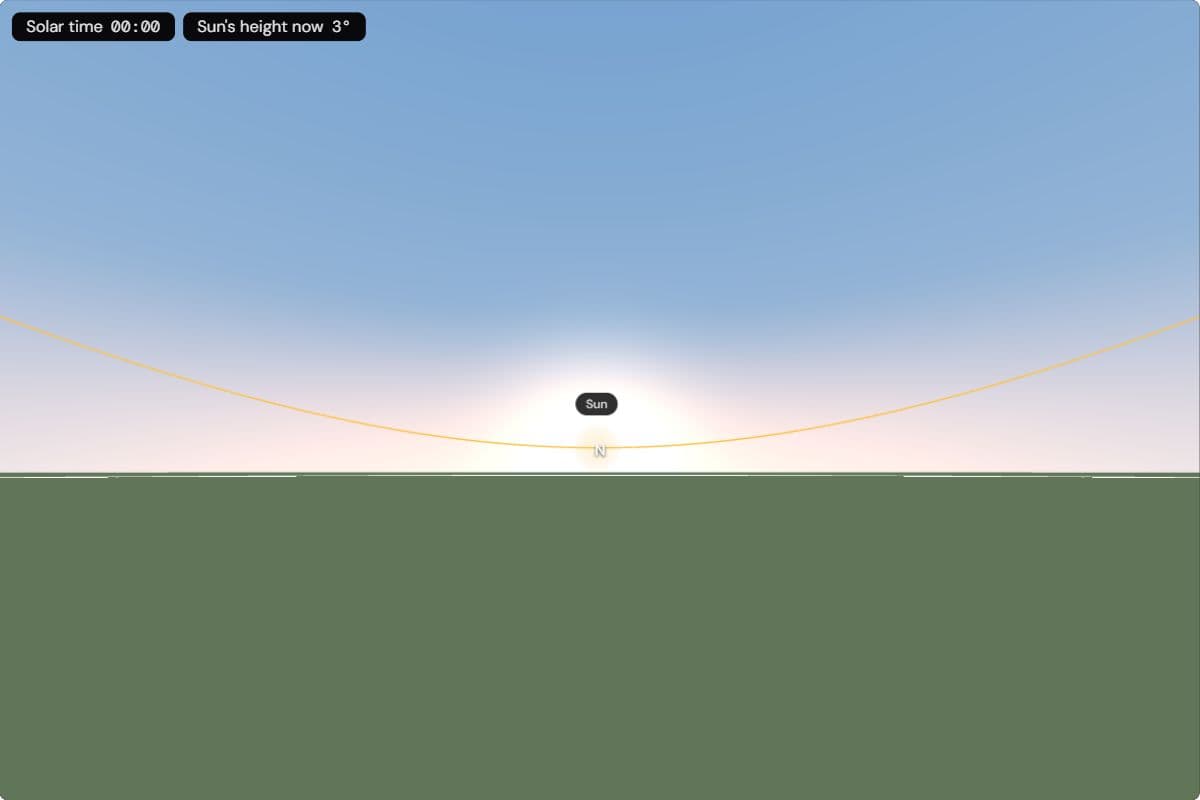
Tromsø in northern Norway lies at 69.7° N. On 21 June at midnight, local solar time, the Sun doesn't set there. It hangs about 3° above the northern horizon, skims along it and then climbs again towards morning. At noon it stands 44° high in the south.
Its whole path across the sky for that day stays above the ground. So the day lasts 24 hours, and it does from about 18 May to 25 July, roughly ten weeks.
The tilted axis keeps the Arctic in the light
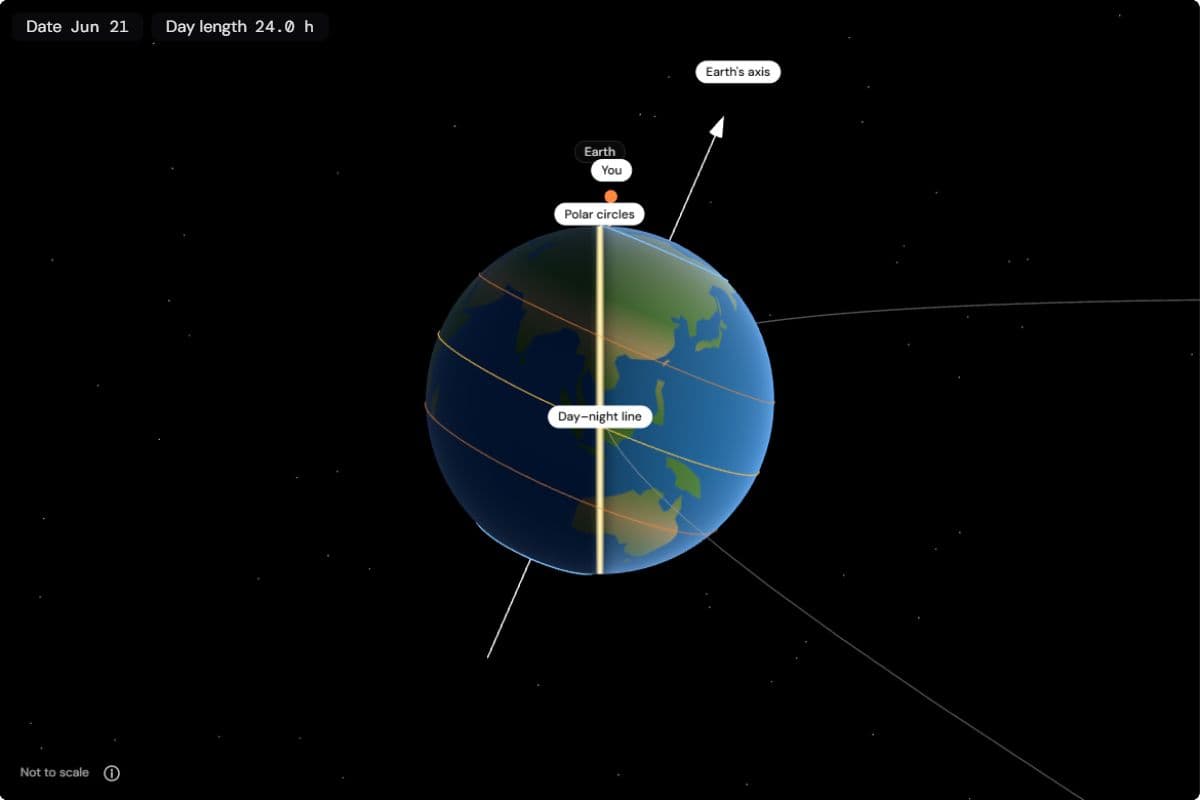
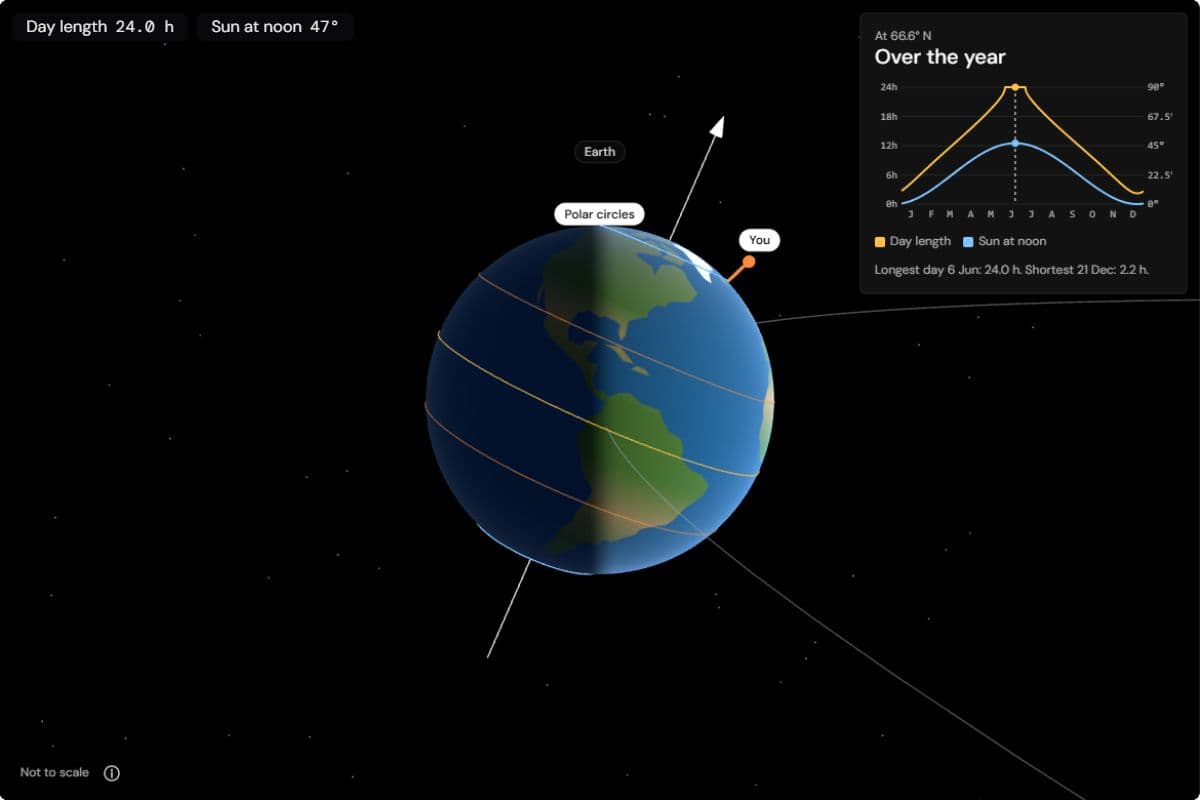
Earth's axis is tilted by 23.4° and always points the same way in space. Around 21 June its northern end leans towards the Sun. The day–night line, the edge of the sunlit half, then runs past the North Pole on the far side.
As Earth turns once in 24 hours, every place north of a certain latitude stays on the sunlit side the whole time. That latitude is 90° minus the tilt: 90° − 23.4° = 66.6°, the Arctic Circle. The circle is not an arbitrary line on the map; it is where the tilt puts it.
Half a year later: polar night
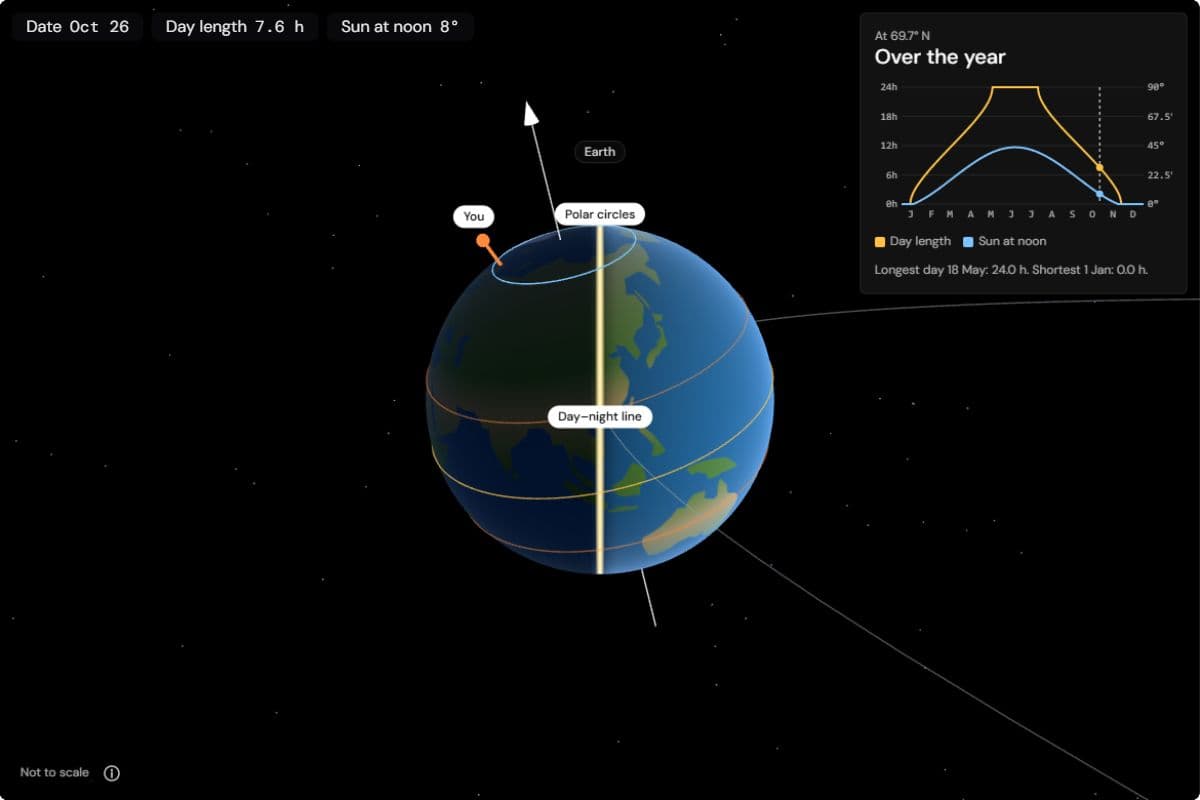
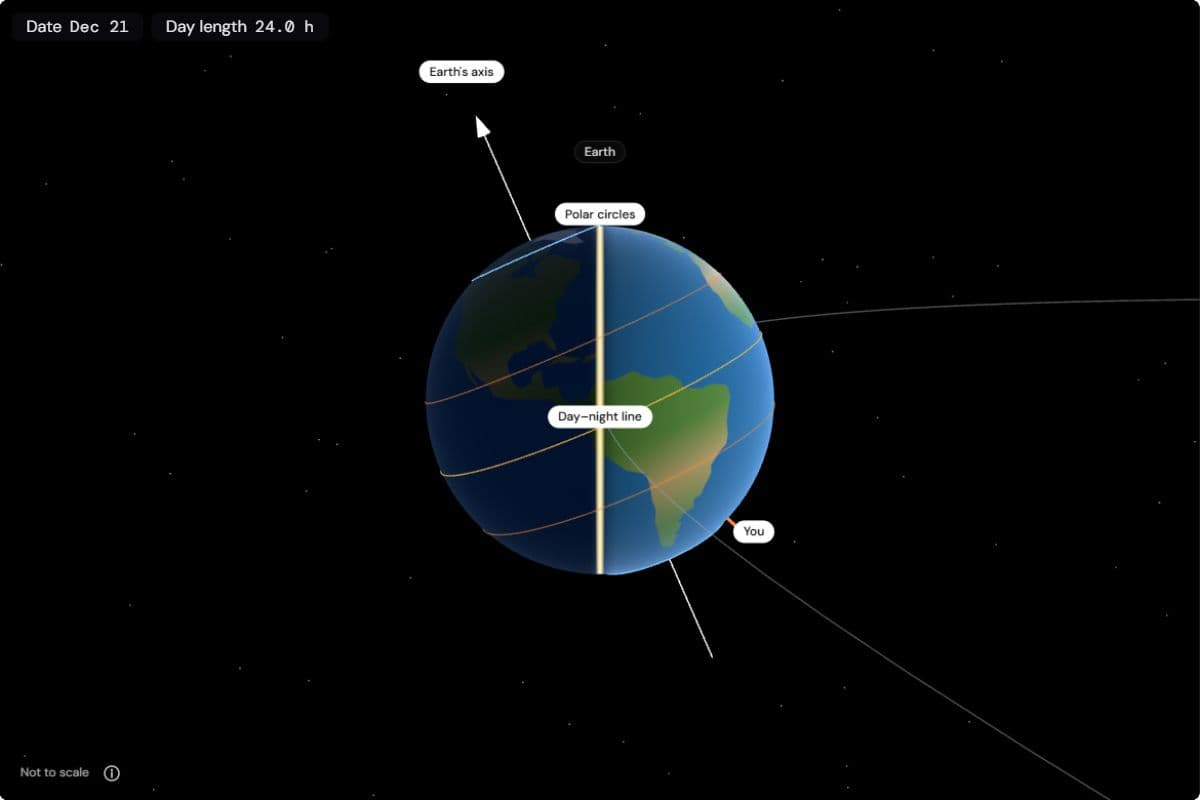
In December the axis still points the same way in space, but Earth is now on the other side of the Sun. The Arctic leans away, and the same places stay on the night side while Earth turns. In Tromsø the Sun doesn't rise from about 28 November to 14 January.
The polar night doesn't arrive overnight. In Tromsø the days get about 8–9 minutes shorter every day in September and October. On 26 October the day still has about 7.6 hours. In the last week before the polar night the days shrink by 20 to 40 minutes a day, until on 28 November the Sun no longer clears the horizon.
No sudden switch at the North Pole
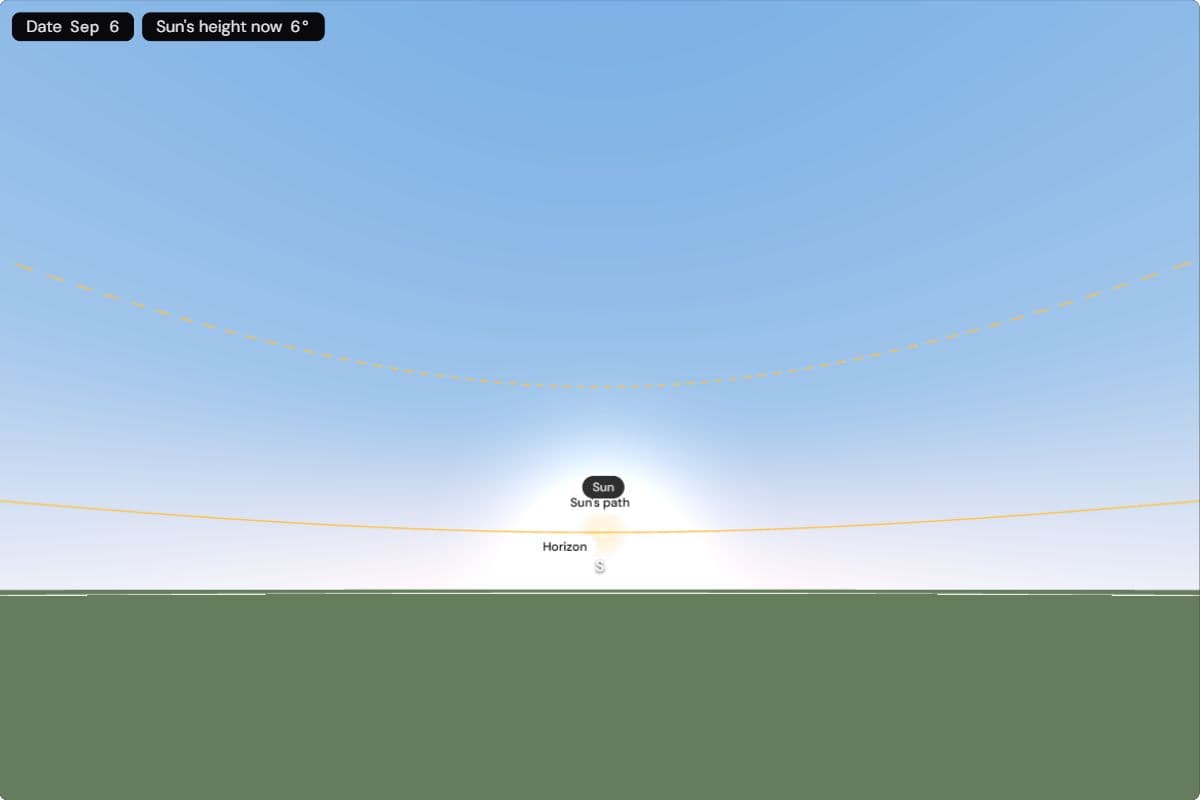
A common idea is that at the North Pole the Sun sets one evening and the next morning a six-month night has begun. That isn't what happens. At the pole the Sun's height barely changes during a day: it circles the sky at almost the same height, and that height drops by only about 0.4° a day around the equinox.
In early September it still circles about 6° above the horizon. Around 23 September its centre reaches the horizon, and only around 25 September is the last bit of the disc gone, so the sunset itself takes more than a day. After that the Sun stays just below the horizon for weeks. Until about 9 October it is still light enough to read outside. Truly dark, with the Sun more than 18° down, it only gets from mid-November to late January.
Further north, longer midnight sun
How long the midnight sun lasts depends on how far north you are. In a chart of day length over the year, the midnight sun is the flat top at 24 hours. Move north and the flat top gets wider.
In the 3D model: about a month on the Arctic Circle (6 June to 6 July), about ten weeks at 70° N, about four months on Svalbard at 78° N (19 April to 23 August) and about six months at the pole (18 March to 24 September). The polar night grows the same way, but it starts a little further north, as the next section explains.
The other way round in the south
On 21 December Earth is on the other side of its orbit and the southern end of the axis leans towards the Sun. Now Antarctica stays on the day side: on the Antarctic Circle the day lasts 24 hours, while the Arctic is in its polar night.
So the midnight sun moves from pole to pole, half a year apart. At the South Pole the Sun is up from about 21 September to 22 March.
Why the Arctic Circle gets a month of midnight sun, not a day
Many textbooks say the midnight sun lasts exactly one day on the Arctic Circle. That is true for a point-sized Sun and an Earth without air. In reality two things keep the Sun visible longer. The atmosphere bends sunlight around the curve of the Earth, so we see the Sun about half a degree higher than it really is. And sunrise and sunset are counted from the Sun's upper edge, not its centre, which adds another quarter of a degree.
Together, the Sun counts as up until its centre is about 0.8° below the horizon. On the Arctic Circle it therefore stays up for about a month, and some midnight sun can be seen as far south as about 65.8° N. The polar night works the other way: right on the circle there is none at all, because the shortest day still has about 2.2 hours of Sun. The polar night only starts at about 67.4° N.
How dark is the polar night?
Polar night doesn't mean pitch black. As long as the Sun is less than 6° below the horizon, there is civil twilight: bright enough to walk around without a lamp. Down to 12° the horizon is still visible (nautical twilight), and only below 18° is the sky fully dark.
In Tromsø the Sun is only about 3° below the horizon at noon even on 21 December, so the darkest day still has a few hours of blue twilight. At the North Pole the Sun sinks much deeper, down to 23.4° below the horizon at the December solstice. Even there, about half of the six-month night is twilight, some seven weeks after sunset and seven weeks before sunrise; true darkness lasts only from about mid-November to late January.
Where you can see the midnight sun
In Europe the midnight sun can be seen in northern Norway, Sweden and Finland, in Lapland and on Svalbard, and on Grímsey, the small island off Iceland on the Arctic Circle. Further away there is northern Russia, Alaska, northern Canada and Greenland. In the south only Antarctica lies beyond the polar circle, and it has no towns, only research stations.
Dates in the model for two popular places: in Tromsø (69.7° N) the Sun doesn't set from about 18 May to 25 July and doesn't rise from about 28 November to 14 January. In Longyearbyen on Svalbard (78.2° N) the midnight sun lasts from about 19 April to 24 August and the polar night from about 27 October to 14 February. Real dates can shift by a day or two, and mountains around a town hide the low Sun for longer.
Frequently asked questions
How long does the polar night last at the North Pole?
About six months: the Sun sets around 25 September and rises again around 18 March. It is not dark all that time. For several weeks after sunset and before sunrise there is twilight, and the sky is fully dark only from about mid-November to late January.
Is it completely dark during the polar night?
Not near the polar circles. In places like Tromsø the Sun stays only a few degrees below the horizon at noon, so there are a few hours of blue twilight every day. Only close to the poles, in the middle of the polar night, is it dark around the clock.
Where does the polar night last only one day?
In theory on the polar circles at 66.6°. In practice the atmosphere bends sunlight over the horizon, so on the circle itself the Sun still rises on its shortest day. A full day without sunrise first happens at about 67.4° north or south.
Is there a midnight sun in Germany or the UK?
No, they are too far south. In Berlin the longest day lasts about 16.8 hours, and at midnight the Sun is about 14° below the horizon, so the sky never gets fully dark around midsummer. The far north of Scotland has similar bright nights, but no midnight sun.
Does Antarctica have a midnight sun too?
Yes, half a year shifted. Around 21 December the southern end of Earth's axis leans towards the Sun, so the Sun doesn't set on and south of the Antarctic Circle. At the South Pole it stays up from about 21 September to 22 March.
More questions on this topic
What causes the seasons?
Find out why it is warm in summer and cold in winter, and why the distance to the Sun is not the reason.
Why does the Moon have phases?
Find out why the Moon changes its shape every month, and why Earth's shadow has nothing to do with it.
What causes a solar eclipse?
Find out how the Moon's shadow makes a solar eclipse, and why there isn't one at every new moon.
What causes day and night?
Find out why the Sun rises and sets, and why it isn't noon everywhere at the same time.
Why do we always see the same side of the Moon?
Find out why the Moon always shows us the same face, and what we would see if it didn't turn at all.
Where does the Sun rise?
Watch sunrise in Berlin through the year and find out why the Sun rises due east only twice a year and never stands overhead in Europe.