What causes day and night?
Earth turns once around its own axis every 24 hours. The half that faces the Sun has day, the other half has night. The Sun doesn't travel around Earth, it only looks that way from the ground. And because Earth turns, noon comes to each place at a different moment. That is why there are time zones.
In this tour you watch Earth turn in 3D, make it night in Berlin and find out why New York is 6 hours behind.
7 steps · Beginner · free, no account
 Start the 3D tour here
Rotation, not revolution
Earth makes two movements at once, and they are easy to mix up. It turns around its own axis, which is called rotation, and it travels around the Sun, which is called revolution. One rotation takes about 24 hours and gives us day and night. One trip around the Sun takes a year and, together with the tilt of the axis, gives us the seasons.
If Earth didn't turn at all, its orbit alone would still bring day and night, but very slowly: each side would face the Sun for about half a year and then face away for the other half. The quick change every 24 hours comes only from the spin.
Step by step
Earth turns once every 24 hours
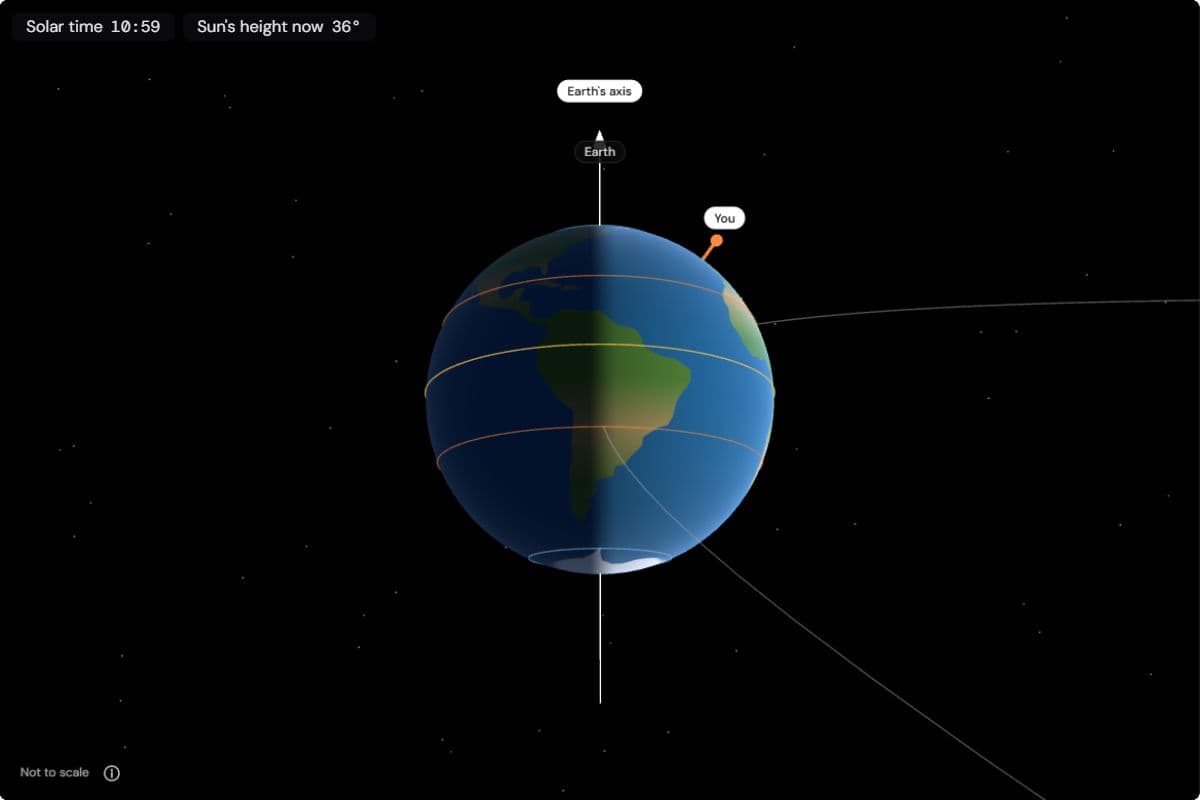
Earth spins around an imaginary axis that runs from the North Pole to the South Pole. It turns from west to east, and seen from above the North Pole that is anticlockwise. One full turn relative to the Sun takes 24 hours, so every hour Earth turns by 15°.
Any place on Earth is carried along on this turn. On 20 March, the start of spring, Berlin comes out of the dark at about 6 in the morning, moves across the sunlit side and reaches its highest Sun of the day at noon, about 37° above the horizon. In the evening it turns back into Earth's shadow, and the Sun's height drops below zero.
The Sun only seems to move across the sky
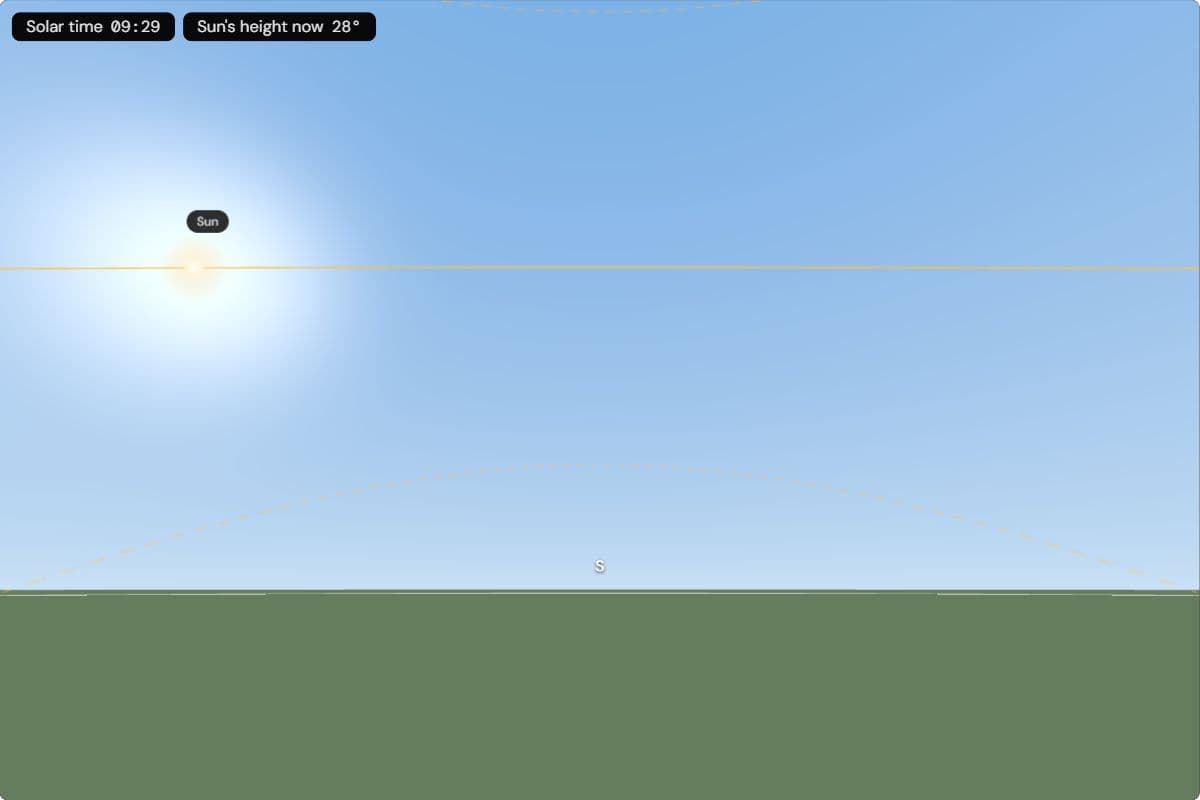
From the ground it looks as if the Sun does all the work: it rises in the east, climbs across the southern sky and sets in the west. For thousands of years people took that at face value and believed the Sun circled Earth once a day.
In fact the Sun stays where it is, and we turn past it. Because Earth spins towards the east, everything in the sky seems to drift the other way, towards the west, just as trees seem to rush backwards when you look out of a train window. We don't feel the turning, because the ground, the air and we ourselves all move along together at a steady speed.
One half of Earth always has day
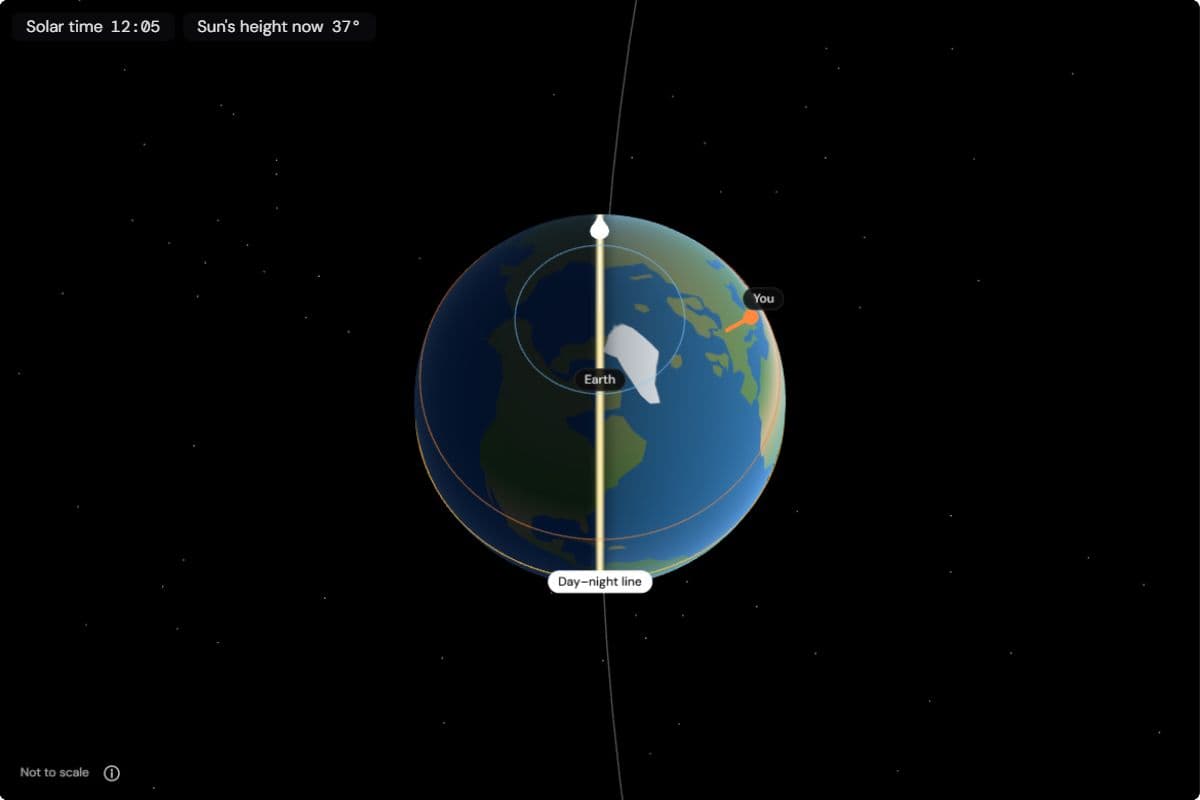
The Sun can only light the side of Earth that faces it, so at every moment one half of the globe has day and the other half has night. The border between the two is called the terminator, or day–night line. It is not a sharp edge in real life, because the air scatters light past it, which gives us dawn and dusk.
Everyone standing on this line sees the Sun on the horizon right now: on one side of the globe it is rising, on the other side it is setting. On 20 March in Berlin, the Sun sets a few minutes after 18:00 Sun time; at 19:00 it is already 7.9° below the horizon. That is past the end of civil twilight at 6° below, when it becomes too dark to read outside without a lamp.
Noon comes later the further west you go
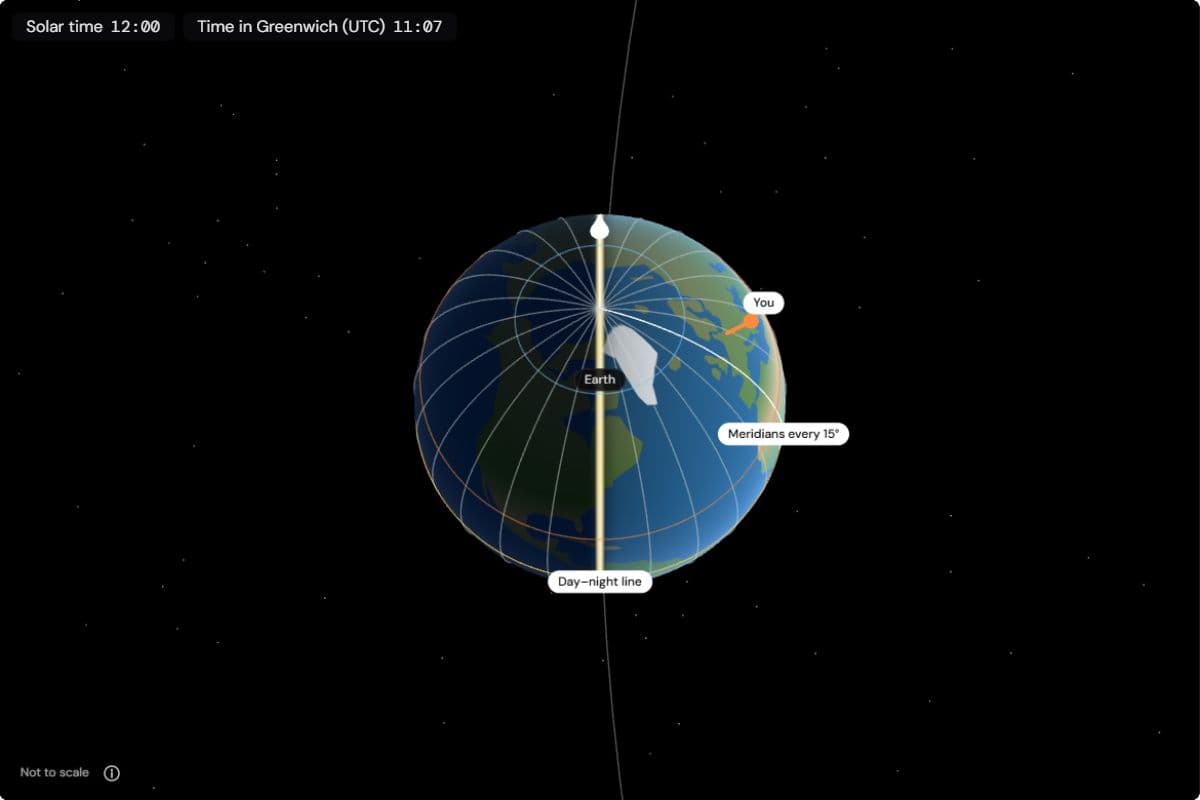
Because Earth turns towards the east, places further east turn into the sunlight first. So noon, the moment when the Sun stands highest, can't be at the same time everywhere. It travels around the globe from east to west, 15° of longitude every hour.
New York lies about 87° west of Berlin. When the Sun stands due south over Berlin at noon, New York still has about 6 hours to go: there it is just after 6 in the morning, and the Sun is only rising. Going the other way, about 90° east of Berlin, near Lake Baikal in Siberia at around 105° east, the Sun is setting at the very same moment. Three places, one instant, three different times of day.
Time zones: why clocks don't follow the Sun exactly
Until the railways came, most larger towns set their clocks by their own noon, so Munich and Berlin ran several minutes apart. Timetables made that impractical. In 1884 an international conference chose Greenwich in London as longitude 0°, and over the following decades countries switched to time zones: in theory 24 zones, each 15° wide, one hour apart.
In practice the borders follow countries, not straight lines. Germany uses Central European Time, which is the Sun's time at 15° east, the longitude of Görlitz. Berlin lies at 13.4° east, so the Sun reaches its highest point there on average about 6 minutes after 12:00, and in summer time about 1:06 pm. China uses a single time zone although it stretches across about 60° of longitude, so in winter the Sun rises in the far west of the country at around 10 in the morning by the clock.
The simulation shows the Sun's time, also called local solar time: 12:00 is always the moment the Sun stands highest at the chosen place.
Why day and night are not always 12 hours long
Earth's rotation makes day and night, but how long each lasts depends on the tilt of the axis, 23.4°. Around the equinoxes in March and September the day–night line runs through both poles, and every place on Earth gets about 12 hours of day and 12 of night.
In June the North Pole leans towards the Sun. Places in the north then spend more of each turn on the day side: Berlin gets about 16 hours 50 minutes of daylight around 21 June, but only about 7 hours 40 minutes around 21 December. North of the Arctic Circle, at about 66.6°, the Sun doesn't set at all for at least one day in summer and doesn't rise for at least one day in winter; at the North Pole each lasts about half a year. At the equator, day and night stay close to 12 hours all year. The same tilt also causes the seasons.
A day is 24 hours, but one turn takes 23 hours 56 minutes
Measured against the distant stars, Earth completes one turn in 23 hours 56 minutes and 4 seconds. This is called a sidereal day. The day we live by, from one noon to the next, is about 4 minutes longer, because Earth moves a little along its orbit while it spins.
In one day Earth travels about 1° of its path around the Sun. To bring the Sun back to the same spot in the sky, it has to turn about 1° more than a full circle, and at 15° per hour that extra degree takes 4 minutes. That is also why the stars rise about 4 minutes earlier each night, and why the winter sky shows different stars from the summer sky.
How fast does Earth spin, and why don't we feel it?
At the equator the ground moves at about 1,670 km/h, because it has to cover Earth's full circumference of about 40,000 km in one day. Further from the equator the circle is smaller: in Berlin the speed is about 1,000 km/h, and at the poles it is almost zero. On top of that, Earth races around the Sun at about 107,000 km/h.
We feel none of it because the speed is steady. Your body only notices changes in speed or direction, like a car braking or a plane turning, and Earth's spin changes so slowly that no sense can pick it up. The air turns along too, so there is no headwind. The first experiment to show the rotation directly was Foucault's pendulum in Paris in 1851: the plane in which a long pendulum swings slowly turns as Earth turns beneath it, in Berlin by about 12° an hour.
Frequently asked questions
Which direction does Earth rotate?
Earth rotates from west to east. Seen from above the North Pole it turns anticlockwise. That is why the Sun, the Moon and the stars rise in the east and set in the west.
Why is it still light after sunset?
The air scatters sunlight over the horizon, so the sky stays bright for a while after the Sun has gone down. This is twilight. It counts as civil twilight until the Sun is 6° below the horizon, and the sky is fully dark only when the Sun is 18° below.
What would happen if Earth stopped spinning?
Day and night would then come only from the trip around the Sun, so one day would last a whole year: about six months of daylight followed by six months of night. The day side would get very hot and the night side very cold.
Does the Moon have day and night?
Yes, but they are long. The Moon turns only once per trip around Earth, so from one sunrise to the next on the Moon takes about 29.5 Earth days: roughly two weeks of sunlight followed by two weeks of night.
Is Earth's rotation slowing down?
Very slightly. The tides raised by the Moon act like a brake, so over long periods the day gets longer by about 2 milliseconds per century. About 600 million years ago a day lasted only around 22 hours.
More questions on this topic
What causes the seasons?
Find out why it is warm in summer and cold in winter, and why the distance to the Sun is not the reason.
Why does the Moon have phases?
Find out why the Moon changes its shape every month, and why Earth's shadow has nothing to do with it.
What causes a solar eclipse?
Find out how the Moon's shadow makes a solar eclipse, and why there isn't one at every new moon.
What causes the midnight sun and polar night?
Find out why the Sun doesn't set for weeks in the Arctic summer, and why the polar night doesn't start with a bang.
Why do we always see the same side of the Moon?
Find out why the Moon always shows us the same face, and what we would see if it didn't turn at all.
Where does the Sun rise?
Watch sunrise in Berlin through the year and find out why the Sun rises due east only twice a year and never stands overhead in Europe.