Where does the Sun rise?
The Sun rises in the east, but due east only around the equinoxes, about 20 March and 23 September. In summer it rises in the north-east, in winter in the south-east: in Berlin anywhere from 48° to 129° on the compass. At noon it stands due south, and outside the tropics it is never straight overhead.
In this tour you watch sunrise in Berlin through the year, find out where the Sun can stand overhead and see the noon Sun in the north from the southern hemisphere.
8 steps · Beginner · free, no account
 Start the 3D tour here
Does the Sun always rise in the east?
In the broad sense, yes. Earth turns from west to east once a day, so the Sun, like every star, appears to come up somewhere on the eastern half of the horizon and go down on the western half. That is true everywhere on Earth, in the northern and the southern hemisphere, except in the polar regions on the days when the Sun doesn't rise at all.
In the exact sense, no. Due east, at 90° on the compass, the Sun rises only around the two equinoxes, about 20 March and 23 September. For the rest of the year the rising point moves along the horizon: towards the north-east until late June, then back and on towards the south-east until late December. In Berlin that swing covers 81°, almost a quarter of the whole horizon. The same goes for sunset: due west only around the equinoxes, north-west in summer, south-west in winter.
Step by step
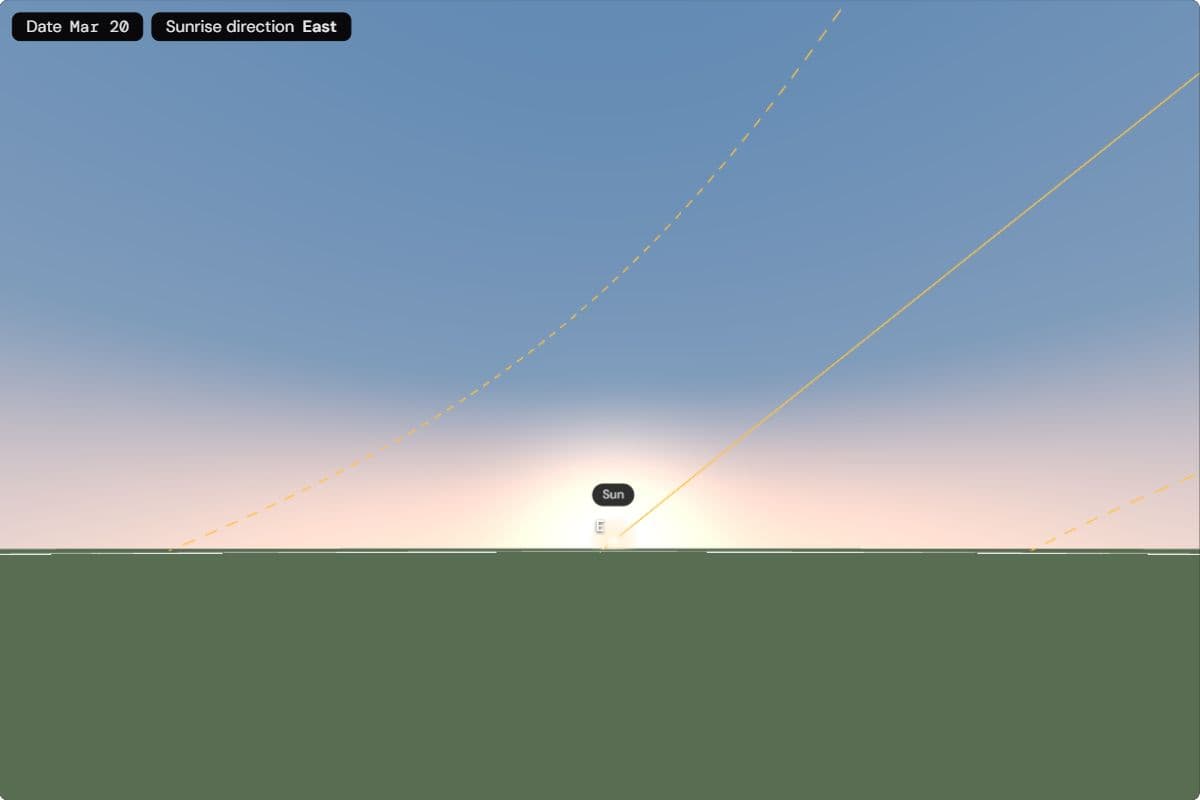
Due east only around 20 March and 23 September
On 20 March the Sun comes up in Berlin at 89° on the compass, practically due east, and sets almost due west. Day and night are about the same length, 12.2 hours of daylight. The same happens around 23 September. These are the equinoxes: the Sun stands right above Earth's equator, and its daily path across the sky is half above and half below the horizon.
A common belief is that this is how it works every day. It isn't. On 21 June, the longest day, the Sun rises in Berlin at 48°, 42° further north than in March, at about 3:35 local solar time. Its path across the sky is so much longer that the day lasts 16.8 hours. The exact day closest to due east is shifted a little by the air, which lifts the Sun's image over the horizon: in Berlin it is 19 March and 24 September.
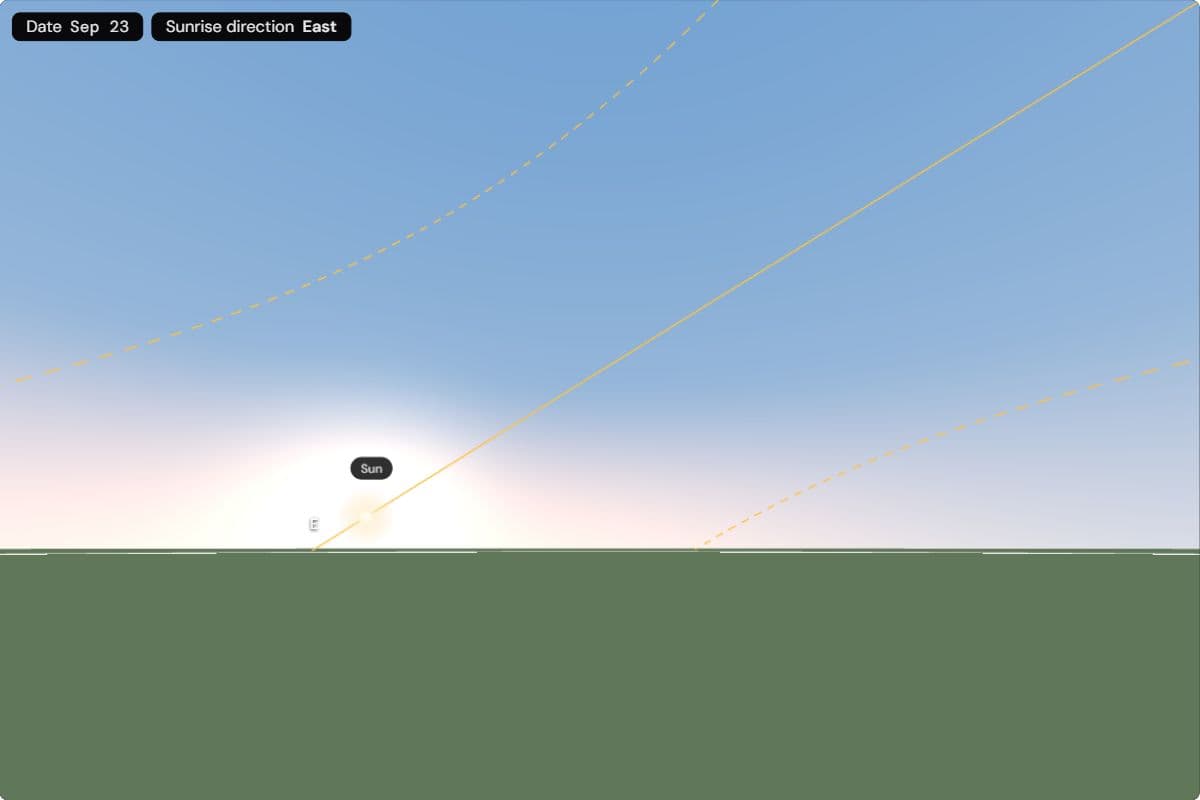
In summer north-east, in winter south-east
After the September equinox the rising point keeps moving, now to the south. By the end of October the Sun rises in Berlin at about 112°, halfway between east and south-east. On 21 December, the shortest day, it rises at 129°, 39° south of east, and only after 8 o'clock solar time. It stays above the horizon for just 7.7 hours.
So over a year the sunrise in Berlin wanders from 48° in June to 129° in December and back: north-east in summer, east in spring and autumn, south-east in winter. Sunset mirrors it in the west. That is why a room with an east window gets morning sun far into its northern corner in June, but only a low, slanting light from the south-east in December.
At noon the Sun stands in the south, but never overhead
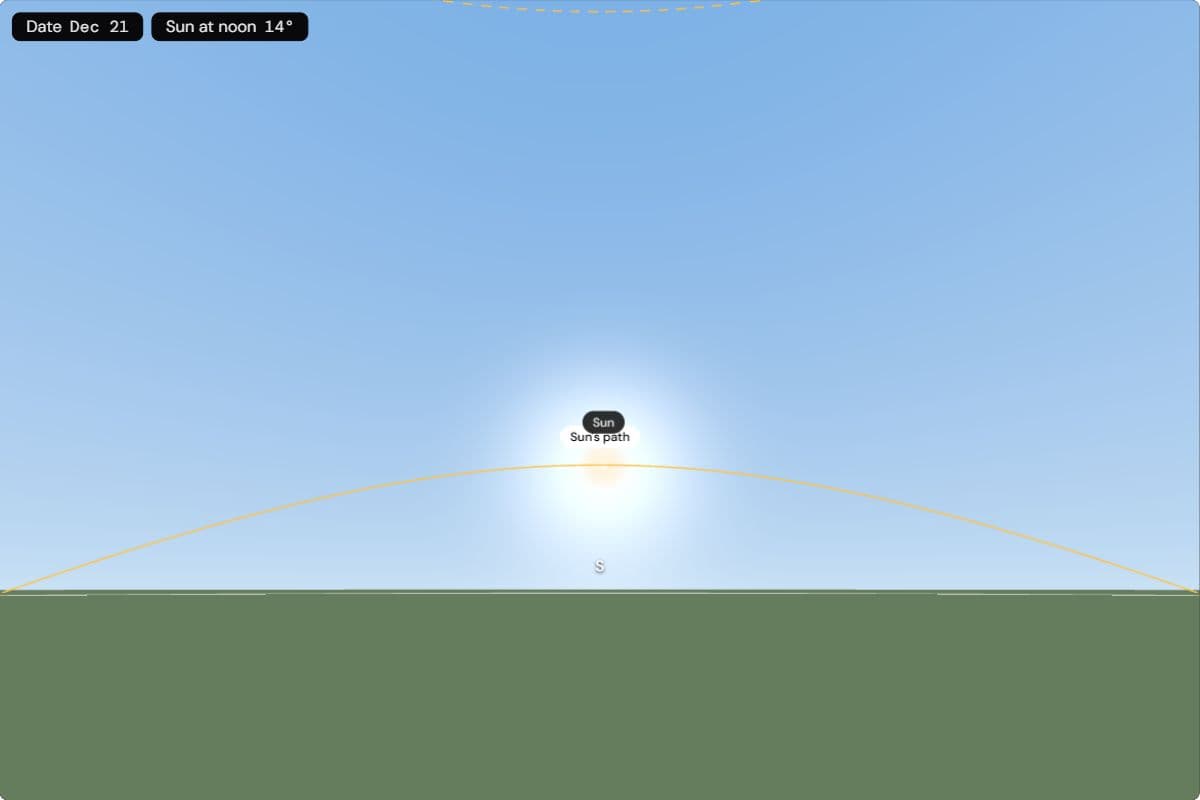
Halfway between sunrise and sunset, at noon by the Sun's own clock, it stands due south in Berlin, every day of the year. How high it gets depends on the date: 14° on 21 December, 37° at the equinoxes and 61° on 21 June. Above 60° it only gets from early June to early July.
The rule behind it is simple: the noon height is 90° minus your latitude, plus or minus the tilt of Earth's axis. For Berlin at 52.5° north that gives 90° − 52.5° + 23.4° = 61° in June and 90° − 52.5° − 23.4° = 14° in December. So the Sun is never straight overhead in Berlin, or anywhere in Europe; it always stays at least 29° away from the point straight above you.
Why: Earth's tilted axis
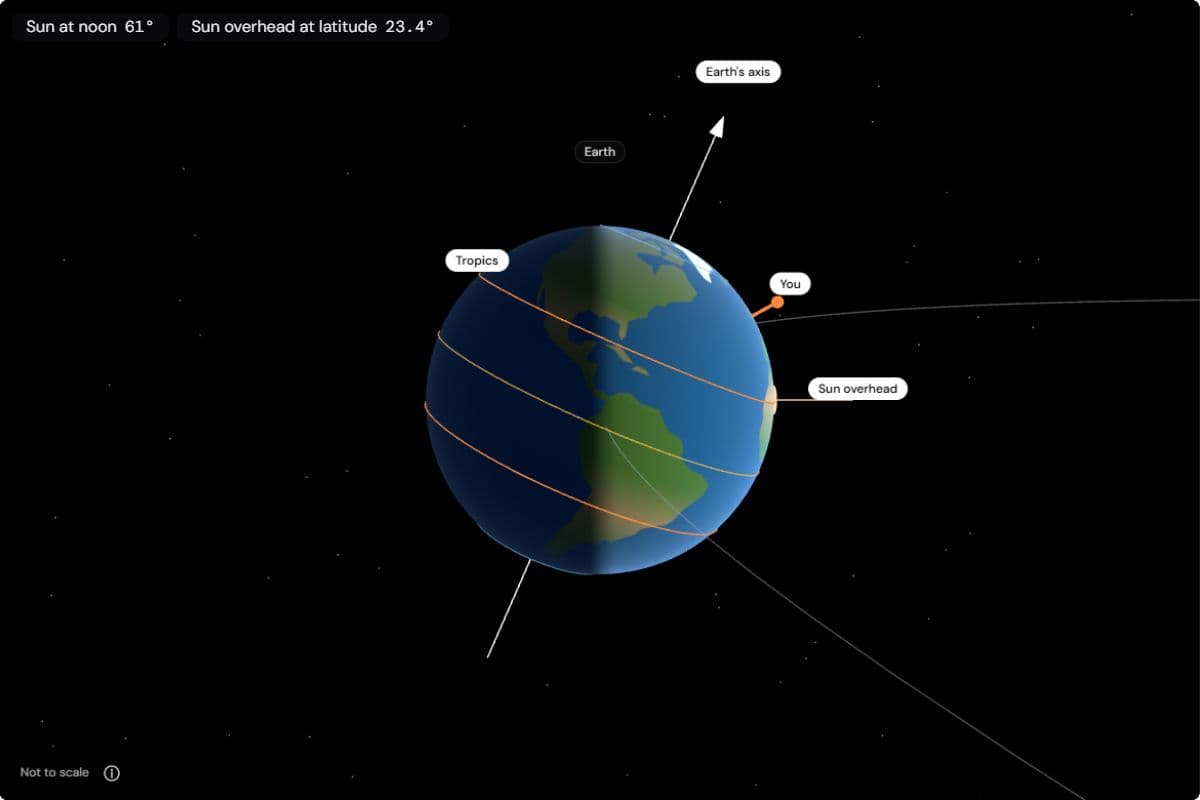
Earth's axis is tilted by 23.4° and always points the same way in space. On 21 June the northern half leans towards the Sun, and the Sun stands straight overhead at 23.4° north, the Tropic of Cancer. Berlin lies 29° further north, so there the noon Sun is 90° − 29° = 61° high. On 21 December the Sun stands overhead at 23.4° south, the Tropic of Capricorn, and Berlin is 76° away from it.
The same tilt moves the sunrise. In June the Sun's daily circle in the sky lies north of the celestial equator, so it comes up north of east and goes down north of west. In December the circle lies south of it, so the Sun rises south of east. Only at the equinoxes, when the Sun is right above the equator, does its circle cross the horizon at due east and due west.
Straight overhead the Sun can only stand between the two tropics, from 23.4° north to 23.4° south. On the equator that happens around 20 March and 23 September, on each tropic once a year, and in between on two days a year.
In the southern hemisphere the noon Sun is in the north
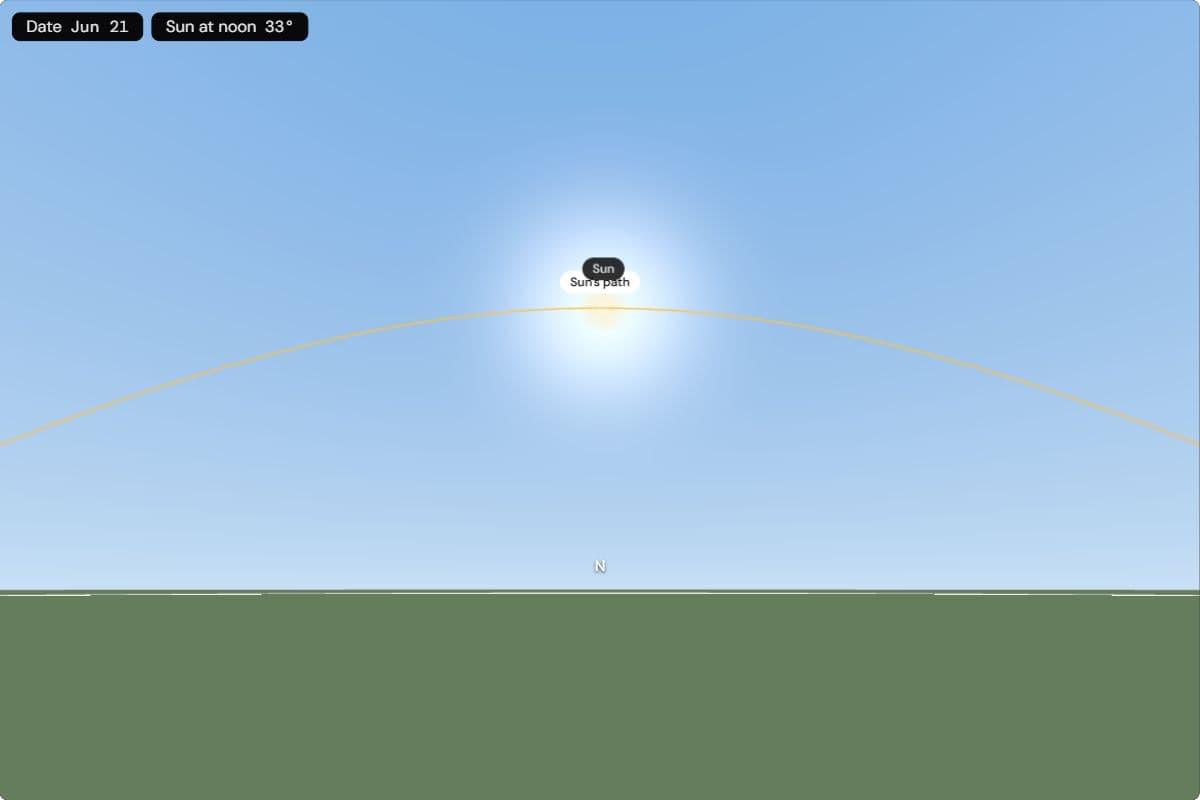
South of the Tropic of Capricorn everything is mirrored. At 34° south, the latitude of Sydney, 21 June is the middle of winter: the Sun rises in the north-east at 62°, stands only 33° high in the north at noon and sets in the north-west after 9.9 hours. In December it rises in the south-east at 119° and climbs to almost 80° in the north.
So the Sun still rises in the east and sets in the west in Australia, South Africa or Argentina. But to face it at noon you look north, and it moves across the sky from right to left, the other way round from Europe.
Where the Sun rises at different latitudes
The further you are from the equator, the wider the sunrise swings over the year. These are the rising points (compass degrees, 90° = due east) and the noon heights on 21 June and 21 December in the 3D model; at the equinoxes the Sun rises at about 90° everywhere.
On the equator the Sun rises at 67° in June and 113° in December, a swing of 47°. The noon Sun stands 67° high in the north in June, 67° in the south in December and almost straight overhead at the equinoxes. Every day there is about 12 hours long.
New York (40.7° N): sunrise 58° in June, 121° in December; noon height 73° and 26°. Vienna (48.2° N): 52° and 125°; noon 65° and 18°. London (51.5° N): 49° and 128°; noon 62° and 15°. Berlin (52.5° N): 48° and 129°; noon 61° and 14°.
Sydney's latitude (33.9° S): 62° in June and 119° in December; noon 33° and almost 80°, both in the north. In Tromsø (69.7° N) the Sun doesn't rise at all around the solstices: in June it doesn't set, in December it stays below the horizon (see the tour on the midnight sun and polar night). Close to the polar circles the rising point swings almost all the way round, from north to south.
Using the Sun to find directions
The most reliable direction the Sun gives is at noon: in Europe, North America and everywhere else north of the Tropic of Cancer, the Sun then stands due south, and its shadows point due north. South of the Tropic of Capricorn it is the other way round. But noon by the Sun is not 12:00 on the clock. In Germany it falls at roughly 12:50 to 13:45 in summer time and an hour earlier in winter, depending on where you are and on the date; the tour on day and night explains time zones.
Sunrise and sunset are much less reliable. Due east and due west they only mark around the equinoxes. In June the Sun in Berlin rises 42° north of east, in December 39° south of it. Taking the sunrise as east in midsummer or midwinter can put you off by almost half a right angle.
Frequently asked questions
Does the Sun rise in the east everywhere on Earth?
Yes, on the eastern half of the horizon, because Earth turns from west to east everywhere, also in the southern hemisphere. Due east it rises only around the equinoxes. The exceptions are the polar regions, where the Sun doesn't rise or set for days or months around the solstices, and the poles themselves, where every direction is south or north.
On which day does the Sun rise exactly in the east?
Around the equinoxes, about 20 March and 23 September. Because the air lifts the Sun's image a little over the horizon, the closest day is shifted slightly: in Berlin it is 19 March and 24 September, when the Sun comes up within half a degree of due east.
Why does the Sun rise in the east?
Because Earth turns from west to east, once a day. Standing on it, you are carried towards the Sun from the west, so it seems to come up on the eastern horizon and move west across the sky. The tour on day and night shows this rotation.
Is the Sun directly overhead at noon?
Only between the tropics, at 23.4° north and south, and there only on one or two days a year. Everywhere else the noon Sun stays lower. In Berlin it reaches 61° at most, on 21 June, and only 14° on 21 December.
Where does the Sun rise in the southern hemisphere?
Also in the east, but the seasons are reversed: in June, the southern winter, it rises in the north-east, and in December, the southern summer, in the south-east. At noon it stands in the north, not in the south.
More questions on this topic
What causes the seasons?
Find out why it is warm in summer and cold in winter, and why the distance to the Sun is not the reason.
Why does the Moon have phases?
Find out why the Moon changes its shape every month, and why Earth's shadow has nothing to do with it.
What causes a solar eclipse?
Find out how the Moon's shadow makes a solar eclipse, and why there isn't one at every new moon.
What causes day and night?
Find out why the Sun rises and sets, and why it isn't noon everywhere at the same time.
What causes the midnight sun and polar night?
Find out why the Sun doesn't set for weeks in the Arctic summer, and why the polar night doesn't start with a bang.
Why do we always see the same side of the Moon?
Find out why the Moon always shows us the same face, and what we would see if it didn't turn at all.