Why do we always see the same side of the Moon?
The Moon does turn: once around its own axis every 27.3 days, exactly as long as it takes to go once around Earth. Because spin and orbit keep pace, the same side always faces us. Earth's pull locked the two together long ago. The far side isn't dark; we just never see it from here.
In this tour you follow a flag on the Moon's near side, see what a Moon without spin would show us, and find out when the far side gets its sunlight.
8 steps · Beginner · free, no account
 Start the 3D tour here
Does the Moon rotate? Yes, once per orbit
A common answer to this question is that the Moon doesn't spin at all. It's the other way round: the Moon does rotate on its axis, just slowly. One turn takes 27.3 days, while Earth turns once a day. A point on the Moon's equator moves at only about 17 km/h because of that spin; on Earth's equator it's about 1,670 km/h.
The trick is the timing. 27.3 days is also exactly how long the Moon needs to go once around Earth. Spin and orbit keep pace, and that is what keeps one face turned towards us. Astronomers call this synchronous rotation or tidal locking.
Step by step
The same face every night
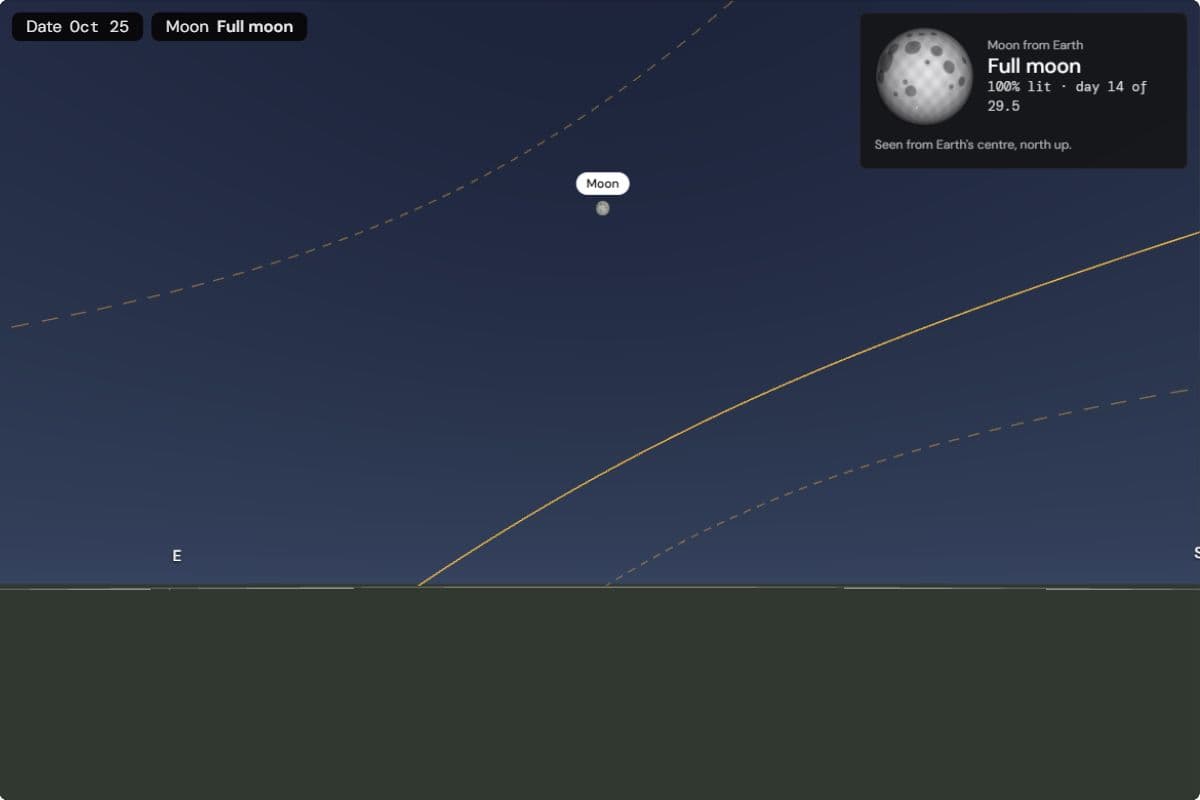
Look at a full moon, for example over Berlin in the night of 25 to 26 October 2026, and you see the familiar dark patches that some people read as a face. These are the lunar maria, wide plains of old lava. At the next full moon they are in exactly the same place, and they were for your grandparents too.
The Moon's phase changes every night, but the pattern on it doesn't move. From Earth we only ever see one side of the Moon, the near side.
The near side always points at Earth
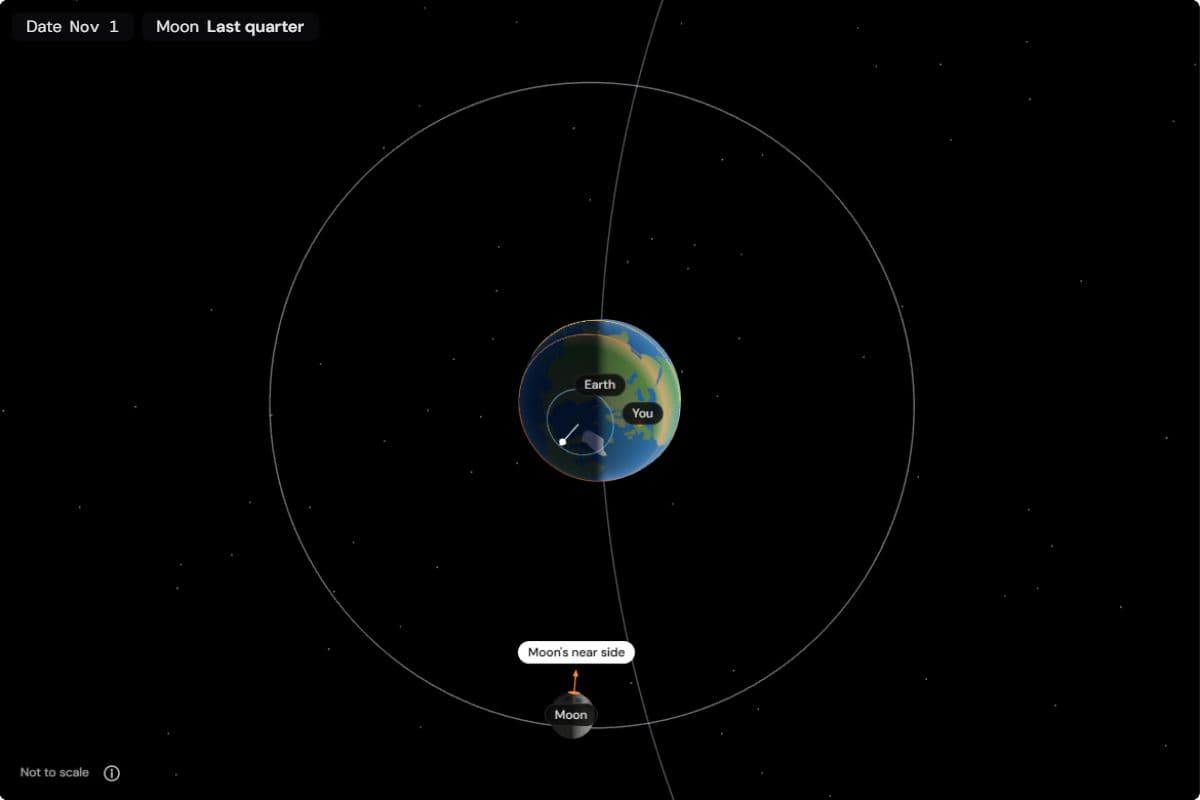
Seen from far above the North Pole, mark the middle of the near side with a little flag. The flag points straight at Earth. A week later the Moon has travelled a quarter of the way around Earth, from full moon to last quarter, and the flag still points at Earth.
So the Moon itself has turned by a quarter turn in that week. As it goes round, it keeps turning so that the same side stays towards us, like a dancer circling a partner without ever turning their back.
A Moon that didn't turn would show us every side
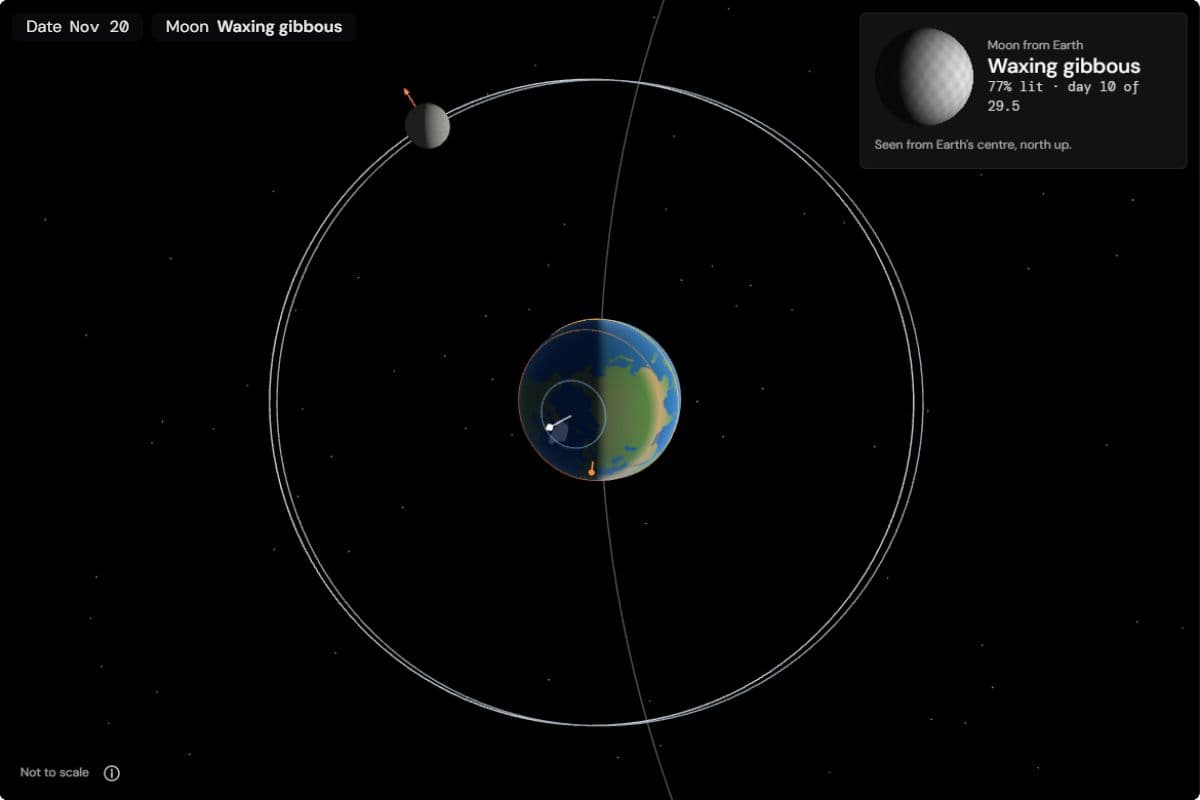
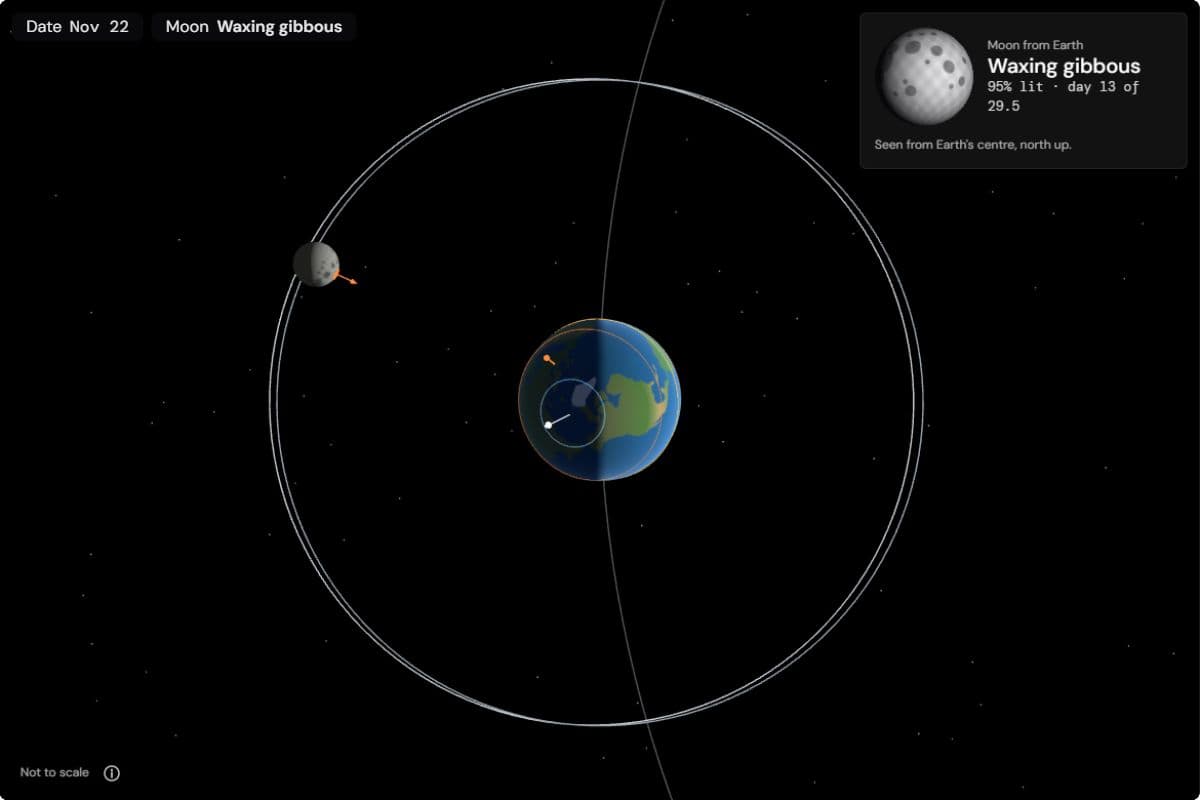
A common explanation is that the Moon shows one face because it doesn't rotate. That fails as soon as you let the Moon really stop turning. Its flag would then keep pointing the same way in space, towards the same stars, while the Moon moves on along its orbit. So the flag would swing away from Earth, and we would see one side after another.
In the model the switch happens on 5 November 2026, when the flag of a non-rotating Moon happens to point at Earth. About two weeks later, on 20 November, it points straight away from Earth, and we would be looking at the far side: a bright disc with almost none of the dark patches we know. Only a Moon that turns once per orbit shows the same face all month.
One turn per orbit: 27.3 days
Walk around a table while always looking at it. After one lap you have also turned once around yourself, because you faced every wall of the room in turn. The Moon does the same: one trip around Earth, one turn around itself.
Measured against the distant stars, both take 27.3 days. From one full moon to the next it takes about 29.5 days, because Earth moves on around the Sun in the meantime and the Moon needs two more days to get back to the same position relative to the Sun. That longer rhythm is the Moon's phases, and it is also one day on the Moon.
The far side isn't dark
The hidden half is often called the dark side of the Moon. It isn't dark. The Sun lights one half of the Moon at all times, and as the Moon goes round, that lit half moves across its surface. At last quarter, half of the near side and half of the far side are lit.
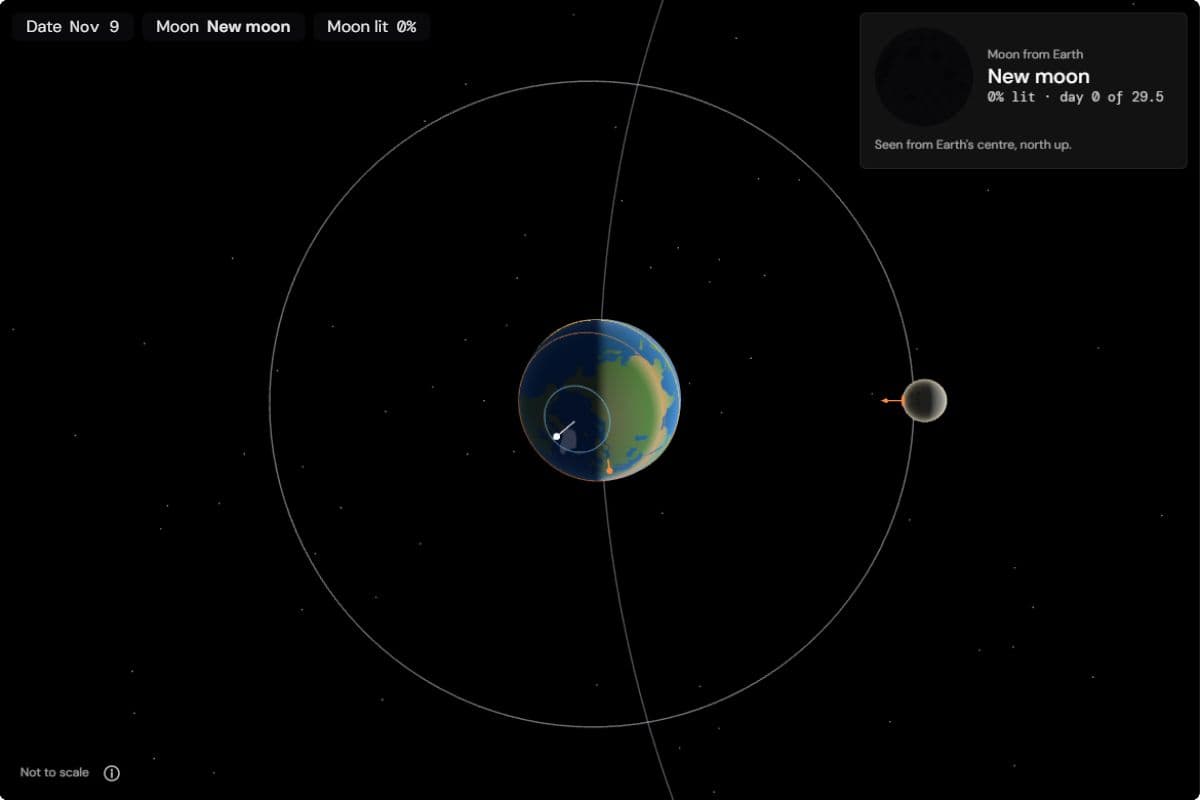
At new moon, on 9 November 2026 for example, the Moon stands between Earth and the Sun. The side facing us has night, and the far side is in full sunlight. Every place on the Moon, front or back, gets about two weeks of day and two weeks of night. Far side is the better name: it is far from us, not far from the Sun.
Why spin and orbit match: tidal locking
The Moon didn't start out like this. Early on it spun faster. Earth's gravity pulls harder on the near side of the Moon than on the far side, which stretches the Moon very slightly into an egg shape with two bulges. While the Moon still turned faster than it orbited, the bulges were dragged around and Earth's pull kept tugging them back. That friction braked the spin until it matched the orbit. From then on the bulges point at Earth and nothing changes any more.
The same happens the other way round, much more slowly, because Earth is far heavier. The Moon's pull raises tides on Earth that brake Earth's spin: the day gets longer by about 2 milliseconds per century. In return the Moon drifts away from Earth by about 3.8 centimetres a year, measured with lasers bounced off mirrors that the Apollo astronauts left on the Moon.
Why we see 59 % of the Moon, not half
Strictly speaking we see a bit more than half. The Moon's orbit is an oval, so it moves faster when it is close to Earth and slower when it is far away, while its spin stays steady. Its axis is also tilted a little against its orbit. Both let us peek a few degrees around its edges at different times of the month. This wobble is called libration, and over time it shows us about 59 % of the Moon's surface. The other 41 % can only be seen from space.
The 3D model leaves libration out: its Moon turns exactly in step, so the flag always points straight at Earth.
What's on the far side
Nobody saw the far side until 1959, when the Soviet probe Luna 3 photographed it. The first people to see it with their own eyes were the three astronauts of Apollo 8, who orbited the Moon in December 1968. In 2019 the Chinese lander Chang'e 4 became the first spacecraft to land there.
The far side looks quite different from the side we know. It has almost none of the dark lava plains, the maria, and is covered in craters instead. The model's far side shows this too: when it faces Earth, the Moon looks like a plain, bright disc.
Not only our Moon
Tidal locking is common. Most large moons in the solar system always show their planet the same face, among them Jupiter's moons Io, Europa and Ganymede and Saturn's moon Titan. Pluto and its moon Charon have gone one step further: they are locked to each other, so each always shows the other the same side.
Frequently asked questions
How long does the Moon take to turn once on its axis?
27.3 days, measured against the stars. That is exactly as long as one orbit around Earth, which is why the same side always faces us. A full day on the Moon, from one sunrise to the next, lasts about 29.5 Earth days.
Is there a dark side of the Moon?
No. The far side gets just as much sunlight as the near side; at new moon it is fully lit while the side facing us is dark. It is only hidden from Earth, which is why astronomers call it the far side.
Can we ever see the far side of the Moon from Earth?
Not all of it. A slight wobble called libration lets us see about 59 % of the surface over time, but 41 % never faces Earth. The rest has only been seen from spacecraft and by the astronauts who flew around the Moon.
Will the Moon always show us the same side?
Yes. Once spin and orbit are locked, Earth's pull keeps them in step. Earth's own day is slowly getting longer too, but it would take tens of billions of years before Earth always showed the Moon the same face.
How fast does the Moon spin?
Very slowly: one turn in 27.3 days. A point on the Moon's equator moves at about 17 km/h because of that spin. A point on Earth's equator moves at about 1,670 km/h.
More questions on this topic
What causes the seasons?
Find out why it is warm in summer and cold in winter, and why the distance to the Sun is not the reason.
Why does the Moon have phases?
Find out why the Moon changes its shape every month, and why Earth's shadow has nothing to do with it.
What causes a solar eclipse?
Find out how the Moon's shadow makes a solar eclipse, and why there isn't one at every new moon.
What causes day and night?
Find out why the Sun rises and sets, and why it isn't noon everywhere at the same time.
What causes the midnight sun and polar night?
Find out why the Sun doesn't set for weeks in the Arctic summer, and why the polar night doesn't start with a bang.
Where does the Sun rise?
Watch sunrise in Berlin through the year and find out why the Sun rises due east only twice a year and never stands overhead in Europe.