Why does the Moon have phases?
The Moon doesn't shine by itself: the Sun always lights one half of it. While the Moon circles Earth once a month, we see more or less of that lit half, from a thin crescent to the full moon and back. Earth's shadow has nothing to do with it.
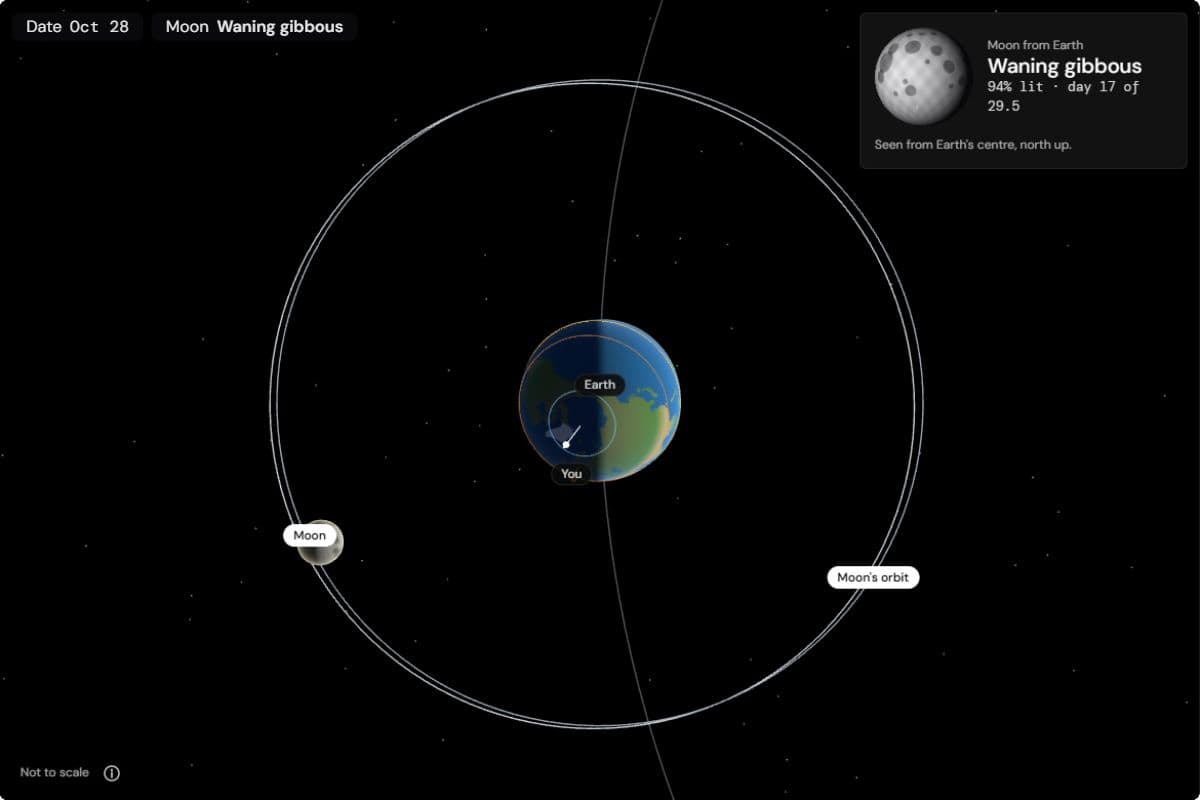
In this tour you watch the Moon orbit Earth in 3D, follow its phases from the ground in Berlin and find the full moon yourself.
7 steps · Beginner · free, no account
 Start the 3D tour here
Moonlight is sunlight
The Moon makes no light of its own. Its surface is grey rock and dust that reflects only about 12 % of the sunlight falling on it, roughly as much as worn asphalt. It looks bright at night only because the sky around it is black.
So whatever we see of the Moon is the part the Sun is shining on. That one fact explains the whole cycle of phases: the Moon never changes shape, only the share of its sunlit side that faces us does.
Step by step
A half moon in the evening sky
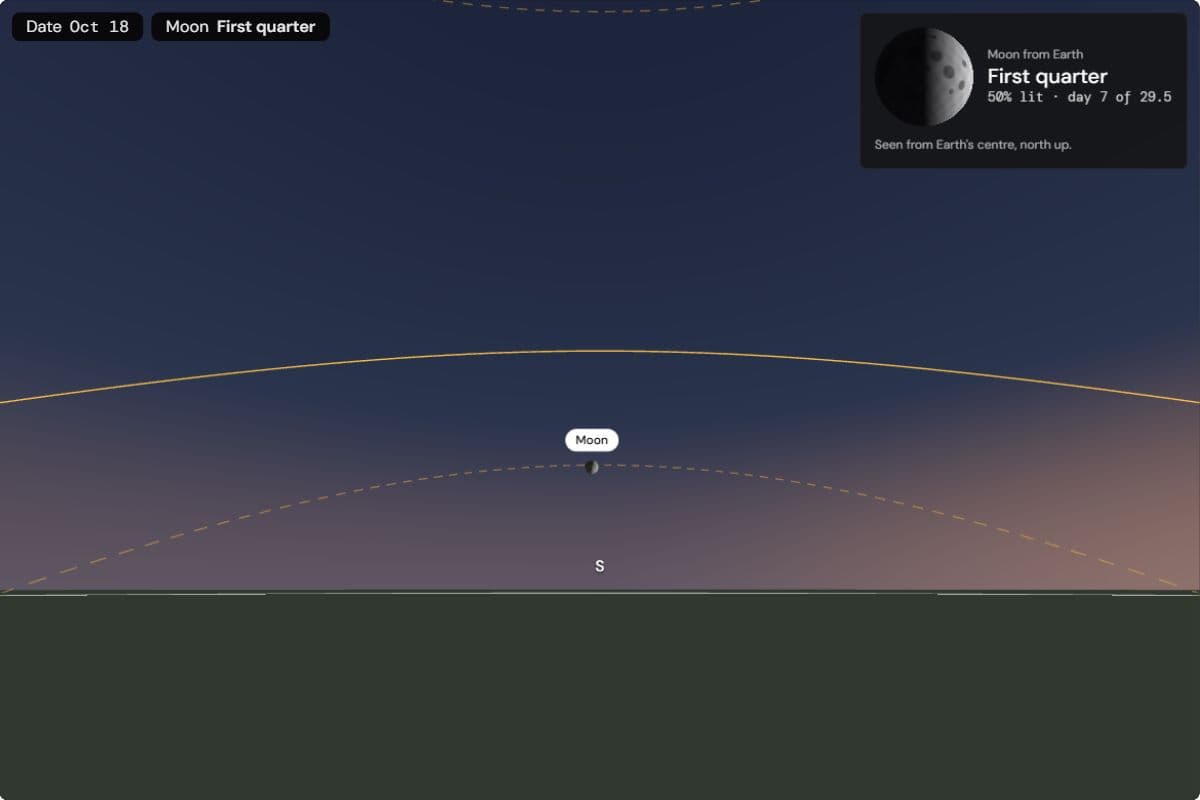
On 18 October 2026, just after sunset in Berlin, the Moon stands low in the south, and exactly its right half is bright. This is the first quarter. Eight days earlier, on 10 October, it was a new moon and could not be seen at all. On 26 October it is full, on 1 November it is a half moon again, this time lit on the left, and on 9 November the next new moon begins a new cycle.
From one new moon to the next takes 29.5 days on average. That rhythm is old enough to have given the month its name.
Why it isn't Earth's shadow
A common explanation is that the dark part of the Moon lies in Earth's shadow. It sounds reasonable, but the geometry rules it out. Earth's shadow always points straight away from the Sun. At half moon, the Moon is a quarter of the way round its orbit, off to the side of Earth, nowhere near that shadow.
The sky shows the same thing. A thin crescent always stands close to the Sun, low in the west after sunset or in the east before sunrise, while Earth's shadow points to the opposite part of the sky. Earth's shadow does reach the Moon now and then, but only at full moon, and then it is a lunar eclipse: a reddish darkening that creeps across the full disc within a few hours, nothing like a phase.
The Moon always has a day side and a night side
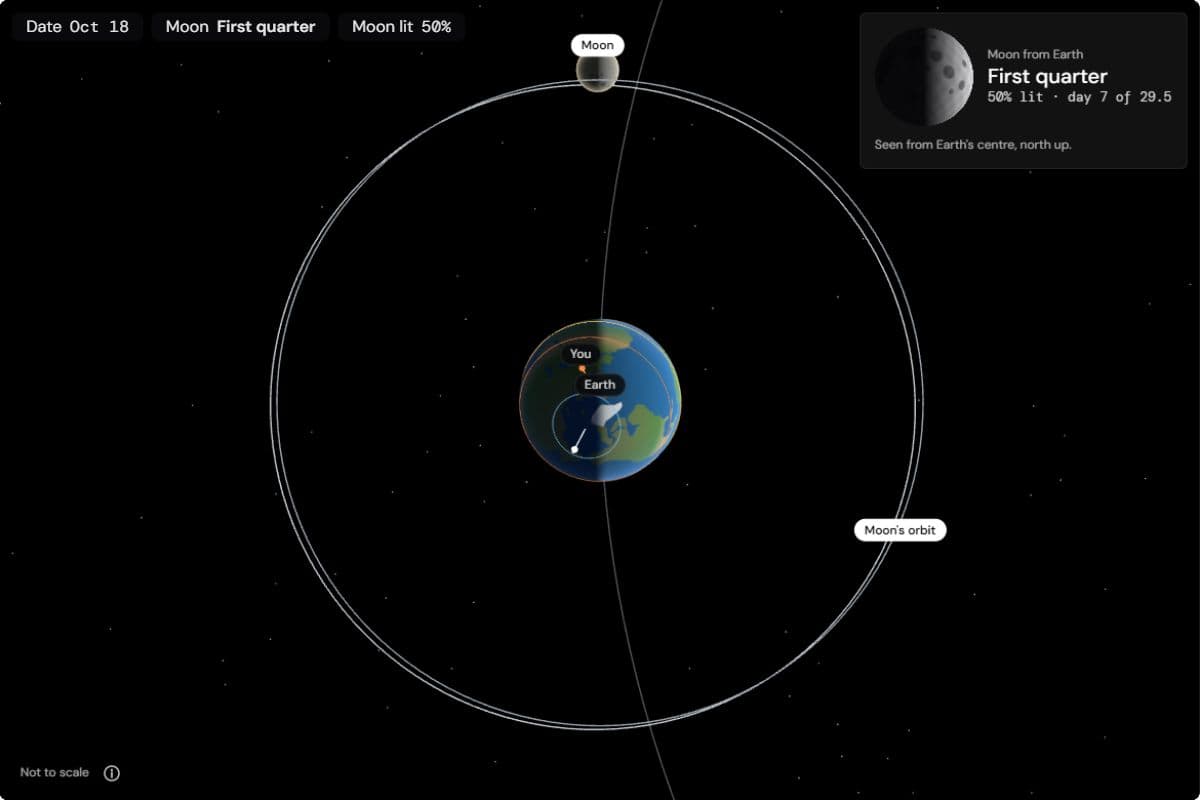
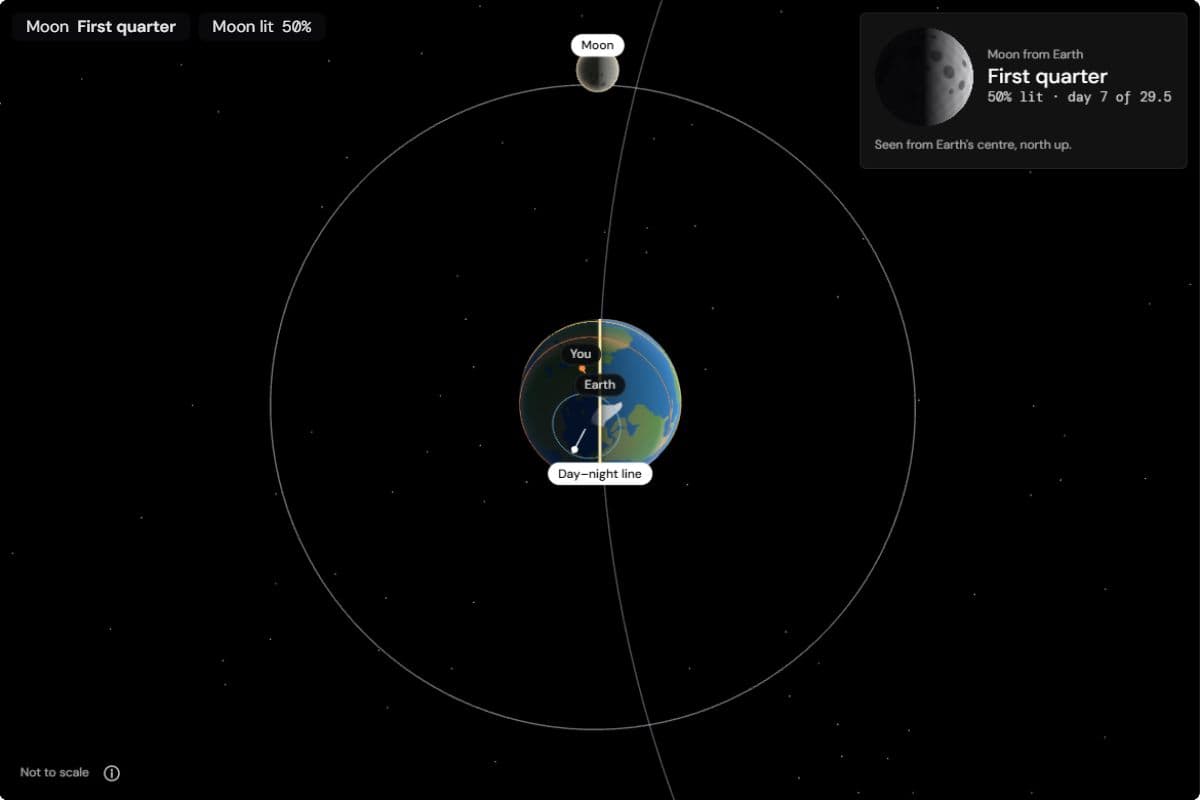
The Moon is a ball lit from one side, just like Earth. At any moment one half of it has day and the other half night. What changes over the month is where we stand in relation to that day side.
At new moon the Moon lies roughly between Earth and the Sun, so its night side faces us. At the quarters we look at it from the side and see half of its day side and half of its night side. That is why the first quarter looks like a half disc, even though it is called a quarter: the name counts the quarters of the cycle, not the lit area.
The full moon rises when the Sun sets
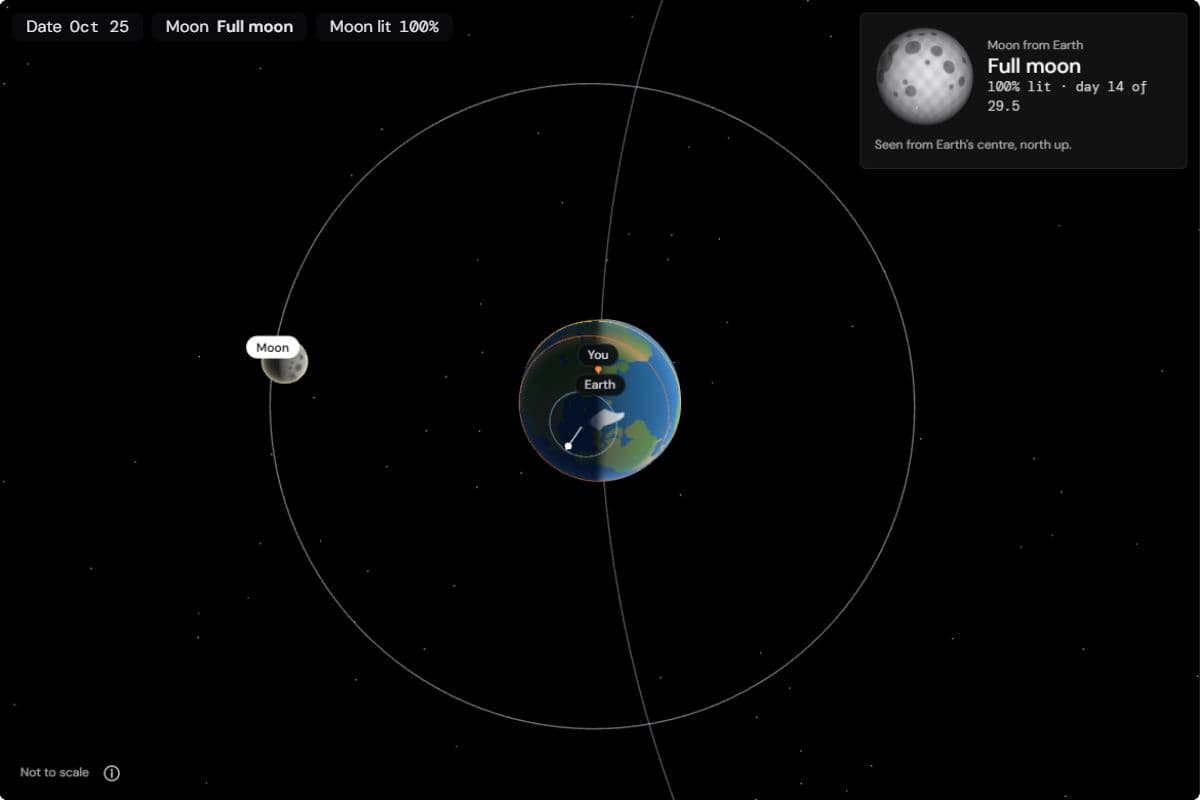
At full moon the Moon stands on the far side of Earth, opposite the Sun, and we look straight onto its day side. Opposite the Sun also sets the timetable: when the Sun goes down in the west, the full moon comes up in the east. It is highest around midnight and sets at sunrise. On 25 October 2026 it rises in the east-northeast just as the Sun sets.
The same rule explains why the winter full moon climbs so high and the summer full moon stays low: it always takes the path the Sun takes half a year later. Every other phase has its own timetable too. The first quarter stands in the south at sunset, the last quarter in the south at sunrise.
Waxing, waning, and why a cycle takes 29.5 days
From new moon to full moon the lit part grows: the Moon is waxing. From full moon to the next new moon it shrinks: the Moon is waning. Seen from the northern hemisphere, a waxing moon is lit on the right and a waning moon on the left, because the Moon travels eastwards around Earth while the Sun stays put.
One orbit around Earth takes only 27.3 days, measured against the stars. In that time, though, Earth has carried the Moon about 27° further around the Sun, so the Sun is in a different direction. The Moon needs about two more days to get back to the same position between Earth and the Sun. That is why one cycle of phases lasts 29.5 days.
The eight phases of the Moon
Astronomers name four main phases, about 7.4 days apart: new moon, first quarter, full moon and last quarter (also called third quarter). In between lie four intermediate phases, which makes eight in all.
New moon: the Moon rises and sets with the Sun and is lost in its glare. Waxing crescent: a thin sickle, lit on the right, low in the west after sunset. First quarter: the right half is lit; it rises around noon and sets around midnight. Waxing gibbous: more than half lit, high in the evening sky. Full moon: the whole disc, up all night. Waning gibbous: rises in the late evening and is still up in the morning. Last quarter: the left half is lit; it rises around midnight and is high in the south at sunrise. Waning crescent: a thin sickle, lit on the left, low in the east before sunrise.
On average the Moon rises about 50 minutes later each day, because it moves eastwards along its orbit by about 12° a day, and Earth needs that long to turn the extra 12°.
Waxing or waning: how to tell
In the northern hemisphere a simple rule works: if the lit part is on the right, the Moon is waxing; if it is on the left, it is waning. A common way to remember it is DOC: a waxing moon looks like a D, the full moon like an O, a waning moon like a C.
The time of day helps as well. A Moon you see in the evening sky is waxing, one you see in the morning sky is waning. The rule about the lit side only holds north of the tropics, though.
Moon phases in the southern hemisphere
The phase itself is the same for everyone on Earth at the same moment: a full moon is full in Berlin and in Sydney. What changes is how it looks. In the southern hemisphere people look north to see the Moon, so the picture is upside down compared with Europe. A waxing moon there is lit on the left, and DOC turns into COD.
Near the equator the Moon passes almost straight overhead, and a crescent can lie on its back like a boat or a smile.
Why we always see the same side
The Moon does turn on its axis, exactly once per orbit. Because spin and orbit take the same 27.3 days, it always keeps the same face towards Earth. This is called tidal locking: Earth's pull has slowed the Moon's spin until the two matched. A slight wobble lets us see about 59 % of its surface over time.
The side we never see is often called the dark side, but it is no darker than ours. It gets just as much sunlight; it is simply always turned away from us. At new moon, when the side facing us is dark, the far side is in full daylight.
Frequently asked questions
How long does a full cycle of moon phases take?
On average 29.5 days from one new moon to the next. The four main phases follow each other about every 7.4 days. Because the Moon's orbit is an ellipse, a single cycle can be up to about seven hours shorter or longer.
Why can we see the Moon during the day?
The Moon is above the horizon for about half of every day, whatever its phase, and it is bright enough to shine through the blue sky. It is easiest to spot around the quarters: the first quarter in the afternoon, the last quarter in the morning.
Is there a dark side of the Moon?
Not a permanently dark one. The far side gets as much sunlight as the near side. We never see it because the Moon turns once per orbit and so always shows Earth the same face.
Is the Moon phase the same everywhere on Earth?
Yes. Everyone sees the same phase at the same moment, because it depends on where the Moon is in its orbit, not on where you stand. Only the orientation changes: in the southern hemisphere the Moon looks upside down, so a waxing moon is lit on the left.
Why can I sometimes see the dark part of a crescent moon?
That faint grey glow is earthshine. Sunlight reflected by Earth lights up the Moon's night side. It is strongest around a thin crescent, because then the Moon sees Earth almost fully lit.
Why isn't there an eclipse every full moon?
The Moon's orbit is tilted by about 5° against Earth's orbit, so at most full moons the Moon passes just above or below Earth's shadow. A lunar eclipse only happens when a full moon falls near one of the two points where the orbits cross.
More questions on this topic
What causes the seasons?
Find out why it is warm in summer and cold in winter, and why the distance to the Sun is not the reason.
What causes a solar eclipse?
Find out how the Moon's shadow makes a solar eclipse, and why there isn't one at every new moon.
What causes day and night?
Find out why the Sun rises and sets, and why it isn't noon everywhere at the same time.
What causes the midnight sun and polar night?
Find out why the Sun doesn't set for weeks in the Arctic summer, and why the polar night doesn't start with a bang.
Why do we always see the same side of the Moon?
Find out why the Moon always shows us the same face, and what we would see if it didn't turn at all.
Where does the Sun rise?
Watch sunrise in Berlin through the year and find out why the Sun rises due east only twice a year and never stands overhead in Europe.