What causes the seasons?
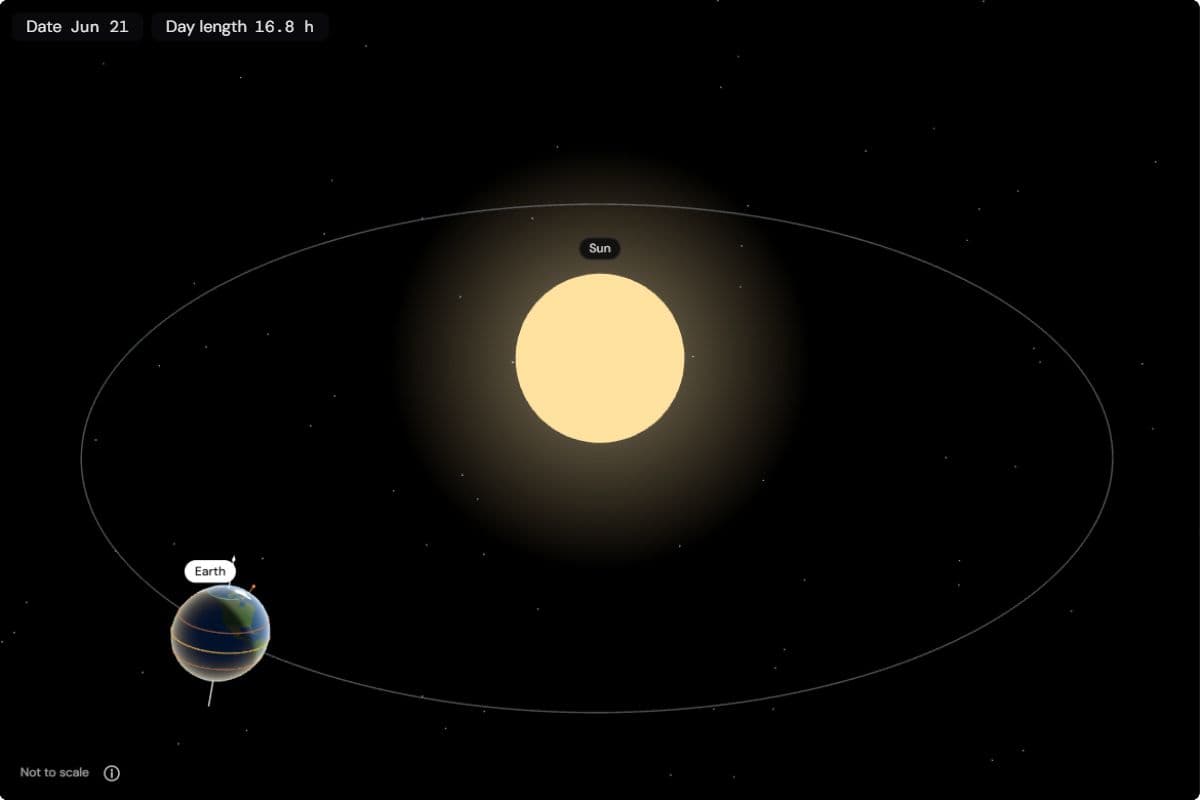
The seasons are caused by the tilt of Earth's axis, about 23.4°. For half the year your half of Earth leans towards the Sun: the sunlight arrives steeper and the days are longer, so it gets warm. It is not the distance to the Sun. Earth is closest in early January, in the middle of the northern winter.
In this tour you move Earth through the year in 3D, tilt its axis and stand on the ground to watch the Sun's path, until you can see the cause yourself.
8 steps · Beginner · free, no account
 Start the 3D tour here
It's not the distance to the Sun
The most common explanation is that Earth is closer to the Sun in summer. It sounds reasonable, because Earth's orbit is not a perfect circle. But the numbers don't fit: Earth is closest to the Sun in early January, about 147 million km away, and farthest in early July, about 152 million km. That is a difference of only about 3 %, and in the northern hemisphere the closest point falls in the middle of winter.
There is a second, simpler check. When it is winter in Germany, it is summer in Australia. Both are on the same planet, at the same distance from the Sun on the same day. Distance can't make one of them warm and the other cold. Something else has to differ between the two halves of Earth.
Step by step
Earth's axis is tilted by 23.4°
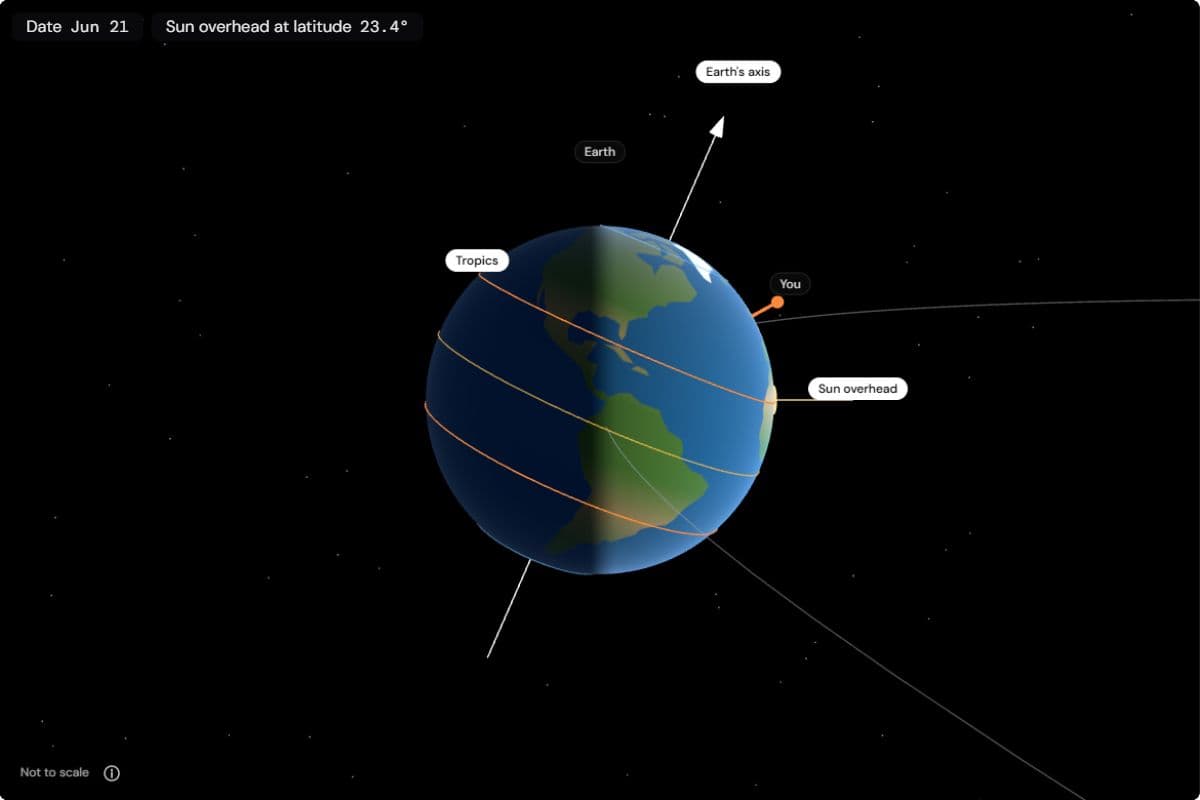
Earth spins around an axis that runs through the North and South Pole. This axis is not upright compared with Earth's path around the Sun: it is tilted by about 23.4°. And it keeps pointing the same way in space all year, towards the Pole Star.
So while Earth travels around the Sun, the same tilted axis sometimes leans the northern half towards the Sun and, half a year later, away from it. Around 21 June the Sun stands straight overhead at noon on the Tropic of Cancer, 23.4° north of the equator. Around 21 December it stands overhead on the Tropic of Capricorn, 23.4° south. Whichever half leans towards the Sun has summer; the other half has winter.
Steep light heats more than flat light
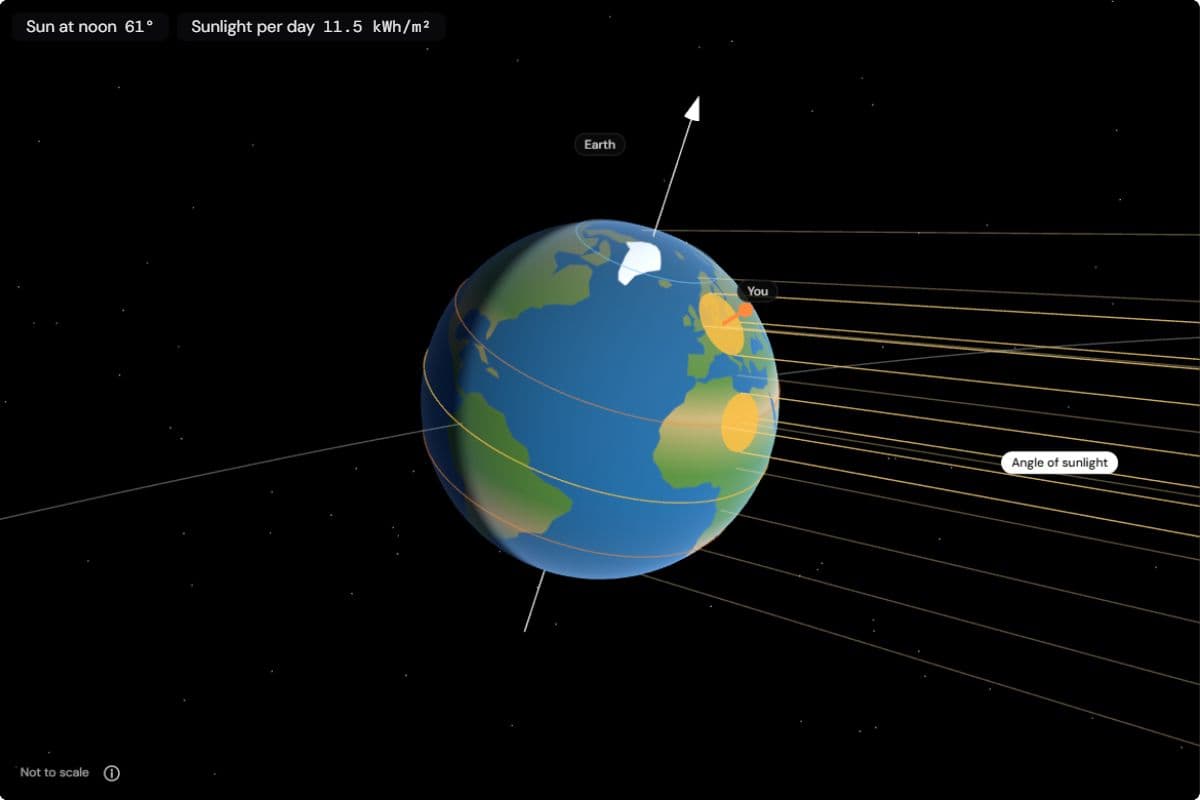
Imagine two equally wide beams of sunlight. One hits the ground from high above and lands on a small, round patch. The other comes in at a slant and spreads over a long oval. Both carry the same energy, but the slanted beam shares it out over a larger area, so each square metre gets less.
That is what the tilt changes over the year. In Berlin the Sun climbs to about 61° above the horizon at noon in June, but only to about 14° in December. The low winter Sun is weak not because it is farther away, but because its light arrives so flat.
Summer days are longer
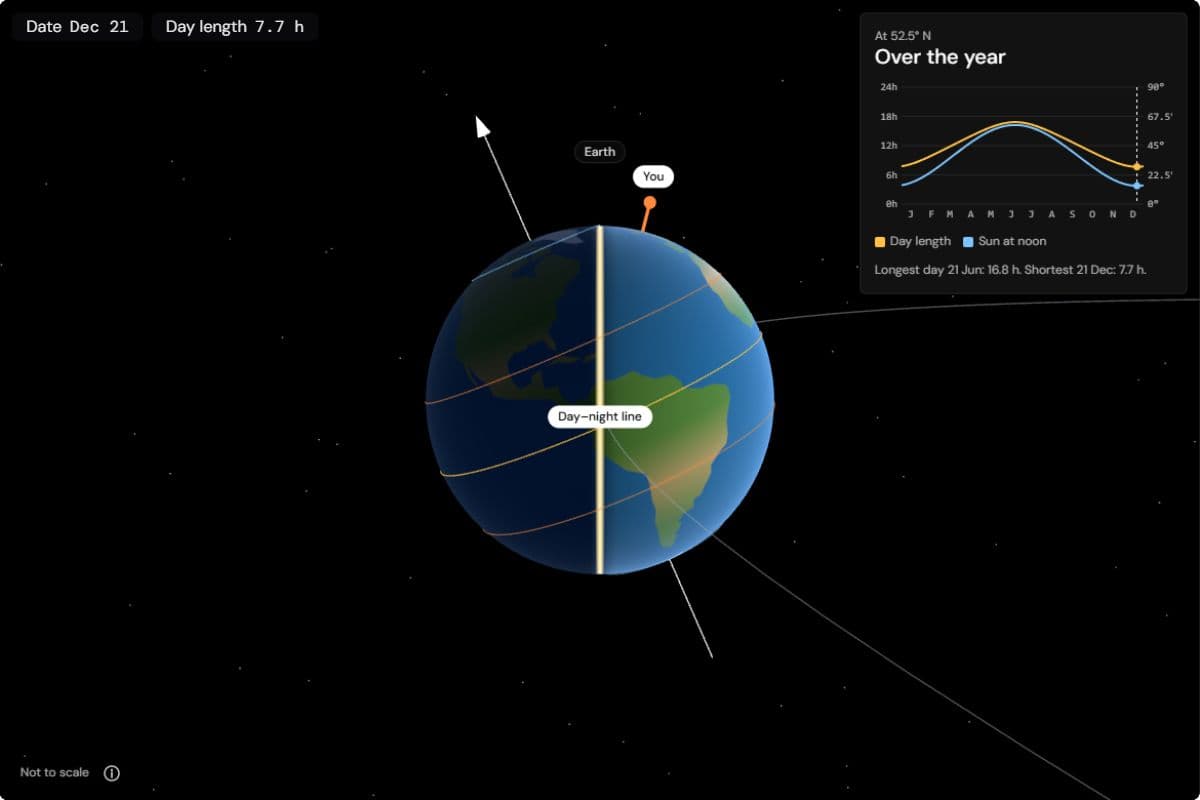
The tilt has a second effect. When your half of Earth leans towards the Sun, a larger part of your circle of latitude lies on the day side, so you spend more of each turn of Earth in sunlight. In Berlin the longest day, around 21 June, lasts almost 17 hours. The shortest, around 21 December, lasts less than 8.
More hours of sunlight mean more time for the ground and the air to warm up, and fewer hours of night to cool down again.
Both effects add up
Steeper light and longer days work in the same direction. Together they make a big difference: on 21 June one square metre in Berlin receives about 11.5 kWh of sunlight over the day (measured above the atmosphere), on 21 December only about 1.7 kWh, almost seven times less. The 3 % change in distance is tiny next to that.
Without the tilt there would be no seasons
The best test of an explanation is to switch the cause off. If Earth's axis stood straight up, the Sun would stand overhead at the equator every day of the year. Every place would get the same noon Sun and the same day length all year round: no summer and no winter, only a cold north and a warm equator. In the tour you can set the tilt to 0° and watch the curves of the year turn flat.
Solstices and equinoxes
Four dates mark the turning points of the year. At the June solstice (21 June 2026) the northern half leans furthest towards the Sun: the longest day in the north, the shortest in the south. At the December solstice (21 December 2026) it is the other way round.
At the two equinoxes (20 March and 23 September 2026) neither half leans towards the Sun. The Sun stands overhead at the equator, and day and night are about 12 hours long everywhere on Earth. Astronomers count the seasons from these four dates; weather services simply start them on 1 March, 1 June, 1 September and 1 December.
Seasons around the world
How strong the seasons are depends on how far you are from the equator. Near the equator the Sun is high at noon all year, and the day length hardly changes, so there is no real summer and winter. Many tropical places have a wet and a dry season instead.
The farther you go towards a pole, the bigger the difference between the noon Sun and the day length in summer and in winter. Beyond the polar circles, about 66.6° north and south, the Sun does not set at all around midsummer and does not rise around midwinter. In the southern hemisphere all of this happens half a year shifted: Christmas falls in the middle of summer in Australia and South Africa.
Why the hottest days come after the longest day
The most sunlight arrives around 21 June, but in Central Europe July and early August are usually warmer, and the coldest weeks come in January, not in December. Oceans and land store heat. In early summer they still take in more energy than they give off, so it keeps getting warmer for weeks after the solstice. In winter it is the other way round. This delay is called the seasonal lag, and it is why the seasons feel a few weeks behind the Sun.
Frequently asked questions
Is Earth closer to the Sun in summer?
No. Earth is closest to the Sun in early January, during winter in the northern hemisphere, and farthest in early July. The distance changes by only about 3 %, too little to cause the seasons.
Why is it summer in Australia when it is winter in Europe?
Earth's axis is tilted. While the northern half leans towards the Sun (June), the southern half leans away, and the other way round in December. So the two hemispheres always have opposite seasons.
Why are there no seasons at the equator?
At the equator the noon Sun is high all year and day and night stay close to 12 hours each. The amount of sunlight barely changes, so temperatures stay similar. Many tropical regions have wet and dry seasons instead.
Does the tilt of Earth's axis change?
Only very slowly. Over a cycle of about 41,000 years the tilt moves between about 22.1° and 24.5°. A larger tilt means stronger seasons. Today it is about 23.4° and slowly getting smaller.
Do other planets have seasons?
Yes, if their axis is tilted. Mars is tilted by about 25° and has seasons like Earth's, each about twice as long. Uranus is tipped over by about 98°, so each pole gets decades of constant daylight followed by decades of night.
More questions on this topic
Why does the Moon have phases?
Find out why the Moon changes its shape every month, and why Earth's shadow has nothing to do with it.
What causes a solar eclipse?
Find out how the Moon's shadow makes a solar eclipse, and why there isn't one at every new moon.
What causes day and night?
Find out why the Sun rises and sets, and why it isn't noon everywhere at the same time.
What causes the midnight sun and polar night?
Find out why the Sun doesn't set for weeks in the Arctic summer, and why the polar night doesn't start with a bang.
Why do we always see the same side of the Moon?
Find out why the Moon always shows us the same face, and what we would see if it didn't turn at all.
Where does the Sun rise?
Watch sunrise in Berlin through the year and find out why the Sun rises due east only twice a year and never stands overhead in Europe.