What causes a solar eclipse?
In a solar eclipse the Moon passes between the Sun and Earth, and its shadow falls on Earth. In a lunar eclipse it is the other way round: the Moon moves into Earth's shadow. So eclipses need a new or a full moon. Yet most months bring none, because the Moon's orbit is tilted by about 5° against Earth's.
In this tour you follow the real eclipses of August 2026 in 3D, find a lunar eclipse yourself and see what a flat orbit would change.
7 steps · Beginner · free, no account
 Start the 3D tour here
The Moon's shadow: umbra and penumbra
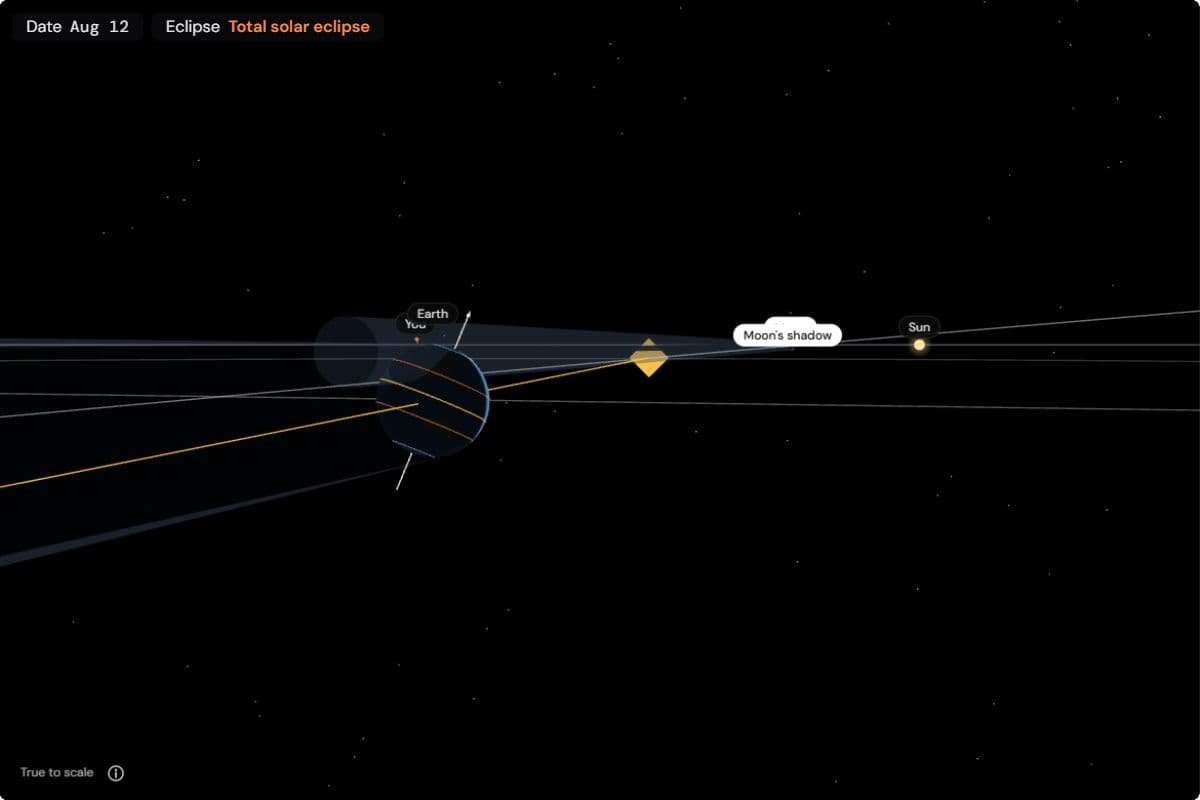
Like every lit object, the Moon trails a shadow away from the Sun. It has two parts. The umbra is a narrow cone of full shadow: from inside it, the Moon hides the whole Sun. Around it lies the much wider penumbra, from where the Moon covers only part of the Sun. Wherever the umbra touches Earth, people see a total eclipse; in the penumbra, thousands of kilometres across, they see a partial one.
That the Moon can hide the Sun at all is a coincidence of numbers. The Sun is about 400 times wider than the Moon, but also about 400 times farther away, so both look almost exactly the same size in the sky, about half a degree. The umbra is only just long enough to reach us: about 374,000 km, while the Moon is between 356,000 and 406,000 km from Earth.
Step by step
A total solar eclipse: 12 August 2026
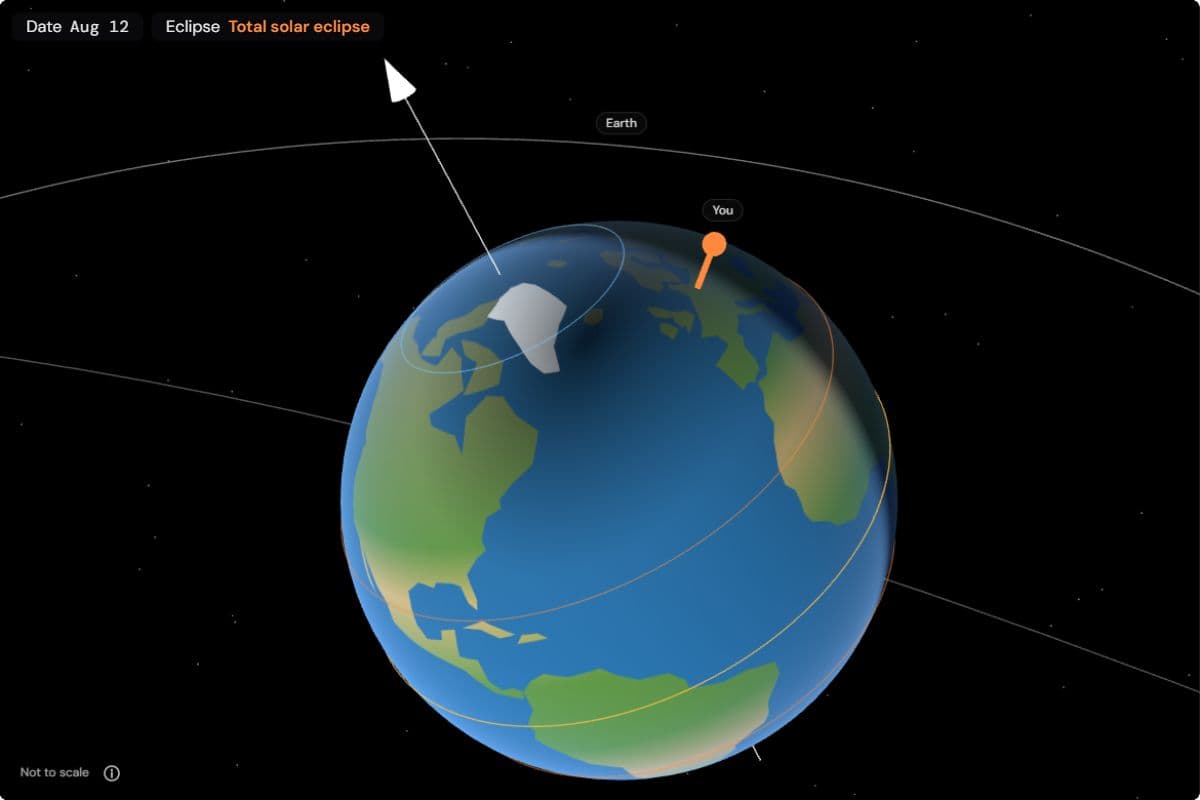
On the evening of 12 August 2026 the new moon passed exactly between the Sun and Earth. Its umbra first touched down in the Arctic, swept across Greenland and Iceland, and an hour later reached northern Spain. There the Sun vanished for up to about two minutes, low in the western sky shortly before sunset.
Everywhere else in Europe the eclipse was partial. In Germany the Moon covered around 85 to 90 % of the Sun: the light turned strangely pale, but it never got dark. That is the usual experience of a solar eclipse. The full shadow is a small dark spot on a huge globe, and the penumbra around it is many times larger.
Why there isn't a solar eclipse at every new moon
The Moon passes between Earth and the Sun every 29.5 days, at every new moon. One explanation people give for why that is not enough is that the Moon is usually too small to cover the Sun. It fails, because the size is right almost every time: whenever the Moon is in line with the Sun, it covers it. The problem is the line, not the size.
The Moon's orbit is tilted by about 5° against the plane of Earth's orbit. Five degrees sounds small, but at the Moon's distance it is enough to carry the Moon well above or below the line from the Sun to Earth. At the new moon of 10 October 2026, for example, the umbra passed below Earth and missed it by almost 19,000 km, about one and a half Earth diameters.
If the orbit lay flat, every new moon would bring a solar eclipse and every full moon a lunar eclipse: about 25 eclipses a year. The tilt alone makes them rare.
The lunar nodes and the two eclipse seasons
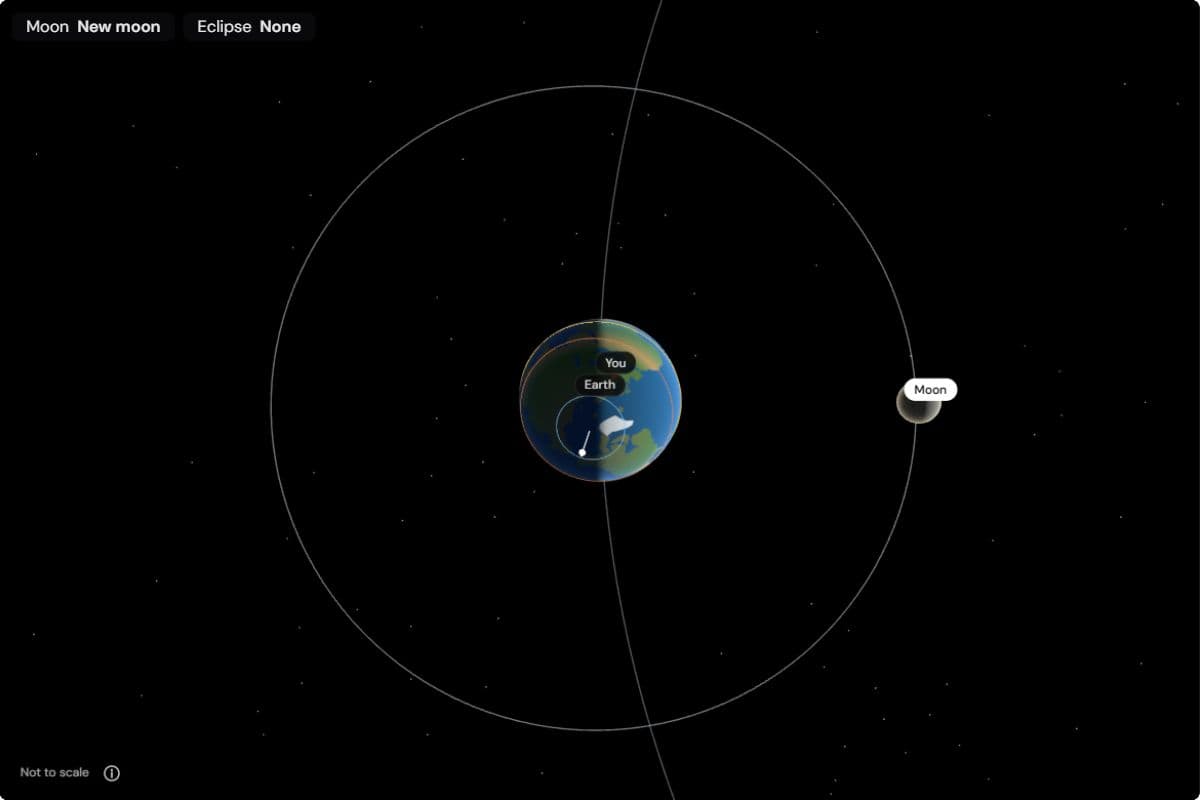
The tilted orbit crosses the plane of Earth's orbit at two points, the lunar nodes. Only near a node can Sun, Moon and Earth stand in a straight line. On 12 August 2026 the new moon fell almost exactly on one of them, so the shadow hit Earth.
The line through the two nodes keeps roughly the same direction in space while Earth travels round the Sun. So twice a year, about 173 days apart, the Sun lines up with it, and for a little over a month any new or full moon can cause an eclipse. These are the eclipse seasons. In 2026 they fell in February and March and in August. Because the nodes slowly turn backwards, once in 18.6 years, the seasons come about 19 days earlier each year.
A lunar eclipse two weeks later
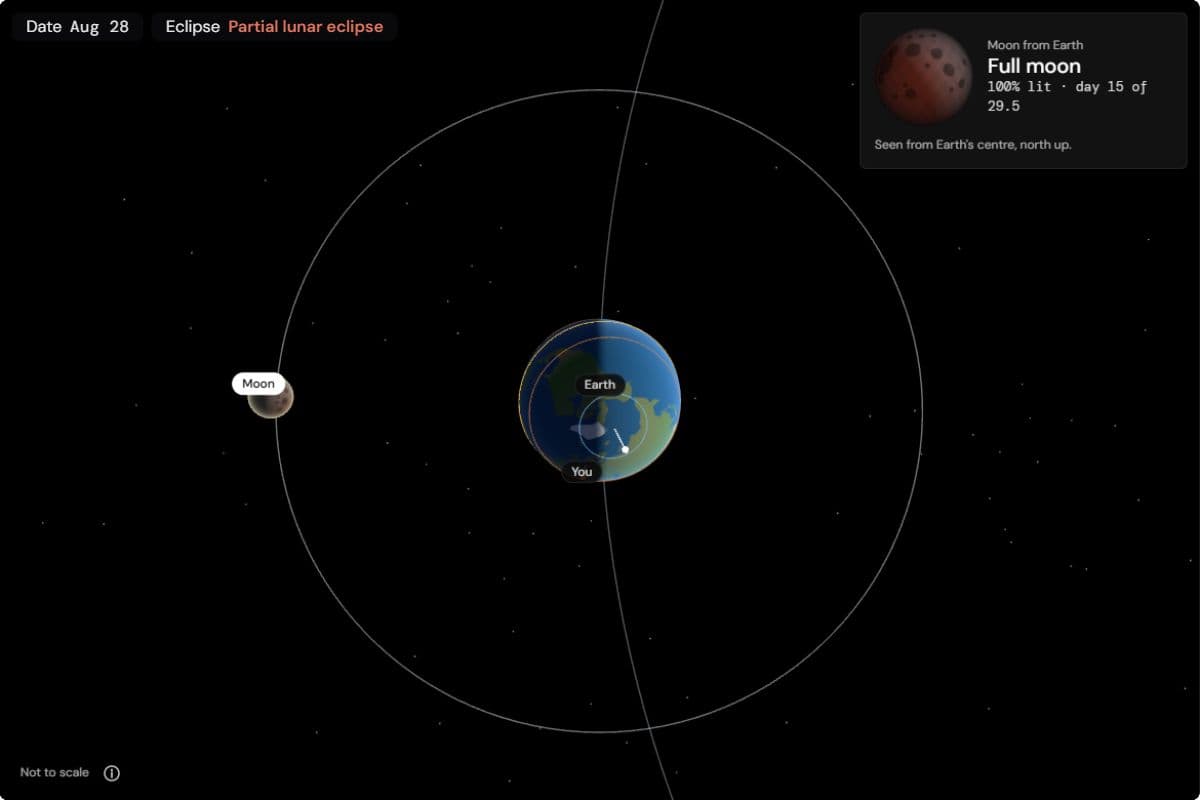
A lunar eclipse is the same alignment the other way round: Earth stands between the Sun and the Moon, and the full moon moves into Earth's shadow. Half a month after a solar eclipse, the full moon has reached the other side of its orbit, close to the other node. That is why solar and lunar eclipses often come in pairs, about two weeks apart.
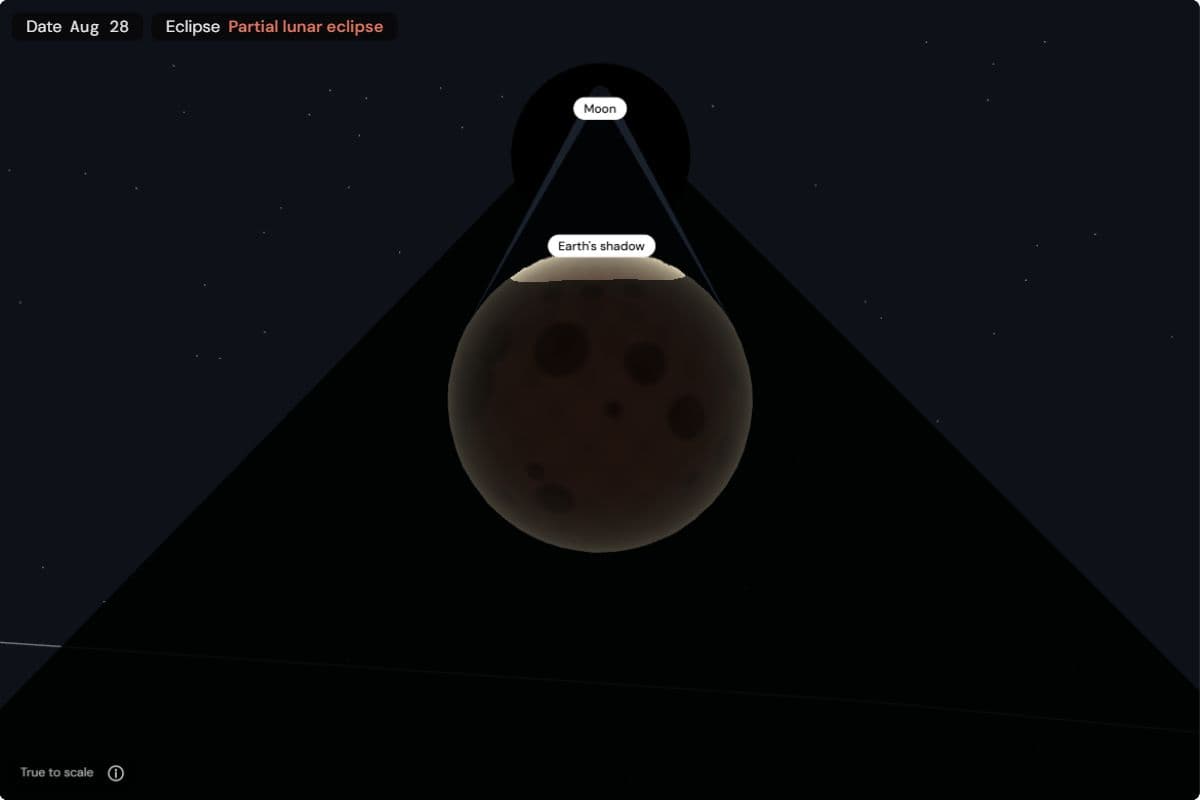
In 2026 it happened on 28 August. In the early morning, seen from Europe, Earth's umbra covered 93 % of the Moon's diameter at most. The partial phase lasted over three hours and was visible from the Americas, Europe and Africa.
Why the Moon turns red in a lunar eclipse
At the Moon's distance, Earth's umbra is still more than twice as wide as the Moon. A lunar eclipse therefore lasts for hours, and everyone on the night side of Earth sees it at the same time. A solar eclipse, in contrast, is total only along a narrow strip.
The Moon does not disappear in Earth's shadow, it turns dark copper red. Earth's atmosphere bends some sunlight into the shadow, and on its long path through the air the blue part is scattered away. What reaches the Moon is the light of all the sunrises and sunsets around Earth at that moment. This is why a total lunar eclipse is also called a blood moon.
Total, annular, partial and hybrid solar eclipses
Total: the umbra reaches Earth, the Sun disappears completely for a few minutes, and the faint corona around it becomes visible. Partial: you are in the penumbra, or the umbra misses Earth altogether, and a bite is taken out of the Sun.
Annular: the Moon's orbit is an ellipse, and when an eclipse falls while the Moon is far away, the umbra ends before it reaches Earth. The Moon then looks slightly smaller than the Sun and leaves a bright ring around it, the "ring of fire". Annular eclipses are a little more common than total ones.
Hybrid: a rare mixture, total in the middle of the path and annular at its ends, because Earth's curved surface is closer to the Moon there. Fewer than one in twenty solar eclipses are hybrid.
Why totality is short and so rare in one place
Where the umbra touches Earth, it is usually 100 to 160 km wide, at most about 270 km. The Moon moves along its orbit at about 3,700 km/h, so the shadow races across the ground at more than 1,700 km/h, even after Earth's rotation is taken into account. Totality at one place therefore lasts a few minutes at most; the theoretical maximum is about 7.5 minutes.
Somewhere on Earth there is a total solar eclipse about every 18 months. At any one spot, though, it happens only about once every 375 years on average. In Germany the last one was on 11 August 1999; the next will be on 3 September 2081.
Total, partial and penumbral lunar eclipses
Earth's shadow also has a full umbra and a wider penumbra. If the whole Moon enters the umbra, the eclipse is total and the Moon turns red, for up to about an hour and three quarters. If only part of it does, as on 28 August 2026, it is partial, and a dark bite with a reddish edge moves across the disc. If the Moon only passes through the penumbra, it is a penumbral eclipse: the Moon dims so slightly that most people do not notice it.
How often eclipses happen
Every year has at least two solar eclipses and at most five; together with the lunar eclipses there are between four and seven a year. Most of them are partial or happen over the oceans or the poles. Lunar eclipses seem more common because each one can be seen by half of the world, while a solar eclipse is total only along a narrow strip.
Eclipses repeat in a cycle of 18 years and 11 days, the saros. After one saros the Sun, the Moon and the nodes are back in almost the same arrangement, and a very similar eclipse follows, shifted by a third of the way round Earth. Astronomers can calculate eclipses for thousands of years ahead and back.
The next eclipses in Europe
2 August 2027: a total solar eclipse with up to 6 minutes 23 seconds of totality, one of the longest of the century. The path crosses southern Spain, Gibraltar, Morocco, Algeria, Libya and Egypt; from the rest of Europe it is partial.
26 January 2028: an annular solar eclipse whose path ends over Portugal and Spain. 31 December 2028: a total lunar eclipse visible from Europe, with 71 minutes of totality. In Germany the next total solar eclipse will not come until 3 September 2081.
Watching a solar eclipse safely
Never look at the Sun without proper protection, even when most of it is covered. The remaining sliver is still bright enough to burn the retina, and it does not hurt while it happens. Sunglasses, smoked glass or several sunglasses stacked do not protect you. Eclipse glasses must meet the standard ISO 12312-2, and binoculars, telescopes and cameras need a proper solar filter in front of the lens.
A safe alternative is projection: a pinhole in a piece of card, or the gaps between leaves in a tree, throw small images of the crescent Sun onto the ground. Only during totality, when the Sun is completely covered, can you look without a filter. A lunar eclipse needs no protection at all.
Frequently asked questions
Can a solar eclipse happen at night?
No. A solar eclipse only happens where the Sun is above the horizon, at new moon, during the day. At night you can see a lunar eclipse instead, because then the full moon is on the opposite side of Earth from the Sun.
How long does a solar eclipse last?
From the first bite to the end, about two to three hours at one place. Totality itself lasts only a few minutes, at most about 7.5. The whole shadow crossing of Earth takes several hours.
Can a planet cause a solar eclipse?
No. Only the Moon is close enough to cover the Sun. When Venus or Mercury passes in front of the Sun, it appears as a tiny black dot. This is called a transit.
Why is it dangerous to look at a solar eclipse?
The uncovered part of the Sun is as bright as ever, but the dimmer light makes you look longer and your pupils open wider. The light can burn the retina without pain, and the damage can be permanent. Use eclipse glasses to ISO 12312-2 or project the Sun's image.
Why isn't a lunar eclipse dangerous to watch?
In a lunar eclipse you look at the Moon, not the Sun, and the Moon gets darker, not brighter. A full moon is far too faint to harm your eyes, so binoculars and telescopes are fine.
Can scientists predict eclipses?
Yes, to the second and for thousands of years ahead. The motions of the Sun, Moon and Earth are known precisely, and the saros cycle of 18 years and 11 days has been used to forecast eclipses since antiquity.
More questions on this topic
What causes the seasons?
Find out why it is warm in summer and cold in winter, and why the distance to the Sun is not the reason.
Why does the Moon have phases?
Find out why the Moon changes its shape every month, and why Earth's shadow has nothing to do with it.
What causes day and night?
Find out why the Sun rises and sets, and why it isn't noon everywhere at the same time.
What causes the midnight sun and polar night?
Find out why the Sun doesn't set for weeks in the Arctic summer, and why the polar night doesn't start with a bang.
Why do we always see the same side of the Moon?
Find out why the Moon always shows us the same face, and what we would see if it didn't turn at all.
Where does the Sun rise?
Watch sunrise in Berlin through the year and find out why the Sun rises due east only twice a year and never stands overhead in Europe.